Guide
Ending a tenancy in England
Checked 10 November 2026England onlyRents: October 2026 asking rentsHow we worked it out
A tenant in England ends a tenancy with written notice that ends on a rent day or the day before. The agreement sets how long, two months at most.
Written for: A London tenant who is ending a tenancy and moving on, or a landlord whose tenant has given notice, in England.
2 monthsthe most notice a landlord can ask a tenant in England to give
In short
If your agreement says nothing about notice, you give two months.
Line the new tenancy up to start the day after the old one ends and nothing is paid twice; the deposit is due back within 10 days of you both agreeing the amount.
This guide is for England and for assured periodic tenancies, which most tenancies became on 1 May 2026. It covers the rules and the dates; the giving notice guide has the wording. If yours began earlier, the table under "If your tenancy began before 1 May 2026" shows which notice applies to you.
This is general information, not legal advice; for your case, Shelter, Citizens Advice or a solicitor.
Citycomb finding: starting the next tenancy a month early means paying one month of rent twice, and on a typical 2-bed that month is £2,000 or less in about 180 areas and over £3,000 in about 85. Send notice on Monday 16 November 2026, with rent due on the 1st, and it ends on Sunday 31 January 2027; the calculator starts there, so put in your own date and rent day. To see which areas ask what you pay now, open the map on 2-beds with Bank as the workplace, set your rent and a 35-minute total journey time.
When does the notice end?
Sunday 31 January 2027the earliest day the tenancy can end
A worked example: a tenant giving notice on Monday 16 November 2026, rent due on the 1st. Turn on JavaScript to type your own.
These are the earliest dates the law allows for assured tenancies in England since 1 May 2026, counting from the day the notice is given or served (allow extra days if it goes by post). A tenant's notice must be in writing, and a shorter time than two months counts only if the landlord agreed it in writing. A rent rise goes on Form 4A and a possession notice on Form 3A. Not checked here: the minimum gap since the tenancy began or the last rise (52 weeks, sometimes 53), and, for Ground 1 or 1A, that the tenancy has lasted a year. A possession notice only lets the landlord apply to court, which decides. Rent days from the 29th to the 31st and weekly rents are left out.
1The rules in force
Every rule below is in force now; none is waiting for a start date.
They came in on 1 May 2026 for assured tenancies that are not social housing assured tenancies (SI 2026/421, regulation 2), which covers private lets.
| Rule | In force | Source |
|---|---|---|
| Notice ends on a rent day or the day before; the agreement sets the length, two months at most, and if it says nothing you give at least two months | 1 May 2026, assured tenancies that are not social housing | GOV.UK guide for tenants; Protection from Eviction Act 1977, s.5(1ZA) |
| Notice is in writing, by any method; a shorter period or early end needs agreement in writing | 1 May 2026 | GOV.UK guide for tenants |
| If a tenant gives less than the minimum notice, the landlord can require a payment of no more than the rent due until the minimum period ends | In force (guidance updated 07/07/2026) | GOV.UK Tenant Fees Act guidance |
| A landlord needs a ground and a section 8 notice; section 21 has ended | 1 May 2026 | Section 21 guide |
| The deposit is returned within 10 days of agreeing the amount | In force | GOV.UK deposit protection |
In the statute's words, a tenant's notice must be given for the time the landlord has agreed in writing, "not exceeding two months", or, with no such agreement, "not less than two months before the date on which the notice is to take effect" (Protection from Eviction Act 1977, section 5(1ZA)). For a joint tenancy, an agreement on that time "is not valid unless it is made between the landlord and all of the tenants" (section 5(1ZB)), and a notice given by one or some of the tenants stays valid (section 5(1ZC)). A notice can be withdrawn "by the tenant and landlord agreeing in writing to the withdrawal" (section 5A(3)). Section 5A(1) makes "any provision that would bind a tenant as to the means of giving a notice in writing" of no effect. GOV.UK gives the rent-day rule: the tenancy ends "on a day when the rent is due or the day before the rent is due".
If your tenancy began before 1 May 2026
A valid notice you gave before 1 May 2026 still applies and ends the tenancy on the date in it. A landlord cannot ask you for more than two months. The notice you give now depends on what the tenancy was before 1 May (GOV.UK). If your agreement asks for less than two months, the first row shows when that shorter notice still applies.
| Before 1 May 2026 the tenancy was | Notice you give now |
|---|---|
| Rolling from the start, or a fixed term ending on or after 1 May 2026 | The notice period in your agreement still applies, even if it is under two months |
| Fixed term that ended before 1 May 2026, and the agreement says what happens next (for example that it rolls on) | The notice period in your agreement usually still applies |
| Fixed term that ended before 1 May 2026, and the agreement says nothing about what follows | The agreement's notice period no longer applies; use the assured periodic process above |
An agreement made another way, such as by email or text, may still apply; Citizens Advice can check it.
2Line up the dates
Say a 2-bed in Peckham costs £2,425 a month, rent is due on the 1st and the agreement asks for two months.
- notice if the agreement says nothing
- 2 months
- or the day before it, when the notice must end
- Rent day
- a month of overlap on a typical Peckham 2-bed
- £2,425
You send notice in writing on Monday 16 November 2026. Two months from then is 16 January 2027, so the notice ends on Sunday 31 January, the day before the 1 February rent day. The new tenancy then starts on Monday 1 February with nothing overlapping.
Start the new tenancy on Friday 1 January instead and January is paid twice. The second payment is the extra cost, £2,425 at Peckham's typical 2-bed rent and one month of your own rent at yours. The middle area in Zone 6 asks £1,875 for a month, and the middle area in Zone 1 asks £4,200.
If the notice ends on 31 January, January's rent is owed whichever way, so the second payment is the new home's January, not a penalty. The calculator at the top starts on the notice sent on Monday 16 November 2026.
Starting a Peckham tenancy a month early costs £2,425 extra.
Starting the new Peckham tenancy on 1 January rather than 1 February costs £2,425 extra
| Old home, rent for Januarypaid either way, because your notice ends on Sunday 31 January 2027 | £2,425.00 |
|---|---|
| New home, rent from Friday 1 January 2027the extra cost of starting a month early | £2,425.00 |
| Paid for January | £4,850.00 |
The same slip costs very different amounts depending on where you live.
The slip to avoid is keys promised for the 1st against a notice that ends on the 31st. Pick the next place before you give notice, so the two dates are set once and checked side by side. The rent pages list typical 2-bed rents for every area. If the dates cannot move, ask the landlord in writing for an earlier end. The holding deposit guide explains what you can be asked for before signing on the new place.
3Getting the deposit back
The landlord must put the deposit in an approved scheme within 30 days of getting it, and return it within 10 days of you both agreeing how much comes back (GOV.UK).
For a new tenancy at Peckham's typical rent the five-week cap is £2,798.08; your own deposit is whatever your agreement says, up to the cap in the tenancy deposit cap guide.
Ask for the end date, the check-out date and the deposit date in one email. Photograph every room and the meters against the move-in inventory on your last day, so the amount you agree is a comparison of two sets of photos.
If you disagree about the amount. The deposit stays protected in the scheme until it is settled. The scheme runs a free dispute resolution service: you do not have to use it, but if you do, you both have to agree, you both send evidence, and the decision is final. If you cannot reach your landlord, you can raise a dispute with the scheme yourself, and there may be a time limit, so contact it soon.
If it was never protected. You can apply to the county court (Form N208, fee £387, which you can claim back if you win). The court can order the deposit repaid or paid into a scheme, and can order up to three times the deposit as compensation. GOV.UK suggests writing to your landlord first, as that can be quicker and cheaper.
4Where to move next
A move is the moment to look at rent again.
A typical 2-bed asks £3,625 in Bermondsey and £2,425 in Peckham, which is £1,200 a month, £14,400 a year, less. The total journey time to Bank is 28 minutes from Bermondsey and 34 from Peckham, for a weekday 09:00 arrival, so the saving costs 6 minutes.
Moving from Bermondsey to Peckham cuts a typical 2-bed rent by £1,200 a month.
Moving from Bermondsey to Peckham cuts the typical 2-bed rent by £1,200 a month
| Item | Leave | Move to |
|---|---|---|
| Bermondsey to Peckham | £3,625 | £2,425 |
| Highbury to New Cross | £3,325 | £2,350 |
| Stoke Newington to Leyton | £2,700 | £2,200 |
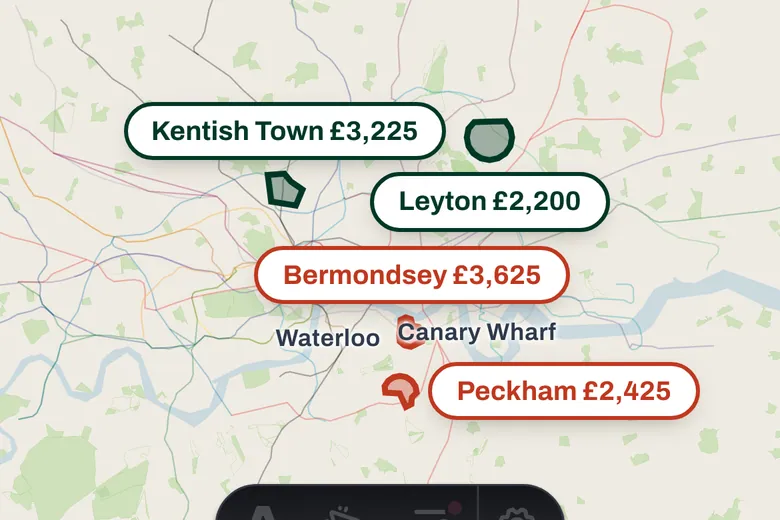
Highbury to New Cross saves £975 a month and cuts the total journey time to Bank from 34 minutes to 30. Peckham, Highbury and Stoke Newington rest on 16 to 21 listings each, so check the advert against the typical figure. To see your own version, open the map on 2-beds, put in your own workplace instead of Bank, set your rent as the budget and a 35-minute total journey time; the closing map shows the same month of overlap in four areas: £2,200 in Leyton, £2,425 in Peckham, £3,225 in Kentish Town and £3,625 in Bermondsey. The rent pages list typical rents by budget, and the negotiation guide helps before you sign for the next place.
A month of overlap is £2,200 in Leyton and £3,625 in Bermondsey.
A month of overlap costs £2,200 in Leyton, £2,425 in Peckham, £3,225 in Kentish Town and £3,625 in Bermondsey
What you need to have ready for the Peckham home is the first month's rent and a deposit of up to five weeks' rent: £2,425 plus £2,798.08, which comes to £5,223.08 before bills, removals and furniture. A holding deposit before you sign is one week's rent at most, £559.61 here. The calculator below starts on one paid on Friday 13 November 2026, before the notice goes out, and shows the cap and the deadline for agreement; change the rent and the date to yours.
Holding deposit: cap and deadline
£559.61the most a holding deposit can be, one week's rent
- Rent a year
- £29,100.00
- Deadline for agreement
- Friday 27 November 2026
- Repay by, if nothing is signed by then
- Thursday 3 December 2026
Anything above one week's rent (the annual rent divided by 52) is a prohibited payment (Tenant Fees Act 2019, Schedule 1, paragraph 3). The deadline for agreement is the 15th day counting the day it was received as day 1, unless you and the landlord or agent agree another day in writing (Schedule 2, paragraph 2). If no tenancy agreement is signed by then, the deposit must be repaid within the 7 days beginning with the deadline (paragraph 4).
A worked example: £2,425 a month, paid on Friday 13 November 2026. Turn on JavaScript to type your own.
The cap is rounded down to the penny, so the figure is the most a landlord or agent can take. The 7 days run from an earlier day if the landlord decides not to go ahead (from the day they decide) or you sign a tenancy agreement (from the date of it). The deposit need not be repaid if you tell them before the deadline that you have decided not to go ahead, or if you gave false or misleading information they could reasonably take into account; the other exceptions are in Schedule 2, paragraphs 8 to 12 of the Tenant Fees Act 2019. To keep it they must tell you why in writing within the same 7 days (paragraph 5).
5For tenants
Send the notice in writing, keep a copy and send it a few days early, because GOV.UK does not say when posted or emailed notice counts as given.
- If you give notice and change your mind, you can stay only if the landlord agrees in writing. Otherwise the tenancy ends as planned, so send nothing until you hold a signed agreement for the next place.
- If you leave without giving the minimum notice, the landlord can require a payment of no more than the rent due until it ends. With two months' notice at Peckham's typical 2-bed that is £4,850, which is rent you would have owed anyway. You can ask in writing for a shorter notice period, and you can agree an earlier end in writing.
- One joint tenant can usually end a joint tenancy for everyone. A shorter notice period needs every joint tenant to agree, and if some of you want to stay the landlord can sign a new agreement with them. Agree a plan as a group before anyone sends notice.
- If it is your landlord who wants you out, the notice needs a ground and a section 8 notice, and a notice does not end the tenancy until a court orders it. The section 21 guide lists the notice for each ground.
Shelter and Citizens Advice can check your own situation.
6For landlords
The tenant's notice has to be in writing and end on a rent day or the day before.
You can ask for two months at most, and you cannot say which method the tenant uses.
- If the agreement says nothing, the tenant gives at least two months.
- You and the tenant can agree a shorter notice or an earlier end, in writing.
- For a tenancy that began before 1 May 2026, the notice period in the agreement can still apply (see the table above), and a valid notice given before that date still ends the tenancy on its date.
- If the tenant leaves without the minimum notice you can require a payment of no more than the rent due until the minimum notice period ends.
- Return the deposit within 10 days of agreeing the amount with the tenant, and leave it in the scheme if you disagree.
- To end a tenancy yourself you need a ground and a section 8 notice. See the section 21 guide, and the section 13 guide for a rent rise.
What else do people ask?
Can I end my tenancy by text or email?
Yes. GOV.UK says notice must be in writing, for example by letter, email or text, and that your landlord cannot tell you which method to use. Keep a copy of what you sent.
How much notice do I give my landlord?
Your tenancy agreement should say. The most a landlord can ask for is 2 months, and if the agreement does not say you give at least 2 months. The notice must end on a day the rent is due or the day before it is due.
Can one joint tenant end the tenancy for everyone?
GOV.UK says one tenant will usually be able to end a joint tenancy without the agreement of the others, but a shorter notice period needs all the other joint tenants to agree. If a joint tenant wants to stay after giving notice, the others and the landlord must agree.
Can I withdraw my notice?
Only if your landlord agrees in writing. GOV.UK says that if you change your mind you can stay only with that agreement, and otherwise the tenancy ends as planned.
How do I end a tenancy agreement early?
You can agree an earlier end or a shorter notice period with your landlord in writing, and you can move out early without paying the rest of the rent if the landlord agrees. If you give less than the minimum notice, GOV.UK's Tenant Fees Act guidance says the landlord can require a payment of no more than the rent due until the minimum notice period ends.
How does a landlord end a tenancy in England now?
Section 21 ended on 1 May 2026. A landlord needs a legal ground and a section 8 notice naming it, and the notice period depends on the ground, from none for nuisance (Ground 14) to four months for selling or moving in. The section 21 guide has every period.
How long does the landlord have to return my deposit?
GOV.UK says within 10 days of you both agreeing how much comes back. If you disagree, the deposit stays protected in the scheme until the dispute is settled.
What if my landlord and I disagree about the deposit?
GOV.UK says the deposit stays protected in the scheme until the dispute is sorted out. The scheme runs a free dispute resolution service: you do not have to use it, but if you do, you both have to agree to it, you both give evidence, and the decision is final. If you cannot reach your landlord, you can raise a dispute with the scheme yourself, and there may be a time limit.
What if my landlord never protected my deposit?
A landlord must put the deposit in an approved scheme within 30 days of getting it. GOV.UK says that if they did not, you can apply to the county court (Form N208, fee £387, which you can claim back if you win). The court can order the deposit repaid or paid into a scheme, and can order up to three times the deposit as compensation.
How did we work this out?
The figures, their dates and sources
Rules were read again on 10/11/2026 on GOV.UK: the guide for tenants on assured periodic tenancies (how to end your tenancy), which took the place of assured shorthold tenancies on 1 May 2026; the Tenant Fees Act 2019 guidance for tenants (updated 07/07/2026); and the tenancy deposit protection pages. The section 8 and section 21 points link to the section 21 guide on this site, which was read on legislation.gov.uk on the same date. The statute quotes are from the Renters' Rights Act 2025, sections 20 and 21 (which insert section 5(1ZA) to (1ZD) and section 5A into the Protection from Eviction Act 1977), read on legislation.gov.uk on 10/11/2026; the Act marks both as in force on 1 May 2026 "for specified purposes", which regulation 2 of SI 2026/421 defines as assured tenancies that are not social housing assured tenancies. The rent-day rule is from GOV.UK's guide, and we found no statute wording for it. GOV.UK does not say when posted or emailed notice counts as given, so the guide does not either. Where a tenancy started before 1 May 2026 the notice depends on what it was before that date; the table of cases is from GOV.UK's page "Ending a tenancy that started before 1 May 2026", read on the same date.
The overlap sums are Citycomb's, not GOV.UK's. They use the typical 2-bed asking rent (Mid finish) from October 2026 listings. Peckham is £2,425 a month and rests on 16 listings, so a single listing can differ. The deposit steps (30 days to protect, 10 days to return, the scheme's dispute service, the county court route with its £387 fee and up to three times the deposit) are from GOV.UK's tenancy deposit protection pages, read on 10/11/2026. The count of areas where a month of overlap is £2,000 or less (about 180) or over £3,000 (about 85) comes from the October 2026 typical 2-bed rents; one rent record does not map to an area, so we give it as "about". A zone figure is the middle area's typical 2-bed rent among the areas whose nearest station within 2.5 km is in that zone (37 areas in Zone 1, 103 in Zone 2, 89 in Zone 3, 98 in Zone 4, 85 in Zone 5 and 66 in Zone 6). The Peckham dates are an example, not a real case. The five-week deposit on Peckham's £2,425 is £2,425 times 12, divided by 52, times 5, £2,798.08, and the move-in sum £5,223.08 is that deposit plus the first month's rent (bills, council tax and removals not included). The holding deposit cap is one week, £2,425 x 12 / 52 = £559.615, shown as £559.61 because a sum rounded up to £559.62 would be above the cap; the page's holding calculator does the same. The move figures use the same typical 2-bed rents for Bermondsey (£3,625, 32 listings), Peckham, Highbury (£3,325, 21), New Cross (£2,350, 50), Stoke Newington (£2,700, 16), Leyton (£2,200, 28) and Kentish Town (£3,225, 27). Total journey times to Bank, for a weekday 09:00 arrival from the middle of each area, are from Citycomb's commute page for Bank, read on 10/11/2026.
Where do these figures come from?
- GOV.UK: Assured periodic tenancies, a guide for tenants: how to end your tenancy, 10 November 2026
- GOV.UK: Assured periodic tenancies, a guide for tenants: ending a tenancy that started before 1 May 2026, 10 November 2026
- GOV.UK: Assured periodic tenancies, a guide for landlords: if your tenant wants to leave, 10 November 2026
- GOV.UK: Assured periodic tenancies, a guide for landlords: if the tenancy started before 1 May 2026, 10 November 2026
- GOV.UK: Tenant Fees Act 2019, guidance for tenants (updated 07/07/2026), 10 November 2026
- GOV.UK: Tenancy deposit protection, 10 November 2026
- GOV.UK: Tenancy deposit protection, disputes and problems, 10 November 2026
- GOV.UK: Tenancy deposit protection, if your landlord does not protect your deposit, 10 November 2026
- legislation.gov.uk: Renters' Rights Act 2025, section 20 (tenants' notices to quit: timing; inserts Protection from Eviction Act 1977, section 5(1ZA) to (1ZD)), 10 November 2026
- legislation.gov.uk: Renters' Rights Act 2025, section 21 (tenants' notices to quit: other; inserts Protection from Eviction Act 1977, section 5A), 10 November 2026
- legislation.gov.uk: SI 2026/421, regulation 2 (what came into force on 1 May 2026, and for which tenancies), 10 November 2026
- GOV.UK: Renters' Rights Act overview for tenants (updated 01/05/2026), 10 November 2026
- Citycomb area data, October 2026: typical 2-bed rents and journey times to Bank, 10 November 2026