Guide
Renters' Rights Act 2025
Checked 10 November 2026England onlyRents: October 2026 asking rentsHow we worked it out
Section 21, the no-fault eviction notice, ended in England on 1 May 2026, and most tenancies became rolling ones with no end date. A landlord now needs a legal ground, and the landlord register is still to come.
Written for: A London tenant or landlord in England who wants to know which Renters' Rights Act rules apply today, in one place.
1 May2026, when most of the Act's tenancy rules came into force in England
In short
Five things apply to a tenancy in England today; the table below names the guide for each.
- A landlord ends a tenancy only with a section 8 notice that names a legal ground, then a court order.
- Your tenancy has no end date, and you leave on the notice your agreement sets, two months at most.
- A rent rise needs a Form 4A and at least two months' notice.
- Rent in advance is one month at most, and none can be asked before you sign.
- Still to come: the landlord register, which reaches London on 15 July 2027, the ombudsman and the standards for homes.
Citycomb finding: at the ONS's 3.5%, one rent rise a year adds more than £1,000 to a typical 2-bed in about 185 areas. To see which areas ask no more than your rent plus a rise, open the map on 2-beds, put in your workplace, and set a 35-minute total journey time.
This is general information, not legal advice; for your case, Shelter, Citizens Advice or a solicitor.
1What changed on 1 May 2026
Most of the Act's tenancy rules came into force on 1 May 2026 under the Commencement No. 2 Regulations (SI 2026/421, regulation 2), for assured tenancies that are not social housing assured tenancies, which covers private lets.
- section 21 notices a landlord can serve since 1 May 2026
- 0
- the least notice of a rent rise, on Form 4A
- 2 months
- a year: one 3.5% rise on the median area's typical 2-bed, £2,200 a month
- £924
Each row names the guide with the detail.
| Rule | What it means | More |
|---|---|---|
| Rolling tenancies | In most cases, fixed-term and assured shorthold tenancies became assured periodic ones on 1 May 2026; new ones are periodic from the start, with no end date | Ending a tenancy |
| No section 21 (no-fault eviction) | A landlord cannot serve one, even if the agreement says they can | Section 21 abolished |
| A ground is needed | A landlord must use a section 8 notice naming a legal ground, and go to court if you stay | Section 21 abolished |
| Ground 1 and 1A | Moving in and selling need a notice date at least a year after the tenancy began | Section 21 abolished |
| Rent arrears (Ground 8) | Three months unpaid, not two, before a court must order possession | Section 21 abolished, landlord checklist |
| Your notice to leave | You give the notice your agreement sets, two months at most; if it says nothing you give two months | Ending a tenancy |
| Rent rises | Form 4A with at least two months' notice, and a rent review clause no longer has effect (from 1 May 2026). Once a year, and never in the first 12 months, was already the law (Housing Act 1988, section 13) | Section 13 rent increase |
| Rent in advance | None can be asked before you sign; no more than one month in advance after | Holding deposit |
| Bidding ban | The advert must name one price, and offers above it cannot be invited or accepted | Rental bidding ban |
| Pets | A landlord cannot unreasonably refuse a written request and must answer in writing within 28 days, unless extended (Housing Act 1988, section 16A) | Renting with pets |
| Discrimination | No refusing to let, or stopping a viewing, because a child would live there or because someone claims benefits (Renters' Rights Act 2025, sections 33 and 34) | The DSS ban |
The rules cover assured tenancies, which is most private lets in London. A tenancy is not assured if the landlord lives in the same home, if it is purpose-built student accommodation under the National Code, or if the rent is under £1,000 a year in London or over £100,000; holiday and business lets are out too. Landlords were due to give existing tenants the government's information sheet by 31 May 2026 (GOV.UK landlord guide). The deposit rules did not change: the cap is still five weeks' rent, six from £50,000 a year, covered in the tenancy deposit cap guide.
Three rules in the statutes' own words (legislation.gov.uk, read 10 November 2026):
- A tenant's notice to quit an assured tenancy must be given for the time the landlord has agreed in writing, "not exceeding two months", or, with no such agreement, "not less than two months before the date on which the notice is to take effect" (Protection from Eviction Act 1977, section 5(1ZA), inserted by section 20 of the Act, in force from 1 May 2026).
- Ground 8 needs "if rent is payable monthly, at least three months’ rent is unpaid", at the date of the notice and at the hearing (Housing Act 1988, Schedule 2).
- On pets, consent "is not to be unreasonably refused by the landlord", and the landlord is to answer in writing "on or before the 28th day after the date of the request", unless a delay in subsections (2) to (5) applies (Housing Act 1988, section 16A).
The dates that have passed
| Date | What happened | Status |
|---|---|---|
| 27 October 2025 | The Act received Royal Assent | Done |
| 13 November 2025 | The government published its implementation roadmap | Done |
| 1 May 2026 | Most tenancy rules came into force (SI 2026/421): no section 21, rolling tenancies, two months' notice on a Form 4A rent rise, the bidding ban, pet requests | In force |
| 31 May 2026 | Landlords were due to have given existing tenants the government information sheet | Deadline passed |
| 31 July 2026 | The latest day to start a court claim on a section 21 notice given before 1 May (Schedule 6, paragraph 4) | Closed |
2What is still to come
The landlord register now has dates; the ombudsman and the homes standards do not.
The register dates are GOV.UK's, from its guidance of 29 October 2026. The rest are government plans in the roadmap of 13 November 2025, the latest dated source for them on 10 November 2026.
| Still to come | What it is | Date |
|---|---|---|
| Landlord register | Landlords register each rental property; the service opens first in the West Midlands | Opens 15 December 2026; London from 15 July 2027, register by 14 October 2027; all active landlords by 14 November 2027 |
| Landlord ombudsman | Landlords must join; for tenant complaints | Expected 2028, year only |
| Awaab's Law for private rented homes | Time limits for fixing damp, mould and other serious hazards | Consultation published 9 October 2026, closes 18 December 2026; no start date |
| Decent Homes Standard in private renting | A standard for the condition of homes | Proposed 2035 or 2037, awaiting the consultation response |
| Minimum energy efficiency | EPC band C proposed by 2030 | Proposed, no date confirmed |
| Digital possession service | A court service for possession claims | First release in 2026; full service 18 months after Royal Assent, no exact date |
We next check this table when GOV.UK responds to the Awaab's Law consultation, which closes on 18 December 2026. GOV.UK adds that later, a property available to let will need its landlord and property registered before it can be advertised; that part has no date yet. If a landlord, an agent or a website quotes a date for anything else in the table, check it against GOV.UK. The landlord database and ombudsman guide follows the first two.
3For tenants
Four things to do: check when your tenancy began, know what a landlord can no longer do, write down every notice the day it arrives, and know who to ask.
- Check the start date. If your tenancy began before 1 May 2026 it is now rolling in most cases (Schedule 6 lists the exceptions), and a notice to leave that you gave before 1 May still ends the tenancy on the date it names (GOV.UK).
- Know what is off the table. A landlord cannot serve a section 21 notice, ask for rent before you sign or more than one month in advance after, invite offers above the advertised rent, or refuse you because a child would live with you or because you claim benefits.
- Write down the day it arrived. When a notice to leave, a rent rise or a message asking you to offer more reaches you, find its rule in the table above and reply in writing rather than on the phone. No rule here asks you to answer on the spot.
- Get help. Shelter and Citizens Advice check your own case. GOV.UK says registration numbers will need to go on adverts later, with no date yet; London landlords have until 14 October 2027 to register.
Picture a tenant in a Walthamstow Village 1-bed at £1,875 a month, ten minutes' walk from Walthamstow Central, on a 12-month tenancy that began on 1 June 2025 and was due to end on Sunday 31 May 2026. For months they would have waited for the call about renewing, or about leaving. On 1 May 2026 the tenancy became a rolling one, in most cases, so 31 May came and went with nothing to sign. The landlord cannot use section 21, and the tenant gives the notice the agreement sets, never more than two months.
Before a new tenancy, the sum to know is the most a landlord can ask for to start it: £4,038.46 on that 1-bed, a five-week deposit of £2,163.46 and one month's rent of £1,875. The Act's change is the rent: none can be asked before you sign, and no more than one month in advance after. The deposit rules are as before, and a holding deposit of up to one week's rent can still be asked before signing; the holding deposit guide covers it.
On a £1,875 1-bed the most to start a tenancy is £4,038.46.
The most a landlord can ask for to start a £1,875 a month 1-bed in Walthamstow Village is £4,038.46
| Depositfive weeks' rent, the cap, unchanged by the Act | £2,163.46 |
|---|---|
| Rent in advanceone month at most, and none before you sign | £1,875.00 |
| Most to start the tenancy | £4,038.46 |
We'd ask for three things in writing when you sign: the deposit scheme's name, the date the deposit was protected, and the rent and the date it can next change. If you want to leave, send your notice in writing, ideally after you hold a signed agreement for your next home.
To see where you could live when your rent is due to rise, open the map on 2-beds, put in your own workplace and a 35-minute total journey time, and set the budget to your rent plus 3.5%. GOV.UK gives you the rules; the map shows which areas ask no more than that, from the rents on current adverts. The link opens on a £2,277 budget (£2,200 plus 3.5%) and Bank.

4For landlords
You need a ground and the right notice to end a tenancy, and Form 4A to raise the rent, each time.
- To end a tenancy, serve a section 8 notice naming a ground and wait for the notice period of that ground. Ground 1 (you or your family moving in) and Ground 1A (selling) need the date named in the notice to be at least a year after the tenancy began (Housing Act 1988, Schedule 2).
- To raise the rent, use the section 13 process with Form 4A every time, even if your tenant agrees. At least two months' notice, once a year.
- For a tenancy made from 1 May 2026, give the tenant the government's written information before you sign; GOV.UK says a fine of up to £7,000 follows if you do not. Protect any deposit in an approved scheme within 30 days.
- Answer a written pet request within 28 days, or the extended time the Act allows, and do not refuse it unreasonably.
- A council can fine a landlord up to £7,000 for the bidding offence (Renters' Rights Act 2025, section 57). A rent repayment order can reach up to two years' rent for offences on or after 1 May 2026 (Housing and Planning Act 2016, section 44(2) as amended; SI 2026/421 sets when it applies).
- Register each property on the new service. It opens on 15 December 2026, in London you start on 15 July 2027 and have until 14 October 2027, and GOV.UK says landlords letting actively must be registered by 14 November 2027. Awaab's Law for private homes is out to consultation until 18 December 2026, with no start date.
The section 21 guide has every ground and its notice period, and the landlord checklist lists what to have in place.
5What a rent rise looks like
Rent can rise once a year, and you can ask the tribunal to look at a rise above the market rent.
GOV.UK (press release, 9 September 2026) says the Valuation Office is set to take over those decisions; until then you apply to the First-tier Tribunal, and you do not have to pay the higher rent until it decides. For scale, the ONS has London rents up 3.5% in the 12 months to September 2026, in the release of 21 October 2026, with the average at £2,338 a month. On £2,200 that is £77 a month, or £924 a year, and across London the same 3.5% costs from £788 a year in the middle Zone 6 area to £1,764 in Zone 1.
The calculator below opens on £2,200, the median typical 2-bed rent across Citycomb's areas, rising to £2,277. Change both to the figure on your notice.
How big is your rent rise?
+3.5%a rise of £77 a month, £924 a year
A worked example: £2,200 rising to £2,277 a month. Turn on JavaScript to type your own.
The typical asking rent is our Mid figure from homes advertised in that area, so it is the price of a new let; areas with no figure are not listed. A rent rise can come once a year at most, never in the first year, and only by a notice in the prescribed form (Form 4A for a private landlord). Since 1 May 2026 that notice must give at least two months, and a rent review clause in the tenancy has no effect; you can ask the First-tier Tribunal to set the open market rent (GOV.UK; Housing Act 1988, section 13).
A typical 3.5% rise adds £1,019 a year in Peckham and £1,397 in Highbury.
A 3.5% rise costs £1,019 a year on a typical 2-bed in Peckham and £1,397 in Highbury
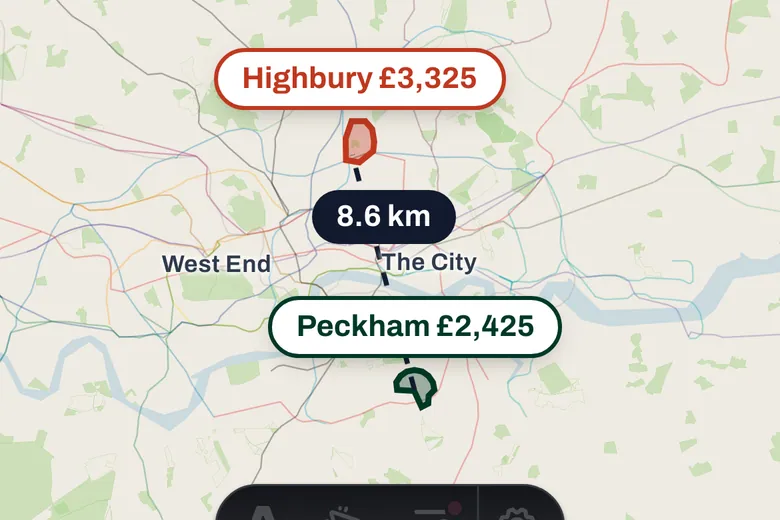
Open the map on 2-beds, click your area and read its typical asking rent next to the new figure on your notice. The section 13 guide sets out the steps and the dates.

What else do people ask?
Has the no-fault eviction ban started?
Yes. Section 21, the no-fault eviction notice, ended for new notices in England on 1 May 2026. A landlord cannot serve one, even if the tenancy agreement says they can, and must use a section 8 notice that names a legal ground. A section 21 notice given before 1 May could only be used if the landlord started a court claim by the end of July 2026.
When did the Renters' Rights Act come into force?
Most tenancy changes came into force on 1 May 2026, including the end of section 21 and the move to rolling tenancies. The Act received Royal Assent on 27 October 2025. The landlord register, the ombudsman and the standards for homes are still to come.
Does the Act apply to my tenancy?
In England it applies to assured tenancies, which includes most private lets. GOV.UK says a tenancy cannot be assured if your landlord lives in the same accommodation, if it is purpose-built student accommodation under the National Code, or if the rent is above £100,000 or under £1,000 a year in London, and it names holiday and business lets too. Wales and Scotland have their own rules.
Do I have to leave when my fixed term ends?
No. In most cases, tenancies that were fixed-term or assured shorthold before 1 May 2026 became assured periodic tenancies on that date, and any end date stopped applying; Schedule 6 of the Act lists the exceptions. New tenancies are periodic from the start. You leave by giving notice of two months at most.
Can my landlord raise my rent whenever they like?
No. Rent can rise once a year, never in the first 12 months, on a Form 4A notice with at least two months' notice. If you think the new rent is above the market rent you can apply to the First-tier Tribunal.
Can a landlord refuse pets or tenants on benefits?
A landlord cannot unreasonably refuse a written request to keep a pet and must answer in writing within 28 days, or a longer time if they ask for more information, need their own landlord's consent or you agree a delay (Housing Act 1988, section 16A). GOV.UK says a landlord should give a reason if they refuse. A landlord or agent cannot refuse to let, or stop someone viewing, because they claim benefits or because a child would live there (Renters' Rights Act 2025, sections 33 and 34).
When does the landlord register start?
The Register your rental property service opens on 15 December 2026, starting in the West Midlands, and it reaches London on 15 July 2027, with London landlords registering by midnight on 14 October 2027. GOV.UK says landlords letting actively must register by 14 November 2027 (press release of 9 September 2026; guidance of 29 October 2026).
What else has not come into force yet?
The landlord ombudsman is expected in 2028. Awaab's Law for private homes (time limits for fixing damp, mould and other serious hazards) is out to consultation, which closes on 18 December 2026, with no start date. The Decent Homes Standard for private rented homes (proposed for 2035 or 2037), the energy efficiency standard and the rest of the digital possession service are in the government's roadmap, which gives no exact dates for them.
How did we work this out?
The figures, their dates and sources
Every rule here was read again on 10/11/2026 on legislation.gov.uk (the Renters' Rights Act 2025, the Housing Act 1988 as amended, the Tenant Fees Act 2019 and the Commencement No. 2 Regulations, SI 2026/421, which brought most tenancy rules into force on 1 May 2026, "for the purposes of assured tenancies that are not social housing assured tenancies only", regulation 2) and on GOV.UK (the Renters' Rights Act overview for tenants, last updated 1 May 2026, the guides to assured periodic tenancies for tenants and for landlords, and the Tenant Fees Act guidance). The Act received Royal Assent on 27 October 2025.
Who is covered: the two GOV.UK assured periodic tenancy guides. Fixed-term tenancies became rolling ones in most cases; Schedule 6 of the Act sets out the exceptions, such as a section 21 notice that was already in progress (paragraphs 1 to 4). The pet rule is Housing Act 1988, section 16A (subsections 2 to 5 allow the 28 days to be extended); the discrimination rules are sections 33 and 34 of the Act; the £7,000 bidding penalty is section 57. The rent repayment order point was read in the Housing and Planning Act 2016, section 44(2) as amended, with SI 2026/421 regulations 3 and 11 setting when it applies. The Act covers England only.
Dates still to come: the landlord register dates are from GOV.UK: the press release of 9 September 2026 (the service launches on 15 December 2026, starting in the West Midlands, and landlords letting actively must register by 14 November 2027) and the guidance for letting agents and property managers of 29 October 2026, which gives each region's start and end dates (London from 15 July 2027, to be registered by midnight on 14 October 2027). The Awaab's Law dates are from the GOV.UK consultation "Extending Awaab's Law to private rented tenancies and to licences", published 9 October 2026 and closing at 11:59pm on 18 December 2026. The ombudsman (2028), the Decent Homes Standard, the energy efficiency standard and the digital possession service are from the government's implementation roadmap of 13 November 2025, the latest dated source for them on 10 November 2026. No section of the Act or of GOV.UK that we read gives them an exact date.
Rents: the London sums use Citycomb's typical asking rents (Mid finish) from October 2026 listings across areas. A week's rent is the monthly rent times 12, divided by 52. The tenancy deposit is five weeks of it, the cap for annual rents under £50,000 (GOV.UK Tenant Fees Act 2019 guidance). It is a ceiling, not what any landlord asks. A zone figure is the middle area's typical 2-bed rent among the areas whose nearest station within 2.5 km is in that zone (37 areas in Zone 1, 103 in Zone 2, 89 in Zone 3, 98 in Zone 4, 85 in Zone 5 and 66 in Zone 6; 20 areas have no station within 2.5 km and are left out of the zone figures), the grouping Citycomb's London zones guide uses; the middle rents are £4,200, £2,925, £2,350, £2,025, £1,925 and £1,875 a month. The yearly cost of a 3.5% rise is that rent times 3.5%, times 12, to the nearest pound. The count of areas where one rise tops £1,000 a year (a typical 2-bed above £2,381 a month) is about 185 areas, "about" because one rent record does not map to an area. The information sheet date is the GOV.UK landlord guide's ("by 31 May 2026"). The 31 July 2026 date is the end of the three months beginning 1 May 2026 in the Act's Schedule 6, paragraph 4. Walthamstow Village rests on 11 listings for a 1-bed, so a single listing can differ. The Walthamstow Village tenancy is an example, not a real case. The 3.5% is the ONS figure for London private rents in the 12 months to September 2026 (Price Index of Private Rents, released 21/10/2026, the latest release on 10/11/2026; the average London rent was £2,338); it is an average, not a rule. The rise calculator starts at £2,200, the median typical 2-bed rent across areas, rising to £2,277, which is 3.5% on £2,200.
Where do these figures come from?
- GOV.UK: Renters' Rights Act overview for tenants (published 07/04/2026, updated 01/05/2026), 10 November 2026
- GOV.UK: Assured periodic tenancies, a guide for tenants, 10 November 2026
- GOV.UK: Assured periodic tenancies, a guide for landlords, 10 November 2026
- legislation.gov.uk: The Renters' Rights Act 2025 (Commencement No. 2 and Transitional and Saving Provisions) Regulations 2026, SI 2026/421 (in force 01/05/2026), 10 November 2026
- legislation.gov.uk: Renters' Rights Act 2025 (Royal Assent 27/10/2025), 10 November 2026
- legislation.gov.uk: Renters' Rights Act 2025, Schedule 6 (existing tenancies and transitional provision), 10 November 2026
- legislation.gov.uk: Renters' Rights Act 2025, section 20 (tenants' notices to quit: timing; inserts Protection from Eviction Act 1977, section 5(1ZA)), 10 November 2026
- legislation.gov.uk: Housing Act 1988, Schedule 2 as amended (Ground 8), 10 November 2026
- legislation.gov.uk: Housing Act 1988, section 8 as amended (grounds and notice), 10 November 2026
- legislation.gov.uk: Housing Act 1988, section 16A (tenant's request to keep a pet), 10 November 2026
- legislation.gov.uk: Housing and Planning Act 2016, section 44 (amount of a rent repayment order), 10 November 2026
- GOV.UK: Stronger protections and greater confidence for renters (press release, 09/09/2026): the landlord register launch, 10 November 2026
- GOV.UK: Register your rental property service, guidance for letting agents and property managers (29/10/2026): regional dates, 10 November 2026
- GOV.UK: Extending Awaab's Law to private rented tenancies and to licences (consultation, 09/10/2026, closes 18/12/2026), 10 November 2026
- GOV.UK: Implementing the Renters' Rights Act 2025, our roadmap for reforming the private rented sector (published 13/11/2025), 10 November 2026
- GOV.UK: Tenant Fees Act 2019, guidance for tenants (updated 07/07/2026), 10 November 2026
- ONS: Private rent and house prices, UK: October 2026 (released 21/10/2026), 10 November 2026
- Citycomb area data, October 2026: typical 1-bed and 2-bed rents across London's areas, 10 November 2026