Guide
Holding deposit: one week's rent at most, and refunds
Checked 9 November 2026England onlyRents: October 2026 asking rentsHow we worked it out
A holding deposit is repaid within 7 days unless Schedule 2 lets the landlord keep it. Failing a reference is not one of those reasons. A failed Right to Rent check, false or misleading information, telling the landlord you are not going ahead, or not taking all reasonable steps to sign can be.
Written for: A renter about to pay a holding deposit in England, or a landlord or agent asking for one.
1 weekof rent is the most a holding deposit can be in England
In short
One week's rent is the most a holding deposit can be: £432.69 on a £1,875 a month flat.
If the tenancy does not go ahead, a failed reference is not a reason to keep it.
This is general information, not legal advice; for your case, Shelter, Citizens Advice or a solicitor. It is for England; which tenancies the Act covers is under "Holding deposit rules in force in England".
1The one-week cap, worked out
A holding deposit can be one week's rent at most, and a week is the annual rent divided by 52.
- the cap on a £1,875 a month 1-bed in Walthamstow Village
- £432.69
- areas where £600 is over the cap on a typical 2-bed
- 350
- areas with a 2-bed cap under £500 and over £1,000
- 246 and 19
Schedule 1, paragraph 3(3): "If the amount of the holding deposit exceeds one week's rent, the amount of the excess is a prohibited payment."
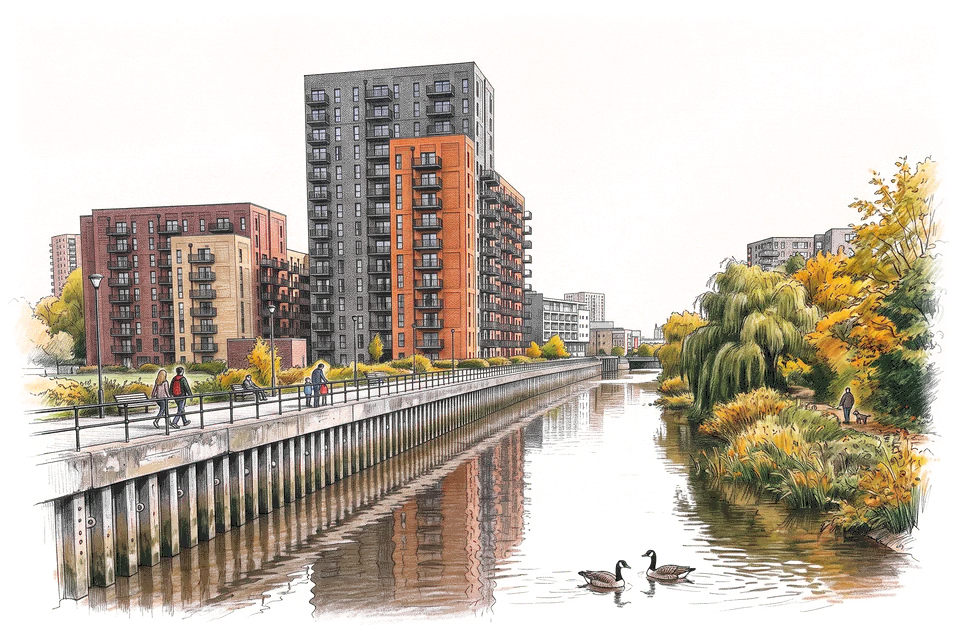
On Saturday 14 November 2026 you view a 1-bed in Walthamstow Village, where a typical 1-bed (Mid finish) asks £1,875 a month; across every finish the median is £1,575, on the same 11 listings. The agent has a card reader out in the hallway. "It'll be gone by Monday," she says. "£600 to hold it." One week's rent is £1,875 times 12, divided by 52, which is £432.69, so £600 is £167.31 over the cap. You can say: "I'll pay £432.69, the most the Act allows. Please confirm the amount, the flat and the deadline by email."
One week's rent on £1,875 a month is £432.69, and that is the most a holding deposit can be.
On a £1,875 a month 1-bed in Walthamstow Village the most a holding deposit can be is £432.69
| Monthly renttypical 1-bed, Walthamstow Village | £1,875.00 |
|---|---|
| Annual rent£1,875 x 12 | £22,500.00 |
| An agent asks forto secure the flat | £600.00 |
| One week's rent, the cap | £432.69 |
Holding deposit: cap and deadline
£432.69the most a holding deposit can be, one week's rent
- Rent a year
- £22,500.00
- Deadline for agreement
- Saturday 28 November 2026
- Repay by, if nothing is signed by then
- Friday 4 December 2026
Anything above one week's rent (the annual rent divided by 52) is a prohibited payment (Tenant Fees Act 2019, Schedule 1, paragraph 3). The deadline for agreement is the 15th day counting the day it was received as day 1, unless you and the landlord or agent agree another day in writing (Schedule 2, paragraph 2). If no tenancy agreement is signed by then, the deposit must be repaid within the 7 days beginning with the deadline (paragraph 4).
A worked example: £1,875 a month, paid on Saturday 14 November 2026. Turn on JavaScript to type your own.
The cap is rounded down to the penny, so the figure is the most a landlord or agent can take. The 7 days run from an earlier day if the landlord decides not to go ahead (from the day they decide) or you sign a tenancy agreement (from the date of it). The deposit need not be repaid if you tell them before the deadline that you have decided not to go ahead, or if you gave false or misleading information they could reasonably take into account; the other exceptions are in Schedule 2, paragraphs 8 to 12 of the Tenant Fees Act 2019. To keep it they must tell you why in writing within the same 7 days (paragraph 5).
The cap is per tenancy and not per tenant, so three people on one agreement pay it between them. A landlord can ask for less, or for nothing. Schedule 1, paragraph 3(5) also stops a second holding deposit for the same home, but only while the first has not been repaid and none of paragraphs 6 to 12 of Schedule 2 let the landlord keep it.
For round rents the cap is below. At £2,600 a month it is exactly £600.
| Monthly rent | Annual rent | One week, the cap |
|---|---|---|
| £800 | £9,600 | £184.61 |
| £1,000 | £12,000 | £230.76 |
| £1,500 | £18,000 | £346.15 |
| £2,000 | £24,000 | £461.53 |
| £2,500 | £30,000 | £576.92 |
| £2,600 | £31,200 | £600.00 |
| £3,000 | £36,000 | £692.30 |
Across London the cap follows the rent. Each zone figure below is a median: put a zone's areas in order of typical rent for that bedroom size and take the one in the middle.
| Zone | 1-bed, one week | 2-bed, one week |
|---|---|---|
| Zone 1 | £709.61 | £969.23 |
| Zone 2 | £530.76 | £675.00 |
| Zone 3 | £438.46 | £542.30 |
| Zone 4 | £375.00 | £467.30 |
| Zone 5 | £357.69 | £444.23 |
| Zone 6 | £346.15 | £432.69 |
A £600 request is over the cap in 350 areas on a typical 2-bed and in 442 on a typical 1-bed: every area where the typical rent for that size is under £2,600 a month. The cap on a typical 2-bed is under £500 in 246 areas and over £1,000 in 19.
Typical rents are a guide, so check the cap against the rent in your advert. To see one, open 1-beds at a £1,900 budget with a 45-minute total journey time to Bank, click Walthamstow Village and read £1,875 a month; times 12, divided by 52, is the £432.69 above. With your own workplace and budget, the map shows which areas, and so which weekly caps, you can reach.
More on rents: 2-beds under £2,000 and under £2,500 list areas by rent, and the tenancy deposit cap guide covers the larger tenancy deposit.
2Getting a holding deposit back
A landlord has 7 days to repay a holding deposit or to give written reasons for keeping it, and a failed reference is not on the list of reasons.
- the default deadline to sign, counting the day it is received
- 15 days
- to repay it, or to give a written reason for keeping it
- 7 days
Schedule 2, paragraph 3: "the person who received the holding deposit must repay it" if the tenancy agreement is signed, if the landlord decides not to go ahead before the deadline, or if no agreement is signed by the deadline. Paragraphs 8 to 12 are the exceptions, and the first four rows below are the cases where it comes back.
| What happened | Do you get it back? | Paragraph |
|---|---|---|
| The landlord decides not to go ahead | Yes | 3(b) |
| You sign the tenancy agreement | Yes, or it goes towards rent or deposit if you agree | 3(a), 6 |
| You fail a reference or credit check and nothing else applies | Yes | None of 8 to 12 |
| Nothing is signed by the deadline and no exception applies | Yes | 3(c) |
| The landlord is barred from letting to you by immigration status (the Right to Rent check), and could not reasonably have known | No | 8; 13 does not override |
| You gave false or misleading information the landlord is reasonably entitled to take into account | No | 9; 13 does not override |
| You told the landlord before the deadline you were not going ahead, and nothing is signed by the deadline | No, unless paragraph 13 applies | 10 |
| The landlord and agent took all reasonable steps to sign and you did not | No, unless paragraph 13 applies | 11, 12 |
Paragraphs 8 and 9 apply where the landlord decides not to go ahead or nothing is signed. Paragraph 13 overrides 10, 11 and 12, so the refund is due anyway, if before the deadline the landlord or agent imposed a requirement to make a payment the Act does not permit or behaved so that it would be unreasonable to expect you to sign. GOV.UK puts the same grounds more briefly: a landlord must refund unless the tenant fails a Right to Rent check, withdraws, does not respond or gives false or misleading information that affects suitability. A misspelling or a missing previous address does not count.
A landlord who believes an exception applies must give written notice explaining it within the same 7 days, or has to repay. Paragraph 4: "the deposit must be repaid within the period of 7 days beginning with" the date of the agreement, the date the landlord decides not to go ahead, or the deadline for agreement. The deadline is the 15th day of the period beginning with the day the landlord receives the money, unless you and the landlord agree another day in writing. In the example you pay on 14 November:
- Nobody decides: the deadline is Saturday 28 November, and the 7 days begin with it and end on Friday 4 December.
- The agent messages on Friday 20 November, "we've gone with another applicant": the landlord has decided not to go ahead, so the 7 days begin on 20 November and the money is due back by Thursday 26 November.
Paid on 14 November, the deadline is 28 November and repayment is due by 4 December if nothing is signed.
Paid on Saturday 14 November 2026, the deadline to sign is 28 November and the last day to repay is 4 December
From payment to repayment
| Stop | Minutes from the start | Note |
|---|---|---|
| 14 Nov | Received; day 1 | |
| 28 Nov | Deadline to sign | |
| 4 Dec | Last day to repay |
If you sign and agree that the holding deposit goes towards your tenancy deposit, paragraph 7 treats that amount as received on the date of the tenancy agreement, so the 30 days to protect it start that day. The tenancy deposit cap guide has that clock, and the ending a tenancy guide has the later dates.
3Holding deposit rules in force in England
The Tenant Fees Act 2019 applies to assured periodic tenancies, student accommodation and licences to occupy housing such as a lodger's room, and not to social housing assured tenancies, shared ownership, holiday lets, excluded licences or a rent over £100,000 a year (GOV.UK landlord guidance, updated 7 July 2026). The cap and the repayment rules have not changed since 1 June 2019: legislation.gov.uk records no changes to paragraph 3 or to Schedule 2. The one nearby rule with a part-dated start is the rent rule in the last two rows, which legislation.gov.uk dates 1 May 2026 "for specified purposes" without saying which purposes.
| Rule | In force | Source |
|---|---|---|
| Holding deposit capped at one week's rent | 1 June 2019; unchanged | Tenant Fees Act 2019, Schedule 1, para 3(3) |
| A week is the annual rent divided by 52 | 1 June 2019 | Schedule 1, para 3(4) |
| No second holding deposit for the same home while an earlier one is unrepaid, unless Schedule 2 paras 6 to 12 let the landlord keep it | 1 June 2019 | Schedule 1, para 3(5) |
| Deadline for agreement is the 15th day unless agreed otherwise in writing | 1 June 2019 | Schedule 2, para 2 |
| Repay within 7 days, or give written reasons within 7 days | 1 June 2019 | Schedule 2, paras 4 and 5 |
| Deposit can go towards first rent or the tenancy deposit with the tenant's consent; an amount applied to the deposit counts as received on the agreement date | 1 June 2019 | Schedule 2, paras 6 and 7 |
| For an assured tenancy, rent payable before the tenancy is entered into is a prohibited payment | 1 May 2026 "for specified purposes"; which purposes is not stated | Schedule 1, para 1(1A), inserted by Renters' Rights Act 2025 s.9; SI 2026/421 |
| No rent before the agreement is signed; after signing, at most 1 month's rent before the tenancy starts | Stated in GOV.UK landlord guidance published 1 May 2026 | GOV.UK tenant and landlord guidance |
4For tenants
Ask for the amount and the deadline in writing before you pay, and keep the receipt, the advert and the messages.
When an agent says the flat will go by Monday, send your ID that evening and ask for the figure by email; do not tap the card before you have it.
- Check the amount against the cap: rent times 12, divided by 52. On £1,875 a month it is £432.69.
- Send your ID, payslips and references straight away, because not responding is one of the reasons GOV.UK gives for a landlord keeping the money.
- If you need longer, say while a guarantor's checks finish, put the new deadline in an email so you both have the same one.
- If you sign, the landlord repays the deposit or, if you agree, applies it to your first month's rent or your tenancy deposit. Write down which when you pay.
If it has already been kept, or you paid more than the cap:
- Write: "I paid £432.69 on 14 November and the tenancy did not go ahead. I have had no written reason, so please repay it under Schedule 2, paragraph 4 or 5."
- Name the amount and the date you paid. If you paid more than the cap, name Schedule 1, paragraph 3(3).
- If the landlord has not repaid or explained in time, GOV.UK says to report it to your local council or the First-tier Tribunal.
- If a letting agent asked for a prohibited payment such as an amount over the cap, GOV.UK also names two redress schemes for agents, The Property Ombudsman and Property Redress.
- For advice on your own case, Shelter or Citizens Advice.
Signing day costs more than the holding deposit: the first month's rent and a deposit of up to five weeks' rent, which is £2,163.46 on £1,875 a month. If you agree, the holding deposit comes off that. The tenancy deposit cap guide has the sum.
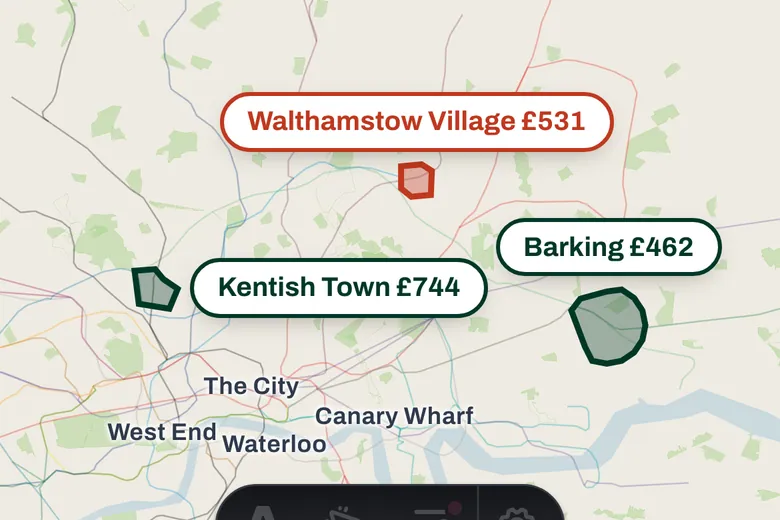
The advert gives you the agent's figure; the map gives you the typical rent around it. Search the area from your advert, read its typical rent for your bedrooms, and compare. Your total journey time and your budget decide which areas, and so which weekly caps, you meet: Barking, Walthamstow Village and Kentish Town sit at £2,000, £2,300 and £3,225 a month for a 2-bed. The link below opens 2-beds at a £2,000 budget; raise it to £2,300 to see Walthamstow Village, or to £3,300 for Kentish Town.
Rent times 12, divided by 52, gives the cap in any area.
A week's rent on a typical 2-bed is £462 in Barking, £531 in Walthamstow Village and £744 in Kentish Town

5For landlords
You can ask for no more than one week's rent per tenancy, and you do not have to take a holding deposit at all.
- Write down the amount, the deadline and the property when you take it.
- Repay, or give written reasons for keeping it, within the 7 days set out under "Getting a holding deposit back". Without reasons you must repay.
- A failed reference or credit check is not among the reasons in paragraphs 8 to 12, so it does not let you keep the deposit.
- Do not take a second holding deposit for the same home while you hold the first, unless a reason in Schedule 2, paragraphs 6 to 12, let you keep it.
- If the deposit goes towards the tenancy deposit, your 30 days to protect it start on the date of the agreement.
- Do not ask for rent before the agreement is signed, and after signing ask for no more than 1 month's rent before the tenancy starts. The rental bidding guide covers what an advert and an offer may say.
In the Walthamstow Village example, an applicant tells you on day 9 that they are not going ahead, and nothing is signed by the deadline of 28 November. You can keep the deposit under paragraph 10, but only with written reasons given by 4 December. Paragraph 13 overrides it if you or your agent charged a payment the Act does not permit.
If you do not repay a holding deposit, or do not give the reason in writing in time, you may receive a financial penalty (GOV.UK landlord guidance). The tenant can report you to the local council or apply to the First-tier Tribunal (GOV.UK tenant guidance).
If you ask for more than the cap, the excess is a prohibited payment: the first financial penalty can be up to £5,000, and a breach within 5 years of a previous penalty can bring a penalty of up to £30,000 or a prosecution.
What else do people ask?
What is the most a landlord can ask for as a holding deposit?
No more than one week's rent (Tenant Fees Act 2019, Schedule 1, paragraph 3(3)), which is the annual rent divided by 52 (paragraph 3(4)). On a £1,875 a month 1-bed that is £432.69. The limit is per tenancy, so three people on one agreement pay one week's rent between them.
Do I get my holding deposit back if I fail referencing?
Yes. A failed reference or credit check is not one of the reasons in Schedule 2, paragraphs 8 to 12, that let a landlord keep it. The table under "Getting a holding deposit back" lists the four that do.
Do I get my holding deposit back if I change my mind?
Not if you tell the landlord before the deadline that you are not going ahead (paragraph 10), unless paragraph 13 applies. The table under "Getting a holding deposit back" has the detail.
Do I get my holding deposit back if the landlord changes their mind?
Yes (paragraph 3(b)), unless paragraph 8 or 9 applies: you were barred by immigration status (the Right to Rent check) and the landlord could not reasonably have known, or you gave false or misleading information the landlord is reasonably entitled to take into account.
Is a holding deposit protected in a deposit scheme?
Not while it is a holding deposit (GOV.UK). Once you sign and it becomes part of your tenancy deposit, the landlord must protect it, and the tenancy deposit cap guide has the clock.
How long does a landlord hold the home for a holding deposit?
Until the deadline for agreement, the 15th day with the day of receipt as day one, unless you both agree another day in writing.
Can an agent take a second holding deposit while they hold the first?
Not while the first is unrepaid and the landlord has no Schedule 2 reason to keep it (Schedule 1, paragraph 3(5)). A landlord who lawfully kept the first can take one from a new applicant.
Can the holding deposit go towards my first month's rent or my deposit?
Yes, if you agree. Schedule 2, paragraph 6 lets it be applied to the first payment of rent or to the tenancy deposit with your consent.
Where do I complain if a holding deposit is kept?
GOV.UK says to report it to your local council or the First-tier Tribunal. For advice on your own case, contact Shelter or Citizens Advice.
How did we work this out?
The figures, their dates and sources
- Law read on 09/11/2026 (legislation.gov.uk): Tenant Fees Act 2019, Schedule 1, paragraph 3 (the cap, the week, a second deposit) and Schedule 2, paragraphs 1 to 13 (the deadline, the 7 days, the reasons to keep a deposit).
- In force: both from 1 June 2019 (SI 2019/857, regulation 3). legislation.gov.uk records no amendment to paragraph 3 and no outstanding change to either schedule.
- Not guessed: Schedule 1 paragraphs 1(1A), 1(1B) and 1A (Renters' Rights Act 2025 section 9) started on 1 May 2026 "for specified purposes" (SI 2026/421, regulation 2(a)). They concern rent, not holding deposits, and legislation.gov.uk does not say which purposes are still to start.
- GOV.UK: the guidance for tenants and the guidance for landlords and agents on fees (both updated 07/07/2026; the landlord guidance was first published 01/05/2026), and the tenancy deposit protection page, which shows no update date.
- Penalties: GOV.UK names no amount for failing to repay a holding deposit or to give the reason in writing, so the page gives none. The £5,000 and £30,000 figures are GOV.UK's for requiring a prohibited payment, such as more than the cap.
- Paragraph 7: an amount applied to the tenancy deposit under paragraph 6(b) is treated, for section 213 of the Housing Act 2004, as received on the date of the tenancy agreement (read 09/11/2026).
- One week's rent: the monthly rent times 12, divided by 52 (Schedule 1, paragraph 3(4)).
- London rents: Citycomb's typical asking rents (Mid finish) from listings seen between 8 and 14 October 2026, across areas. Mid is the middle of three finish tiers: Walthamstow Village's 1-bed median across every finish is £1,575 on the same 11 listings.
- Zone figures: each is a median. List the areas whose nearest station within 2.5 km is in the zone (37 in Zone 1, 103 in Zone 2, 89 in Zone 3, 98 in Zone 4, 85 in Zone 5, 66 in Zone 6; 20 areas have no zone), order them by typical rent for that bedroom size, and take the middle one. The 2-bed and 1-bed columns use their own orders, so the middle area can differ (Zone 3: £2,350 for a 2-bed, £1,900 for a 1-bed, giving £542.30 and £438.46 a week). Zone 1's middle area is Oval and Vauxhall at £4,200; the next area down asks £4,050.
- How solid the rents are: typical 2-bed rents: 161 rest on fewer than 10 listings and 36 of those have one listing or none behind them and are modelled. The areas named in the text rest on 11 or more (Walthamstow Village's 1-bed on 11 and its 2-bed on 16).
- The example: the Walthamstow Village scene, its dates, the £600 request and the 20 November message are an example, not a real case.
Where do these figures come from?
- legislation.gov.uk: Tenant Fees Act 2019, Schedule 1 (permitted payments; holding deposits, paragraph 3; rent, paragraphs 1 and 1A), 9 November 2026
- legislation.gov.uk: Tenant Fees Act 2019, Schedule 2 (treatment of holding deposits), 9 November 2026
- GOV.UK: Tenant Fees Act 2019, guidance for tenants (updated 07/07/2026), 9 November 2026
- GOV.UK: Fees you can charge as part of a tenancy, guidance for landlords and agents (updated 07/07/2026), 9 November 2026
- legislation.gov.uk: Housing Act 2004, section 213 (requirements relating to tenancy deposits; Tenant Fees Act 2019, Schedule 2, paragraph 7 treats an applied holding deposit as received on the agreement date), 9 November 2026
- GOV.UK: Tenancy deposit protection (no update date shown on the page), 9 November 2026
- Citycomb area data, October 2026: typical 1-bed and 2-bed rents across London's areas, 9 November 2026