Guide
Section 21 abolished
Checked 10 November 2026England onlyRents: October 2026 asking rentsHow we worked it out
Yes: section 21, the no-fault eviction notice, ended in England on 1 May 2026, so a landlord now needs a legal ground and a section 8 notice. The notice runs from none to four months, depending on the ground.
Written for: A London tenant who has been given a notice to leave, or a landlord who wants a tenancy to end, in England.

1 May2026, the day section 21, the no-fault eviction notice, ended in England
In short
A notice only counts if it is a section 8 notice that names a legal ground and gives that ground's full notice period.
Check the one you have been given:
- Does it say section 8 and name a ground? A landlord can no longer serve a section 21 notice.
- Is the date on it at least as far away as the notice period for its longest ground?
- If it is Ground 1 or 1A, does the date on the notice fall at least a year after the tenancy began? The notice can be served earlier, but the date it names cannot.
- If it is Ground 8 (serious rent arrears), is the unpaid rent at least three months of your own rent, not a London figure, both now and at the hearing?
Citycomb finding: in October 2026 asking rents, three months of a typical 2-bed's rent, the Ground 8 line, is over £7,000 in about 200 areas. The line is three times your own rent, so it moves with the home. To see which areas ask no more than you pay now, open the map on 2-beds, put in your rent and your workplace, and set a 35-minute total journey time.
This guide is for England, and it covers assured tenancies, most private lets in London; the renters' rights guide lists the exceptions, such as a landlord who lives in the same home. It lists the grounds you are most likely to meet with the notice each one needs (GOV.UK on ending a tenancy).
This is general information, not legal advice; for your case, Shelter, Citizens Advice or a solicitor.
Landlords: selling is Ground 1A, moving in is Ground 1, arrears of three months or more is Ground 8, and a breach of a term is Ground 12. Each needs its notice period first.
1Notice periods by ground
The notice runs from none to four months, and the longest ground in a notice sets the date.
- notice for sale or moving in
- 4 months
- notice for serious rent arrears
- 4 weeks
- unpaid on a £2,200 rent before Ground 8 applies
- £6,600
Section 8(4AA) says the date on a notice "must not be before the end of the longest period shown in the following table for any ground specified in the notice", and it puts the grounds in four groups.
| Notice | Ground | What it covers |
|---|---|---|
| 4 months | 1 | Landlord or close family moving in |
| 4 months | 1A | Landlord selling, or leasing over 21 years |
| 4 months | 2, 6 | Lender selling; works that need the tenant out |
| 4 months | 4A | Student house let to students again (conditions below) |
| 2 months | 7 | Tenancy passed on after a death |
| 2 months | 9 | Suitable alternative home available |
| 4 weeks | 8 | Serious rent arrears |
| 4 weeks | 10, 11 | Some rent unpaid; persistent late payment |
| 2 weeks | 12, 13, 15, 17 | Breach of a term; damage; furniture; false statement |
| None | 7A, 14 | Serious anti-social behaviour; nuisance to neighbours, or a conviction |
Grounds 1, 1A, 2, 4A, 6, 7, 7A and 8 are "must order": the judge has to make a possession order if the ground is proved. Grounds 9, 10, 11, 12, 13, 14, 15 and 17 are "may order": the judge decides whether it is reasonable to make one.
When a notice names more than one ground, the longest period applies. Five rules narrow the table:
- For Grounds 7A and 14 the date can be the day the notice is served: section 8(4) now reads "either or both of Grounds 7A and 14", and the date "shall not be earlier than the date of the service of the notice". Legislation.gov.uk marks that wording as in force from 1 May 2026 and the old Ground 7A rule in section 8(3A) as omitted from the same date, both for the purposes in the next paragraph.
- Grounds 1 and 1A need the tenancy to have begun at least 1 year before the "relevant date", which for these grounds is the date specified in the notice (Housing Act 1988, Schedule 2). A landlord can serve the notice earlier, but the date it names must be a year or more after the tenancy began.
- Ground 1A is not available against a legacy assured tenancy, one that began before 1 May 2026 and was not an assured shorthold tenancy that day (SI 2026/421, regulation 5).
- Ground 4A has conditions (GOV.UK): every tenant was or expected to become a full-time student, the landlord means to let to students again, the tenancy was signed less than six months before the move-in date, the home is a house in multiple occupation, the tenants were told in writing before signing that this ground might be used, and the four months' notice ends between 1 June and 30 September.
- A tenancy that began before 1 May 2026 follows a shorter route for Ground 4A: the landlord had to tell tenants in writing by 31 May 2026, and could then give two months' notice instead of four, in a notice served between 1 May and 30 July 2026 (GOV.UK; SI 2026/421, regulation 6). Nothing is left to run on that route now.
Legislation.gov.uk marks these section 8 changes as in force from 1 May 2026 "for specified purposes". Regulation 2 of the Commencement No. 2 Regulations (SI 2026/421) says which: "assured tenancies that are not social housing assured tenancies only", so private lets are covered. GOV.UK puts the notice more briefly, as usually at least two months and up to four; the shorter periods for the arrears and breach grounds are in section 8(4AA) itself. If a notice gives a different period from this table, check it with Shelter or Citizens Advice. The table leaves out grounds for social landlords and specialist cases; the full list is in Schedule 2.
2What ended on 1 May 2026
The section 21 rules stopped for new notices on 1 May 2026, with the rest of the tenancy changes, for assured tenancies that are not social housing assured tenancies (SI 2026/421, regulation 2).
Nothing in this table is waiting for a start date.
| Rule | In force | Source |
|---|---|---|
| A landlord cannot serve a section 21 notice, even if the agreement says they can | 1 May 2026 | GOV.UK landlord guide |
| Fixed-term and assured shorthold tenancies became rolling assured periodic ones | 1 May 2026 | GOV.UK overview |
| A landlord needs a section 8 notice naming a ground, then a court order | 1 May 2026 | Housing Act 1988 s.8 |
| A tenant ends the tenancy with the notice the agreement sets, two months at most, on a rent day or the day before | 1 May 2026 | GOV.UK guide for tenants, how to end your tenancy |
| Last day to start a claim on a section 21 notice given before 1 May 2026 | 31 July 2026 (closed) | Renters' Rights Act 2025, Schedule 6, paragraph 4 |
| Court process changes (the digital possession service) | No exact date | Government roadmap, 13 November 2025 |
A section 21 notice given before 1 May 2026 stayed valid only if a possession claim was requested by the earlier of six months after the notice and three months after 1 May 2026. A claim made in time continues until the case concludes (Renters' Rights Act 2025, Schedule 6, paragraphs 3 and 4). Where an old notice named a later date, because it asked for more than two months, the window was four months from that date but never later than three months from 1 May 2026 (paragraph 4, section 21(4EA)). So the window for starting a claim on any old notice has closed: it could not run past 31 July 2026. A claim already requested in time carries on until it ends.
3For tenants
A first notice is a form, not a verdict: it has to be right before it counts, and it starts a process rather than ending the tenancy.
You stay in the home while it runs. On the day it arrives, find the ground and the date on it and write both down. You can stay until a court orders you to leave, and a landlord cannot remove you by force: GOV.UK says illegal eviction is a criminal offence.
Take a tenant in Leyton on £2,200 a month who has paid nothing since 1 November. On Monday 18 January 2027 the landlord hands over a section 8 notice naming Ground 8. Rent due on 1 November, 1 December and 1 January is three months, £6,600, so the sum is enough. The notice cannot name a date earlier than Monday 15 February 2027, four weeks on. Nothing happens on that day beyond the landlord being able to apply to court. The calculator below starts on that example.
When does the notice end?
Monday 15 February 2027the earliest day court proceedings can start
A worked example: a landlord serving a notice on Monday 18 January 2027 for Ground 8, rent arrears. Turn on JavaScript to type your own.
These are the earliest dates the law allows for assured tenancies in England since 1 May 2026, counting from the day the notice is given or served (allow extra days if it goes by post). A tenant's notice must be in writing, and a shorter time than two months counts only if the landlord agreed it in writing. A rent rise goes on Form 4A and a possession notice on Form 3A. Not checked here: the minimum gap since the tenancy began or the last rise (52 weeks, sometimes 53), and, for Ground 1 or 1A, that the tenancy has lasted a year. A possession notice only lets the landlord apply to court, which decides. Rent days from the 29th to the 31st and weekly rents are left out.
- Find the ground on the notice and look it up in the table, with its notice period.
- Check the notice period against that ground. For Grounds 1 and 1A, check the date on the notice is at least a year after the tenancy began.
- If the ground is arrears, check the sum. Schedule 2 says, for Ground 8, "if rent is payable monthly, at least three months’ rent is unpaid", and for weekly or fortnightly rent at least thirteen weeks, both "at the date of the service of the notice" and "at the date of the hearing". If you claim Universal Credit and the rent is unpaid only because your housing payment has not yet arrived, that sum is not counted.
- Get advice from Shelter or Citizens Advice before the court date, and before you decide to leave.
Ground 8 needs £6,600 unpaid on Leyton's £2,200 rent, up from £4,400.
Ground 8 now needs £6,600 of unpaid rent on Leyton's typical 2-bed, up from £4,400
| Two months of rentthe threshold before 1 May 2026 | £4,400.00 |
|---|---|
| Three months of rentthe threshold now | £6,600.00 |
| Extra unpaid rent needed | £2,200.00 |
You can also leave yourself: the notice is the one your agreement sets, two months at most, ending on a rent day or the day before. The ending a tenancy guide works through the dates and what a move costs.
4For landlords
You need a ground, a correct notice and a court order.
GOV.UK's landlord guidance says that if you took a deposit, you need to have complied with the deposit rules.
- Pick the ground that matches your reason, and give the whole notice period for the longest ground you name.
- For Ground 1 or Ground 1A, the date you put on the notice must be at least a year after the tenancy began. Ground 1A is also not available against a legacy assured tenancy (see the rules above).
- Wait for the notice to run out before you apply to court. Serving a section 8 notice does not give you the right to remove the tenant.
- Never change the locks or remove belongings yourself.
- A rent rise is a separate process: see the section 13 guide. The ending a tenancy guide covers dates, notice and moving costs from the tenant's side.
5Three months of rent across London
The Ground 8 line is three times your own rent, so it moves with the home.
In Citycomb's October 2026 data, three months of a typical 2-bed's rent runs from £5,625 in the middle Zone 6 area to £12,600 in the middle Zone 1 area.
A typical 2-bed asks £2,150 in Ladywell and £2,500 in Nunhead.
In south-east London a typical 2-bed asks £2,150 in Ladywell, £2,350 in New Cross and £2,500 in Nunhead
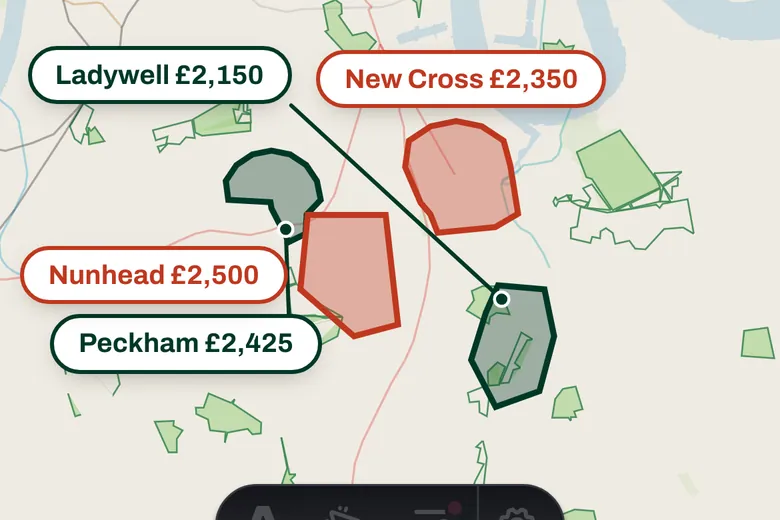
The map shows four south-east London areas where a typical 2-bed asks between £2,150 and £2,500, so three months of rent is £6,450 to £7,500. The map link opens on a £2,200 budget and a 35-minute total journey time to Bank; set your current rent and your workplace to see which areas ask no more. The sum that counts is your own rent. Asking rents are what adverts list, not what tenants pay, and nothing here says whether your notice is valid. The renters' rights guide has the full list of what changed on 1 May 2026, including the dates still to come for the landlord register.
What else do people ask?
What happened to section 21 notices served before 1 May 2026?
One stayed valid only if the landlord asked the court for possession by the earlier of six months after the notice and three months after 1 May 2026. A claim started in time carries on until the case ends (Renters' Rights Act 2025, Schedule 6). That three-month limit also caps an old notice that named a later date: the window is the earlier of four months from the named date and three months from 1 May 2026. So the window for starting a claim on any old notice closed at the end of July 2026.
Is no-fault eviction banned in England? Is section 21 abolished?
Yes. Section 21 was the no-fault eviction notice, and since 1 May 2026 a landlord cannot serve one, even if the tenancy agreement says they can. They must use a section 8 notice that names a legal ground, and go to court if the tenant stays.
How long is the notice for a section 8 eviction?
It depends on the ground: four months for the sale, moving-in and student-let grounds, two months for a few others, four weeks for rent arrears grounds, two weeks for breaches such as damage, and for the anti-social behaviour grounds, 7A and 14, a notice that can name a date as early as the day it is served. GOV.UK summarises this as usually at least two months and up to four. If a notice names several grounds, the longest period applies.
Do I have to leave when I get a section 8 notice?
No. A notice only starts the process. After the notice period the landlord can apply to court, and a landlord cannot remove you by force. GOV.UK says illegal eviction is a criminal offence.
Can a landlord sell the home or move in?
Yes, on Ground 1 (the landlord or a close family member moving in) or Ground 1A (selling), with four months' notice. Both need the tenancy to have begun at least a year before the date named in the notice; a landlord can serve the notice sooner, but cannot name an earlier date.
How much rent has to be unpaid for Ground 8?
At least three months' rent for monthly rent, or thirteen weeks for weekly or fortnightly rent, both when the notice is given and at the court hearing. On a £2,200 rent that is £6,600; the test is your own rent, not a London figure. If you claim Universal Credit and the rent is unpaid only because your housing payment has not yet arrived, that sum is not counted.
How did we work this out?
The figures, their dates and sources
Rules were read again on 10/11/2026 on legislation.gov.uk (Housing Act 1988 section 8 and Schedule 2 as amended by the Renters' Rights Act 2025; the Act's Schedule 6; the Commencement No. 2 Regulations, SI 2026/421, regulations 5 and 6) and on GOV.UK (the tenant overview, updated 01/05/2026, and the tenant and landlord pages on ending an assured periodic tenancy, which also give the Ground 4A conditions). Legislation.gov.uk marks section 8(4AA), the Ground 8 change and the other possession changes as in force from 1 May 2026 "for specified purposes". Regulation 2 of SI 2026/421 says what that means: they came into force "for the purposes of assured tenancies that are not social housing assured tenancies only", which includes private lets, and this guide does not cover the social housing ones. Section 8(4) now says a notice naming either or both of Grounds 7A and 14 cannot give a date earlier than the day it is served (the words "either or both of Grounds 7A and 14" are marked as substituted from 1 May 2026 for specified purposes, and section 8(3A), the old separate rule for Ground 7A, as omitted for the same purposes). Grounds 1 and 1A are worded in Schedule 2 as the tenancy having "began at least 1 year before the relevant date", and Schedule 2 defines the relevant date as the date specified in the notice, so a notice may be served earlier but cannot name a date inside the first year. GOV.UK's pages summarise the notice as "usually at least 2 months, but up to 4"; the per-ground periods in the table are from section 8(4AA) itself, which gives four weeks for the arrears grounds 8, 10 and 11 and two weeks for grounds 12, 13, 15 and 17. We list the grounds a private landlord or tenant most often meets, not all of Schedule 2.
The arrears sums use Citycomb's typical asking rents for a 2-bed (Mid finish) from October 2026 listings. The map compares four south-east London areas on the same rents: Ladywell £2,150 (16 listings), Peckham £2,425 (16), New Cross £2,350 (50) and Nunhead £2,500 (14). £2,200 a month is the median across areas and also Leyton's typical rent, from 28 listings. A zone figure is three times the middle area's typical 2-bed rent among the areas whose nearest station within 2.5 km is in that zone (37 areas in Zone 1, 103 in Zone 2, 89 in Zone 3, 98 in Zone 4, 85 in Zone 5 and 66 in Zone 6). A single listing can move the figures for the areas resting on 14 to 16 listings. Schedule 2, Ground 8, says "if rent is payable monthly, at least three months’ rent is unpaid" and, for weekly or fortnightly rent, at least thirteen weeks, both at the date the notice is served and at the date of the hearing. We could not confirm the quarterly and yearly rules, which legislation.gov.uk marks as omitted from 1 May 2026. The Leyton notice is an example, not a real case; the notice period is counted from the day it is given by hand, and the calculator uses the same four weeks, from 18 January 2027 to Monday 15 February 2027. The count of areas where three months of rent tops £7,000 (a typical 2-bed above £2,333 a month) is about 200 areas, "about" because one rent record does not map to an area. Ground 4A is from Schedule 2 and the two GOV.UK pages: the conditions and the 4 months, with 2 months only for a tenancy that began before 1 May 2026 and a notice served between 1 May and 30 July 2026.
Where do these figures come from?
- legislation.gov.uk: Housing Act 1988, section 8 as amended (notice of proceedings; notice periods in s.8(4AA)), 10 November 2026
- legislation.gov.uk: Housing Act 1988, Schedule 2 as amended (grounds for possession), 10 November 2026
- legislation.gov.uk: Renters' Rights Act 2025, Schedule 6 (existing tenancies; section 21 notices given before commencement), 10 November 2026
- legislation.gov.uk: SI 2026/421, regulations 5 and 6 (Ground 1A and legacy tenancies; Ground 4A notice period), 10 November 2026
- GOV.UK: Renters' Rights Act overview for tenants (updated 01/05/2026), 10 November 2026
- GOV.UK: Assured periodic tenancies, a guide for tenants: if your landlord wants to end your tenancy, 10 November 2026
- GOV.UK: Assured periodic tenancies, a guide for landlords: ending a tenancy, 10 November 2026
- GOV.UK: Assured periodic tenancies, a guide for tenants: how to end your tenancy, 10 November 2026
- Citycomb area data, October 2026: typical 2-bed rents across London's areas, 10 November 2026