Guide
Renting with pets in England: how to ask your landlord for a pet
Checked 9 November 2026England onlyRules read 9 November 2026Rents: October 2026 asking rentsHow we worked it out
A tenant in England can ask in writing to keep a pet, and since 1 May 2026 the landlord must answer in writing within 28 days. Refusal needs a reasonable reason, and a pet deposit on top of the normal deposit is not a permitted payment.
Written for: A London renter who wants to keep a pet, or a landlord who has been asked, in England.
28 daysthe landlord has to give or refuse consent in writing
In short
Send the request in writing, describe the pet and date it.
The landlord must give or refuse consent in writing within 28 days, and can say no only for a reasonable reason. If nothing arrives by day 29, complain in writing.
This guide is for England and for assured tenancies, which covers almost every private tenancy outside social housing. The right came into force on 1 May 2026, and we found nothing in it waiting for a later date. It is general information, not legal advice; for your case, Shelter, Citizens Advice or a solicitor.
1For tenants
If you already share your home with an animal, or are about to, the first step is a short email, not a conversation on the doorstep.
Send the request in writing, describe the pet and keep the date, because the 28 days run from the date of the request. The right covers any pet and the 28 days are the same for a cat, a dog or a rabbit; the dog guide adds parks and Tube rules for dogs.
Request to copy. Change the details: "I would like to keep a cat at [address]. She is a neutered adult cat, and she would live in the home. Please give or refuse consent in writing within 28 days of the date of this request, 1 December 2026. I can give more information about her if you need it."
Take a tenant in Leyton on a £2,200 a month 2-bed who sends that on Tuesday 1 December 2026. The answer is due by Tuesday 29 December 2026.
If nothing arrives by day 29:
- Write a short complaint to the landlord or letting agent, quoting the date of your request. GOV.UK points tenants to that first.
- If it is still unanswered, or the reason looks unreasonable, Shelter or Citizens Advice can say how a court order under section 16B(5) applies to your tenancy.
- Keep the request, the date it was sent and every reply.
Three more points:
- Once consent is given the landlord cannot take it back, and each further pet needs a new request.
- If your landlord asks about the pet, answer quickly, because the extra 7 days run from your answer.
- If you keep a pet without permission, GOV.UK says you may be breaking the terms of your tenancy agreement.
2The 28-day clock
The landlord gives or refuses consent in writing by the 28th day after the date of the request.
They get more time in two cases, and where both apply the latest date counts:
- They reasonably ask about the pet within the 28 days: 7 days after you answer.
- They need a superior landlord's consent: 7 days after that answer.
The 7 days only matter when they end after day 28.
A request sent on 1 December needs an answer by 29 December, or 3 January if a question is answered on 27 December.
A pet request sent on 1 December 2026 needs a written answer by 29 December, or by 3 January if a question is answered on 27 December
| Request sentin writing, describing the pet | 1 Dec 2026 |
|---|---|
| Answer duethe 28th day after the request | 29 Dec 2026 |
| You answer a question on 12 Dec7 days from 12 Dec is 19 Dec, so day 28 still counts | 29 Dec 2026 |
| You answer a question on 27 Dec7 days from 27 Dec is later than day 28 | 3 Jan 2027 |
All of this applies to assured tenancies except social housing (s.16A(6)), and it has been in force since 1 May 2026 (SI 2026/421 regulation 2(a)).


3What a landlord can still do
A landlord can still say no, when the reason is reasonable.
Consent is "not to be unreasonably refused", and section 16B(4) gives two examples of reasons that count as reasonable:
- keeping the pet would put the landlord in breach of an agreement with a superior landlord
- a head lease bars pets and the landlord took reasonable steps to get consent, but the superior landlord has not given it
GOV.UK's tenant guide adds examples. A refusal may be reasonable if:
- someone you live with has an allergy
- the home is too small for a large pet or several pets
- a freeholder bars pets
- the pet is illegal to own
It would usually be unreasonable if the landlord:
- simply dislikes pets, or has had problems with earlier tenants' pets
- worries about future damage, or thinks a pet will make the home harder to let
- knows you need an assistance animal such as a guide dog
GOV.UK says a landlord should give a reason if they refuse.
4Can a landlord charge a pet deposit or extra rent?
A separate pet deposit or pet fee is not on the list of permitted payments in the Tenant Fees Act 2019, Schedule 1, and a deposit held against pet damage sits inside the normal cap.
The cap on the whole deposit is five weeks' rent when the annual rent is under £50,000, and six weeks from £50,000, a rent of £4,167 a month or more (4% of London areas). Take Leyton's £2,200 a month: a week's rent is £507.69 and the whole deposit can be £2,538, pet or no pet.
What is the most deposit a landlord can ask for?
A worked example for £2,200 a month. Turn on JavaScript to type your own.
The Tenant Fees Act 2019 caps a tenancy deposit at 5 weeks' rent, or 6 weeks when the rent is £50,000 a year or more, and a holding deposit at 1 week's rent. One week is the annual rent divided by 52.
GOV.UK says a landlord can take the cost of pet damage from your deposit, and may claim on your pet insurance if you have it, but cannot claim twice for the same damage. It does not make insurance a condition of consent, and neither it nor the sections mention extra rent for a pet. Rent in an existing tenancy can rise only through a section 13 notice.
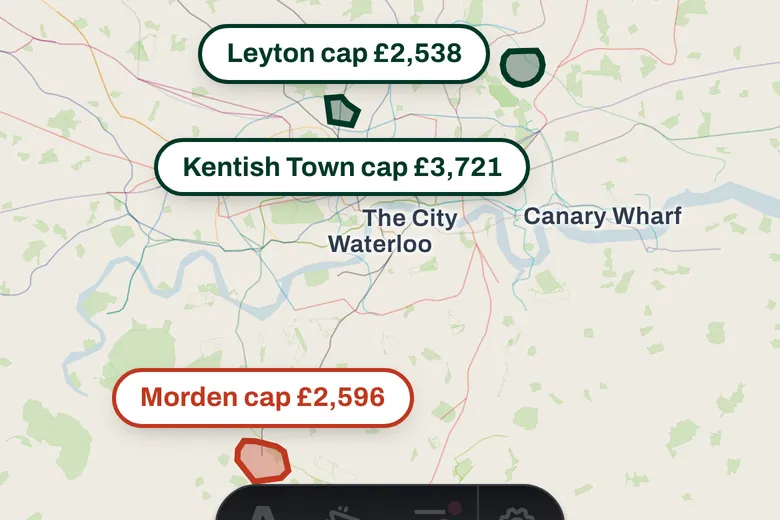
The cap is £2,538 in Leyton and £3,721 in Kentish Town, pet or no pet.
The whole-deposit cap on a typical 2-bed is £2,538 in Leyton, £2,596 in Morden and £3,721 in Kentish Town, pet or no pet
Citycomb does not know which listings accept pets, so ask each agent before you view and before any holding deposit. It does know two things a pet owner plans around, the deposit you need ready and the nearest big park. In 67% of London areas the nearest big park on the area page is a 10-minute walk or less, and that includes 99 of the 156 areas where a typical 2-bed asks £2,000 or less.
| Area | Typical 2-bed, whole-deposit cap | Nearest big park |
|---|---|---|
| Kenley | £1,625, cap £1,875 | Riddlesdown, 2 min |
| Chadwell Heath | £1,725, cap £1,990 | St Chad's Park, 6 min |
| Thornton Heath | £1,800, cap £2,077 | Grangewood Park, 7 min |
| Hornchurch | £1,825, cap £2,106 | Harrow Lodge Park, 6 min |
| Leyton | £2,200, cap £2,538 | Leyton Jubilee Park, 7 min |
The first four are among the 20 cheapest areas with 11 or more listings for a 2-bed; Leyton is this page's example. Every rent here rests on 12 or more listings.
To shortlist for your own case, open the map on 2-beds, set your monthly budget and a 45-minute total journey time to Bank, then open each area that is left and check its nearest big park.
5For landlords
You can refuse a pet request only on a reasonable ground, and your answer has to be in writing.
The deadlines and the law behind each:
| Step | Your deadline | Law |
|---|---|---|
| The tenant asks in writing and describes the pet | Any time from 1 May 2026 | Housing Act 1988 s.16B(3) |
| You give or refuse consent in writing | The 28th day after the request | s.16A(1) |
| You reasonably ask about the pet, or need your own landlord's consent | The later of day 28 and 7 days after the tenant's answer or that consent | s.16A(2), (3) and (5) |
| You and the tenant agree another date | The agreed date | s.16A(4) |
| You do not comply | A court can order you to | s.16B(5) |
For example, a request dated 1 December 2026 is due by 29 December. A question the tenant answers on 27 December moves it to 3 January 2027.
- Do not add a pet fee or a pet deposit. Neither is among the permitted payments in the Tenant Fees Act 2019, Schedule 1, and the whole deposit stays within five weeks' rent, or six weeks from £50,000 a year.
- Do not claim twice for the same pet damage, from the deposit and from the tenant's pet insurance.
- The sections we read do not set out what happens if you stay silent, beyond a court being able to order you to comply (section 16B(5)), so ask Shelter, Citizens Advice or a solicitor before you rely on silence.
What else do people ask?
Can a landlord in England refuse a pet?
Yes, but only for a reason that is reasonable. The landlord has to give or refuse consent in writing within 28 days of your request, and GOV.UK says they should explain a refusal.
How long does a landlord have to answer a pet request?
28 days from the date of the request. If the landlord reasonably asks about the pet, or needs a superior landlord's consent, the deadline becomes 7 days after your answer or their reply if that is later than day 28.
What counts as a reasonable reason to refuse, and what does not?
Section 16B(4) gives two examples: keeping the pet would put the landlord in breach of an agreement with a superior landlord, or a head lease bars pets and the landlord took reasonable steps to get consent but the superior landlord has not given it. GOV.UK adds an allergy in the home, a home too small for a large pet or several pets, a freeholder who bars pets, and a pet that is illegal to own. It says refusal is usually unreasonable if the landlord simply dislikes pets, has had problems with earlier tenants' pets, worries about future damage, thinks a pet will make the home harder to let, or knows you need an assistance animal such as a guide dog.
What if I already have a pet?
GOV.UK says that if you keep or get a pet without permission you may be breaking the terms of your tenancy agreement. Ask in writing, as above, and keep the date of the request.
Does the request have to be in writing?
Yes, and it must describe the pet: what type of animal it is, how big, and how much room it will need. Date it, because the 28 days run from the date of the request.
Can a landlord charge a pet deposit or a pet fee?
A separate pet deposit or pet fee is not on the list of permitted payments in the Tenant Fees Act 2019, Schedule 1. A deposit held against pet damage is a tenancy deposit, so the whole deposit stays within five weeks' rent, or six weeks when the annual rent is £50,000 or more. On Leyton's typical £2,200 a month that is £2,538.
Can a landlord ask for extra rent because of a pet?
The sections we read and GOV.UK's pet guidance do not mention extra rent, so we cannot say it is allowed or banned. What is clear is that rent in an existing tenancy can rise only by a section 13 notice, or an agreement that follows one, once a year (see the section 13 guide).
Can a landlord require pet insurance?
GOV.UK's pet guidance does not make insurance a condition of consent; it says only that a landlord may claim on your pet insurance if you have it, and cannot claim twice for the same damage, from the insurance and the deposit. The sections do not mention insurance either.
What can I do if my landlord ignores or unreasonably refuses my request?
GOV.UK says to complain to your landlord or letting agent if there is no reply within 28 days, or if the reason for refusing looks unreasonable. Section 16B(5) says the court can order a landlord to comply with the tenancy term. For your own case, contact Shelter or Citizens Advice.
How did we work this out?
The figures, their dates and sources
The rule. Read on 09/11/2026 on legislation.gov.uk (Renters' Rights Act 2025, section 11, which inserts sections 16A and 16B into the Housing Act 1988; SI 2026/421, regulation 2; Tenant Fees Act 2019, Schedule 1) and GOV.UK (the Renters' Rights Act overview for tenants, updated 01/05/2026; the Tenant Fees Act guidance for tenants, updated 07/07/2026; the tenants' guide "If you want a pet to live with you"). Section 16A applies to every assured tenancy other than social housing (section 16A(6)) and was inserted from 1 May 2026 (regulation 2(a)). The deadline. Section 16A(1) gives 28 days from the request. Section 16A(2) lets the landlord wait until the 7th day after the tenant supplies information the landlord reasonably asked for within the 28 days, section 16A(3) until the 7th day after a superior landlord's answer, and section 16A(5) says that where more than one applies the latest date counts. GOV.UK puts it as the rest of the 28 days or an extra 7 days, "whichever is later", so a question answered on day 12 changes nothing and one answered on day 26 moves the deadline to day 33. The sections do not say what happens if a landlord never replies beyond the court's power in section 16B(5); GOV.UK only says to complain. What GOV.UK adds. The examples of reasonable and unreasonable refusal, the point about assistance animals (section 16B does not mention them), the damage, deposit and insurance points and the advice to complain are from the tenants' guide. Neither it nor the sections mention extra rent or insurance as a condition of consent. The sums. Citycomb's typical asking rents for a 2-bed (Mid finish) from October 2026 listings, in areas with at least 2 listings for a 2-bed . Leyton is £2,200 from 28 listings. A week's rent is the monthly rent times 12, divided by 52, so £507.69 at £2,200, and five weeks is £2,538.46. The cap is five weeks under £50,000 a year and six weeks from £50,000 (a rent of £4,167 a month or more), under Tenant Fees Act 2019, Schedule 1 and GOV.UK's guidance. Across the areas the whole-deposit cap on a typical 2-bed is over £3,000 in 146 and £2,500 or less in 212, and 20 areas have a typical 2-bed rent of £4,167 a month or more, where the six-week cap applies. The deposit calculator opens on the Leyton rent of £2,200 and shows the cap to the whole pound. Morden rests on 21 listings, Queen's Park on 23 and Kentish Town on 27. The Leyton request is an example, not a figure from any source. Reading a deposit held against pet damage as a tenancy deposit inside the cap is ours (Schedule 1, paragraph 2). The park figures: each area page prints its nearest big park and the walk to it (public/data/v1/areas/<slug>.json, green_space.walk_min). Across the areas with a 2-bed rent, 311 have a walk of 10 minutes or less, and 99 of the 156 areas with a typical 2-bed of £2,000 or less do; 14 areas have no figure. The table shows four of the 20 cheapest areas with 11 or more listings (Kenley 12, Chadwell Heath 27, Thornton Heath 20, Hornchurch 25), each with a park of 7 minutes or less, and Leyton (28). Caps: rent x 12 / 52 x 5, to the nearest pound (Kenley £1,875, Chadwell Heath £1,990, Thornton Heath £2,077, Hornchurch £2,106, Leyton £2,538). The Peckham caption uses £2,425 from 16 listings, a cap of £2,798. The 29 December 2026 answer date and the 3 January 2027 extension are date arithmetic on the example request.
Where do these figures come from?
- legislation.gov.uk: Renters' Rights Act 2025, section 11 (right to request permission to keep a pet; inserts Housing Act 1988 sections 16A and 16B), 9 November 2026
- legislation.gov.uk: Housing Act 1988, section 16A (consent to keep a pet, as inserted), 9 November 2026
- legislation.gov.uk: Housing Act 1988, section 16B (consent to keep a pet, as inserted), 9 November 2026
- legislation.gov.uk: SI 2026/421, Commencement No. 2 Regulations (regulation 2 in force 01/05/2026), 9 November 2026
- legislation.gov.uk: Tenant Fees Act 2019, Schedule 1 (permitted payments), 9 November 2026
- GOV.UK: Renters' Rights Act overview for tenants (updated 01/05/2026), 9 November 2026
- GOV.UK: Tenant Fees Act 2019, guidance for tenants (updated 07/07/2026), 9 November 2026
- GOV.UK: If you want a pet to live with you (guide for tenants on assured periodic tenancies), 9 November 2026
- GOV.UK: If a tenant wants a pet to live with them (guidance for landlords and letting agents), 9 November 2026
- Citycomb area data, October 2026: typical 2-bed rents (Mid finish) for London areas with at least 2 listings, 9 November 2026