Guide
Rental bidding ban in England: what it bans and what to do
Checked 9 November 2026England onlyRules read 9 November 2026Rents: October 2026 asking rentsHow we worked it out
Since 1 May 2026 a written advert in England must state one specific rent, and landlords and agents must not invite, encourage or accept offers above it, even a tenant's own. A council can fine a breach up to £7,000 for each penalty, and a tenant cannot be fined for offering more.
Written for: A London renter who has been asked to offer above the advertised rent, or a landlord or agent who wants to stay within the rules, in England.

156 areasof 462 where a £100 a month bid is 5% or more of a typical 2-bed rent
In short
If you are asked to go higher, say no in writing, keep the message and report it to the council.
The landlord or agent cannot accept an offer above the advert, and you cannot be fined for making one; a council can fine the landlord or agent up to £7,000 for each penalty.
This guide is for England and for assured tenancies, which covers almost every private let. The ban began on 1 May 2026, and we found nothing in it waiting for a later date. It is general information, not legal advice; for your case, Shelter, Citizens Advice or a solicitor.
1For tenants
Picture the viewing on a Saturday afternoon: the agent says there are other offers and asks whether you want to go higher.
You do not have to answer, and the landlord or agent cannot accept more than the advertised rent, so a bid does not buy you the flat. Screenshot the message first, with its date.
Reply to copy. Change the figures: "Thanks for letting me know. I'm happy to take the home at the advertised rent of £2,700 a month and I'm not able to offer more. Under section 56 of the Renters' Rights Act 2025 a rent above the advertised rent can't be asked for or accepted. Please confirm in writing that the rent is £2,700 a month, and what the next step is."
What a landlord or agent cannot do, in an advert, a message or at a viewing:
- advertise without a rent, or give a price range or an "offers over" figure instead of one specific amount
- ask or encourage you to pay more than the advertised rent
- tell you there are other bids, to push your offer up, or act in any way that leads you to believe you need to offer more
- accept an offer above the advertised rent, even one you volunteered
GOV.UK names price ranges; barring "offers over" is our reading of section 56(2), which requires one specific amount.
An agent is bound by the same rule as the landlord, because section 56 covers anyone acting for them. The ban is not limited to writing, so it covers what is said at a viewing as well as what is typed. Then:
- Ask for the rent in writing and check it matches the advert. Keep screenshots of the advert and the messages, with the dates.
- Report a breach to your local council, with the address, the advert and the messages. If you already bid after being encouraged, or the landlord accepted a bid, you can still report it. The council may ask for a statement or the tenancy agreement, and it decides whether to fine.
- If you are asked to pay rent before you sign, that is a separate rule: see the holding deposit guide for what can be taken and when.
2What a bid costs
Take a 2-bed in Stoke Newington advertised on Friday 13 November 2026 at £2,700 a month, the area's typical 2-bed rent from 16 listings.
After the viewing on Saturday 14 November, the agent writes that others have offered £2,800 and asks whether the tenant wants to go higher. That is an invitation to offer above the advertised rent, and it is now barred. The calculator opens on these figures; the £2,800 is an example, not a real offer.
How much more is that bid?
£100more a month than the advertised rent, £1,200 more a year
A worked example: £2,800 offered against £2,700 advertised. Turn on JavaScript to type your own.
The rule covers lets that would be assured tenancies in England; social housing and supported accommodation are left out (Renters' Rights Act 2025, section 56). It is about what a landlord or agent may invite or accept, so it does not stop you from offering the advertised rent.
The same £100 weighs differently depending on where the home is. It is 5% or more of the typical 2-bed rent in 34% of London areas with a figure, and 3% or less in 55. A bid of 5% is £100 on Barking's £2,000 and £426 on Mayfair's £8,525.
| Area | Listings | Typical 2-bed asking rent | £100 more is |
|---|---|---|---|
| Barking | 71 | £2,000 | 5.0% |
| Leyton | 28 | £2,200 | 4.5% |
| Peckham | 16 | £2,425 | 4.1% |
| Stoke Newington | 16 | £2,700 | 3.7% |
| London Fields | 35 | £3,125 | 3.2% |
| Waterloo | 32 | £3,675 | 2.7% |
| Notting Hill | 74 | £4,075 | 2.5% |
| Mayfair | 116 | £8,525 | 1.2% |
If an advert sits far above its area's typical rent, ask why in writing, because the advertised figure is the one the landlord is held to. Open the map on 2-beds, click the area of the advert and read its typical asking rent before you book a viewing.
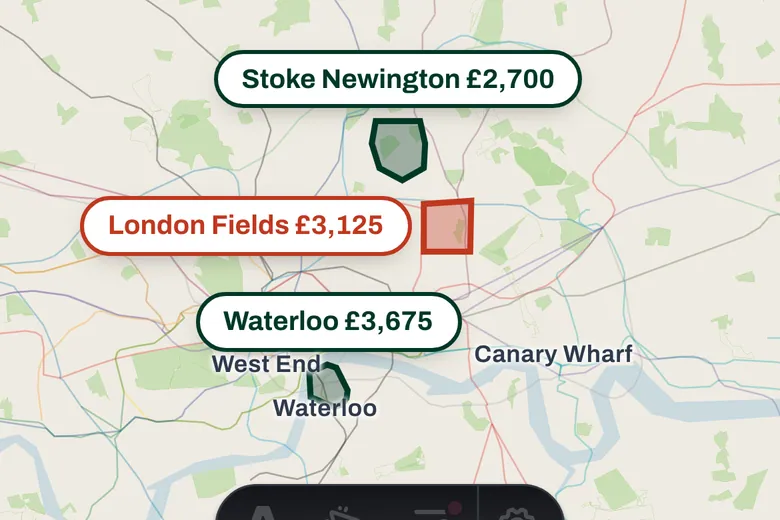
A £100 a month bid is 3.7% of a typical 2-bed rent in Stoke Newington and 2.7% in Waterloo.
A typical 2-bed asks £2,700 in Stoke Newington, £3,125 in London Fields and £3,675 in Waterloo
3For landlords and agents
The advert is the price.
Put one specific figure in every written advert and offer, and decline a higher offer even if the tenant volunteers it.
An advert or offer must state the rent as one specific amount. A landlord or agent must not:
- publish a range, or an "offers over" figure, and ask for bids within or above it
- invite or encourage offers above the stated rent, in writing, in a message or out loud
- tell applicants that others have bid, or act in any way that leads them to believe they need to offer more
- accept an offer above it, even a tenant's own
If several people apply, you can still choose between them on other grounds, such as references and move-in date; the ban is on price, and declining a higher offer is not bidding. If the price in the advert is wrong, change the advert instead of asking for offers. A sign at the property that only says it is to let is not a written advert and needs no figure (section 56(5)).
A council can fine a breach, and the cap applies to each penalty, not to a total. It can add a further penalty where it has already penalised you for a breach of the same subsection of section 56 in the past five years. It can also penalise a landlord and agent jointly for the same conduct. A rent rise in an existing tenancy is a separate process: see the section 13 guide.
4The rules and when they started
Every rule below applies from 1 May 2026: section 56 came into force then under SI 2026/421 regulation 3(c), and section 57 came into force for specified purposes at Royal Assent and in full on 1 May 2026.
We found no part of the bidding rules announced but not yet in force.
| Rule | Who it binds |
|---|---|
| A written advert or offer must state the rent as a specific amount (s.56(2)) | The landlord, and anyone acting for them |
| Invite or encourage offers above it, or accept them (s.56(3)): barred | The landlord, and anyone acting or claiming to act for them |
| A council can impose a penalty of up to £7,000, on the balance of probabilities (s.57) | The council, not a court, decides |
| An additional penalty is possible after a previous penalty for the same subsection within five years; each penalty has the same cap (s.57(2) and (3)) | The council, against the same person |
A sign at the property that only says it is to let is not a written advert (s.56(5)). The ban covers assured tenancies and leaves out social housing and supported accommodation.

What else do people ask?
Is rental bidding banned in England?
Yes. Since 1 May 2026 a written advert or offer must state a specific rent, and landlords and agents must not invite, encourage or accept offers above it (Renters' Rights Act 2025, section 56).
Can a tenant offer more than the advertised rent?
You can say what you like and you cannot be fined for it, but the landlord or agent must not accept an offer above the stated rent, even one you volunteer. The ban sits on the landlord and the people acting for them, so the one who says yes is in breach.
Are 'offers over', a guide price or a price range allowed?
No. An advert must state a specific amount, and GOV.UK says a price range is not allowed and that a landlord or agent cannot publish a range and ask for bids within it. On our reading 'Offers over £2,700' breaks the one-specific-amount rule in section 56(2) and invites offers above the figure, which section 56(3) bars.
Can an agent say there are other offers on the home?
Not to push your offer up. GOV.UK lists saying there are other bids, to encourage you to pay more, as bidding, and so is acting in any way that leads you to believe you need to offer more.
What is the fine for rental bidding?
A local council can impose a financial penalty of up to £7,000 under section 57. That cap applies to each penalty, and a council can add a further penalty where it has penalised the same person for the same subsection of section 56 in the previous five years.
Does the ban cover agents, and a message, a call or a viewing?
Yes to both. Section 56 binds the landlord and anyone acting, or claiming to act, for them, directly or indirectly, such as a letting agent, and a council can penalise a landlord and agent jointly for the same conduct. The duty to state the rent applies to written adverts and written offers, and GOV.UK's guide for councils counts social media and digital messages as written. The ban on inviting, encouraging or accepting a higher offer in section 56(3) is not limited to writing, so it covers a phone call or a viewing too.
Does the ban apply to every rental home?
It applies to assured tenancies, which is almost every private tenancy in England. Social housing and supported accommodation are not covered, and this guide does not cover Scotland or Wales.
Does the ban cover an advert posted before 1 May 2026?
The sources we read do not say. Section 56 has been in force since 1 May 2026 and covers an advert or offer a landlord or agent makes while it applies, so the safe course is to give any advert still live a single specific rent. If you are unsure about your case, ask your council or Shelter.
Who do I tell if I am asked to bid?
Your local council. GOV.UK says you can report a landlord or agent who encouraged rental bidding, accepted a higher bid, or advertised without stating the rent, and you can still report if you bid after being encouraged or the landlord accepted a bid. The council may ask for the advert, the messages, a statement or the tenancy agreement.
How did we work this out?
The figures, their dates and sources
The rule. Read on 09/11/2026 on legislation.gov.uk (Renters' Rights Act 2025, sections 56 and 57; SI 2026/421, regulation 3) and GOV.UK (the tenants' guide on rental bidding, which has no date on the page; the Renters' Rights Act overview for tenants, updated 01/05/2026; MHCLG's "Rental bidding: a guide for local authorities and councils", published 13/11/2025). Section 56 came into force on 1 May 2026 under regulation 3(c); section 57 came into force at Royal Assent for specified purposes and in full on 1 May 2026. Section 56(2) requires a written advert or written offer to state a specific rent. GOV.UK's tenant guide says a price range is not allowed, that a landlord or agent cannot say there are other bids to push your offer up or act in any way that leads you to believe you need to offer more, and that you can still report to the council if you bid after being encouraged or the landlord accepted a bid. The council guide says a higher offer a tenant volunteers still cannot be accepted, that declining one is not bidding, that social media and digital messages count as written, and that tenants cannot be found liable.
The fine. Section 57(3) caps each penalty at £7,000, so £7,000 is a limit for each penalty and not a total. Section 57(2)(b) allows an additional penalty where a previous penalty was imposed on the same person within the five years before it for the same subsection of section 56, and section 57(5) lets a council penalise a landlord and agent jointly for the same conduct. Section 57 does not say whether a council fines per advert or per conversation. Two points are our reading of section 56, not GOV.UK's words: that nothing in it stops a landlord choosing between applicants who all pay the advertised rent (it says nothing about other grounds), and that an "offers over" figure is barred (GOV.UK names price ranges; "offers over" breaks section 56(2), one specific amount, and invites offers above it under section 56(3)).
The rents. Citycomb's typical asking rents for a 2-bed (Mid finish) from October 2026 listings, in areas with at least 2 listings for a 2-bed (median £2,225). The table shows areas with 16 or more listings, and the listing count sits beside each rent. A £100 bid is 5% or more of the typical 2-bed rent in 34% of London areas (a rent of £2,000 or less) and 3% or less in 55 (a rent above £3,333). The viewing, the £2,800 offer and the dates are an example, not a real case.
Where do these figures come from?
- legislation.gov.uk: Renters' Rights Act 2025, section 56 (requirement to state rent and to avoid rental bidding), 9 November 2026
- legislation.gov.uk: Renters' Rights Act 2025, section 57 (financial penalties), 9 November 2026
- legislation.gov.uk: SI 2026/421, Commencement No. 2 Regulations (regulation 3 in force 01/05/2026), 9 November 2026
- GOV.UK: Assured periodic tenancies, guide for tenants: rental bidding, 9 November 2026
- GOV.UK: Rental bidding, a guide for local authorities and councils (published 13/11/2025), 9 November 2026
- GOV.UK: Renters' Rights Act overview for tenants (updated 01/05/2026), 9 November 2026
- Citycomb area data, October 2026: typical 2-bed rents for London areas, 9 November 2026