Guide
How to give notice to your landlord in England (2026)
Checked 9 November 2026England onlyRules read 9 November 2026Rents: October 2026 asking rentsHow we worked it out
A tenant on an assured tenancy in England gives written notice of the length in the agreement, and a landlord cannot require more than two months. It must end on a rent day or the day before, so the rent day decides the end date.
Written for: A London renter on an assured tenancy who wants to leave, or a landlord who has just received a notice, in England.
26 dayspast two months for a notice sent on 7 December 2026 when rent is due on the 6th; it ends on Friday 5 March 2027
In short
Write it down, end it on a rent day or the day before, and count two months from the day you send it.
Two mistakes cost money: signing the next tenancy before your end date is fixed, which can leave you paying two rents, and one joint tenant sending a notice, which usually ends the tenancy for everyone.
The middle of the typical 2-bed rents across 327 London areas is £2,375 a month, about £78 a day, so for a notice sent on 7 December 2026, rent due on the 20th adds 12 days past two months, about £940 in rent.
This guide is for assured tenancies in England and was checked on 9 November 2026. The ending a tenancy guide covers the overlap with a new home and the deposit; this one covers the notice itself, the dates and joint tenancies.
1Sending the notice
It has to be in writing, for example a letter, an email or a text.
A term in your tenancy that binds you to one method has no effect (section 5A of the Protection from Eviction Act 1977, inserted by section 21 of the Renters' Rights Act 2025), and GOV.UK says to keep a copy. We did not trace a rule on when a posted or emailed notice counts as given, so keep the proof of sending and ask the landlord to confirm the date of receipt in writing.
Copy this and fill in the brackets, using the end date from the next section: To [landlord or agent name], [address you send it to]. I give notice to end my tenancy of [full address] on [day, date and year, for example Friday 19 February 2027]. This is the day before my rent day, the [20th]. Signed [every tenant who is signing], [date]. Sent by [post, email or text] on [date].
- Write the end date out in full, with the day, the date and the year.
- Name every tenant on the agreement and the address.
- Keep a copy and the proof of sending.
2Which day it ends
Your tenancy agreement should say how much notice you give.
- past two months for rent due on the 10th, on the same notice
- 2 days
- past two months for rent due on the 20th, the worked example
- 12 days
- past two months for rent due on the 1st
- 21 days
Two months is the most a landlord can require, and the minimum if the agreement says nothing. A shorter notice needs the landlord to agree in writing (Renters' Rights Act 2025, section 20). The table and the calculator assume the full two months.
GOV.UK says the notice must end "on a day when the rent is due or the day before the rent is due" (GOV.UK, how to end your tenancy). Count from the day you send it: Monday 7 December 2026 plus two months is Sunday 7 February 2027, and the first rent day, or day before one, on or after that is your end date. The Act and GOV.UK do not say when a notice counts as given, so send it earlier than the count needs. If your rent is due weekly, use your weekly rent day the same way.
The calculator opens on a tenant sending notice on 7 December 2026 with rent due on the 20th, and shows Friday 19 February 2027. Change the date and the rent day to your own. It counts two months, so if your agreement sets a shorter notice, count that instead; it lists rent days from the 1st to the 28th, so for the 29th to the 31st or a weekly rent, apply the same rule by hand. The other two choices in it are for landlords, and the section 13 guide and section 21 guide explain them.
When does the notice end?
Friday 19 February 2027the earliest day the tenancy can end
A worked example: a tenant giving notice on Monday 7 December 2026, rent due on the 20th. Turn on JavaScript to type your own.
These are the earliest dates the law allows for assured tenancies in England since 1 May 2026, counting from the day the notice is given or served (allow extra days if it goes by post). A tenant's notice must be in writing, and a shorter time than two months counts only if the landlord agreed it in writing. A rent rise goes on Form 4A and a possession notice on Form 3A. Not checked here: the minimum gap since the tenancy began or the last rise (52 weeks, sometimes 53), and, for Ground 1 or 1A, that the tenancy has lasted a year. A possession notice only lets the landlord apply to court, which decides. Rent days from the 29th to the 31st and weekly rents are left out.
The table shows the same count for other rent days. The gap past two months moves with the send date and the length of the months, so 26 days for the 6th is the figure for this send date only, not a maximum for the year:
| Rent day | Notice ends | Days past two months |
|---|---|---|
| 1st | Sunday 28 February 2027 | 21 |
| 6th | Friday 5 March 2027 | 26 |
| 10th | Tuesday 9 February 2027 | 2 |
| 15th | Sunday 14 February 2027 | 7 |
| 20th | Friday 19 February 2027 | 12 |
| 25th | Wednesday 24 February 2027 | 17 |
| 28th | Saturday 27 February 2027 | 20 |
Take a tenant who pays rent on the 20th and sends the notice on Monday 7 December 2026: the two months run to Sunday 7 February, and Friday 19 February 2027, the day before the next rent day, is the last day of the tenancy. If you had paid rent in advance for days after the tenancy ends, the landlord must repay it (Housing Act 1988, section 14ZC).
At the same London rent, the 26 days for the 6th cost about £2,030, rent only and our arithmetic.
When the date runs long, ask the landlord in writing for an earlier end date, and if the landlord names a different one, reply in writing with your date and the rent day it rests on. Keep the proof of sending, and ask Shelter or Citizens Advice before you sign a new tenancy.
Once you have the date, open the map at your own desk and budget to see what your next home costs.
If your tenancy started before 1 May 2026, the answer can differ: see the last row of the table under "The rules by date", and GOV.UK on ending a tenancy that started before 1 May 2026 if your fixed term ended before then.
3Joint tenants and changing your mind
A notice from one or some of the joint tenants is still valid, and it usually ends the tenancy for everyone on the agreement.
A shorter notice period is valid only if the landlord and all the tenants agreed it (section 20).
If you give notice and change your mind, the notice can be withdrawn only if the landlord and you agree in writing, and with joint tenants every tenant has to agree. Ask before you send, particularly in a shared home, because a notice sent in a hurry can end the tenancy for the people who are staying.
4The rules by date
All the rules below are in force.
The three from the Renters' Rights Act began on 1 May 2026 (SI 2026/421), and GOV.UK gives no start date for its own.
| Rule | Status | Source |
|---|---|---|
| Tenant's notice at least the shorter length agreed in writing, otherwise at least two months | In force 1 May 2026, for specified purposes | Renters' Rights Act 2025, section 20; SI 2026/421, regulation 2(a) |
| A term on how to give the notice has no effect; withdrawal needs written agreement | In force 1 May 2026, for specified purposes | Section 21, new section 5A; same regulation |
| Rent for days after the tenancy ends must be repaid | In force 1 May 2026, for specified purposes | Section 10, new section 14ZC; same regulation |
| Notice ends on a rent day or the day before; in writing, by any method | In force; GOV.UK gives no date | GOV.UK, how to end your tenancy |
| Section 21 notices can no longer be served | In force 1 May 2026 | Section 21 guide |
| Tenancy started before 1 May 2026: a notice given before that date still applies, and a notice period already in the agreement, such as one month, can still apply | Separate rules; GOV.UK gives no start date | GOV.UK, ending a tenancy that started before 1 May 2026 |
5For tenants
Pick the day first.
Find your rent day in the calculator and count two months from the day you will send the notice. If the end date falls weeks past the day you need, ask the landlord for an earlier one in writing before you take a new tenancy.
- Send the notice by a method that leaves proof, and keep the copy.
- Do not sign a new tenancy to start before your notice ends unless you can pay both rents: in the worked example, a new tenancy starting on Monday 1 February 2027 would overlap the old one for 19 days, 1 to 19 February. The ending a tenancy guide works through the overlap.
- Ask for the deposit back in writing; the tenancy deposit guide covers what can be taken off.
- If damp or a repair is the reason you are leaving, read the damp and mould guide first.
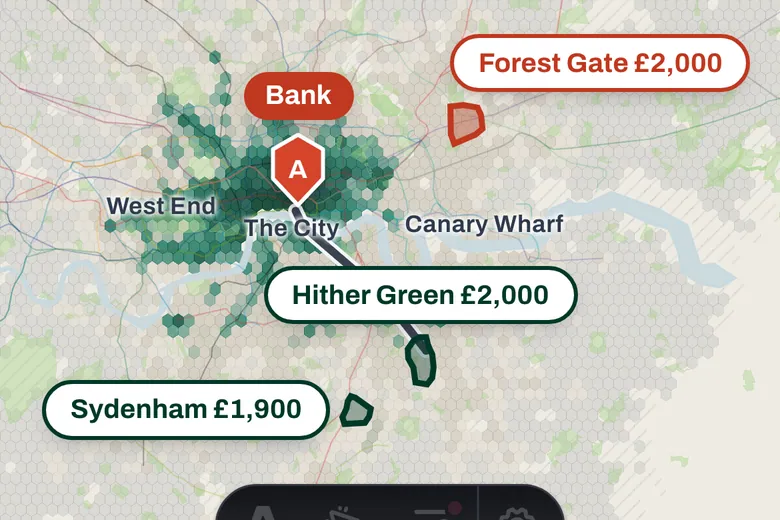
Once you have an end date, the next tenancy should start the day after it: Saturday 20 February 2027 in the worked example. Of the 327 London areas with more than 10 listings for a 2-bed, 77 ask £2,000 a month or less for a typical mid-standard 2-bed, and 10 of those are within 45 minutes total journey time of Bank. Hither Green and Forest Gate ask £2,000 and Sydenham £1,900; Furzedown, in the drawing at the top, asks £2,275. Try this: open the map on 2-beds up to £2,000 within 45 minutes of Bank, click an area to read its rent, and ask its landlord or agent which start date they can offer.
Ten London areas ask £2,000 or less for a 2-bed and are within 45 minutes of Bank.
Three of the 10 London areas where a 2-bed asks £2,000 or less and Bank is within 45 minutes
This is general information, not legal advice. For your own case, ask Shelter, Citizens Advice or a solicitor if you are a tenant, and a solicitor or a landlord association if you are a landlord.

6For landlords
A tenant in England on an assured tenancy can end it with up to two months' notice, and you cannot require more.
- A letter, an email or a text all count; you cannot require one method.
- Reply in writing with the date you take the notice to end.
- A shorter notice needs your written agreement, and from joint tenants all of them.
- A notice from one joint tenant usually ends the tenancy for all, so check who is staying.
- A tenant can withdraw a notice only if you agree in writing.
- Your own notice to a tenant is different: see the section 21 guide and the Renters' Rights Act guide.

What else do people ask?
How much notice does a tenant have to give in England?
The tenancy agreement should say. A landlord can ask for at most two months, and if the agreement says nothing the minimum is two months (Renters' Rights Act 2025, section 20). A shorter notice needs the landlord's agreement in writing.
Which day does the notice end?
On a day when the rent is due, or the day before, GOV.UK says. A tenant who pays on the 10th ends it on the 9th or the 10th of a month, and the first of those at least two months after sending is the date to use. With weekly rent, use your weekly rent day the same way.
Does notice have to be in writing, and how do I send it?
It has to be in writing, for example a letter, an email or a text. A tenancy term that binds you to one method has no effect (section 5A of the Protection from Eviction Act 1977), and GOV.UK says to keep a copy.
When does a posted or emailed notice count as given?
We did not trace a rule on this. Send it earlier than the table needs, keep proof of sending, and ask the landlord to confirm the date they received it in writing.
Can I change my mind after giving notice?
Only if the landlord agrees in writing, and with joint tenants every tenant has to agree too (section 5A). Ask before you send, because a notice cannot simply be withdrawn.
What if there are two or more tenants on the agreement?
A notice from one or some of the joint tenants is still valid, and it usually ends the tenancy for everyone on the agreement. A shorter notice period is valid only if the landlord and all the tenants agreed it.
What if my tenancy started before 1 May 2026?
Any notice you gave before 1 May 2026 still applies, and where your agreement already sets a notice period, for example one month, GOV.UK says it can still apply. A landlord still cannot ask for more than two months.
How did we work this out?
The figures, their dates and sources
Rules were read on 09/11/2026 on legislation.gov.uk and GOV.UK. The tenant's notice is set by section 20 of the Renters' Rights Act 2025, which amends section 5 of the Protection from Eviction Act 1977: the notice must be not less than any length of time the landlord agreed in writing (not more than two months), and not less than two months if nothing was agreed. Section 21 of the Act inserts section 5A: a term binding the tenant on how to give the written notice has no effect, and a notice can be withdrawn only if the landlord and the tenant agree in writing (for joint tenants, all of them). Section 10 inserts section 14ZC into the Housing Act 1988: rent paid for days after the tenancy ends must be repaid. Each is in force from 1 May 2026 "for specified purposes" under regulation 2(a) of SI 2026/421, "The Renters' Rights Act 2025 (Commencement No. 2 and Transitional and Saving Provisions) Regulations 2026". The Housing Act 1988 section 5, as amended, covers how a landlord ends an assured tenancy and not the tenant's notice.
GOV.UK's page "How to end your tenancy", which shows no update date, adds that the notice must end "on a day when the rent is due or the day before the rent is due", that it must be in writing (for example a letter, an email or a text), and that you should keep a copy. GOV.UK gives no start date for each rule, so the dates here come from SI 2026/421 or the dated sources, not from GOV.UK. For a tenancy that started before 1 May 2026, GOV.UK has a separate page, which we read: any notice already given still applies, and where the agreement already sets a notice period, for example one month, that period can still apply. GOV.UK says rent due, so for a tenant whose rent is due every week the same rule applies with the weekly rent day; the table shows monthly rent days only. We did not trace how days are counted or when a posted or emailed notice counts as given, so the table counts two months from the day the notice is sent. It uses Monday 7 December 2026 as an example send date, and assumes two months. The calculator and the table use the same count and agree: rent due on the 20th gives Friday 19 February 2027, and rent due on the 6th gives the longest gap, 26 days, ending Friday 5 March 2027. The gap is not fixed: it depends on the rent day and the month lengths, so the page states no general maximum. If the agreement says less, or the landlord agrees in writing to less, the dates move earlier.
Citycomb rents are typical asking rents for a mid-standard flat (the "Mid" finish) from October 2026 listings. The £2,375 is the median of the 327 areas' typical 2-bed rents, and a day is that figure × 12 ÷ 365 = £78.08, so 12 days is £937 and 26 days £2,030, rent only. The counts use the 327 London areas with more than 10 listings for a 2-bed. Areas with 10 or fewer listings are left out. Of those 327 areas, 77 ask £2,000 or less for a 2-bed, and 10 of the 77 are within 45 minutes total journey time of Bank on a weekday 09:00 arrival. The map card and the three drawings show three of them: Hither Green £2,000 from 18 listings (28 minutes), Forest Gate £2,000 from 22 (36 minutes) and Sydenham £1,900 from 16 (45 minutes). Furzedown, in the top drawing, is not one of the 10: it asks £2,275 from 17 listings.
Where do these figures come from?
- legislation.gov.uk: Renters' Rights Act 2025, section 20 (tenant's notice to quit, amending the Protection from Eviction Act 1977), 9 November 2026
- legislation.gov.uk: Renters' Rights Act 2025, section 21 (new section 5A, notices given by tenants), 9 November 2026
- legislation.gov.uk: Renters' Rights Act 2025, section 10 (new section 14ZC of the Housing Act 1988, rent for days after the tenancy ends), 9 November 2026
- legislation.gov.uk: The Renters' Rights Act 2025 (Commencement No. 2 and Transitional and Saving Provisions) Regulations 2026, SI 2026/421, 9 November 2026
- GOV.UK: How to end your tenancy (assured periodic tenancies, guidance for tenants; no update date shown), 9 November 2026
- GOV.UK: Ending a tenancy that started before 1 May 2026 (no update date shown), 9 November 2026
- Citycomb area data, October 2026: typical 2-bed rents across London's areas, 9 November 2026