Guide
How to spot a bad flat in London
Checked 10 November 2026For England, rules from 1 May 2026Rents: October 2026 asking rentsHow we worked it out
Compare the advert with the area's typical rent: a 2-bed advertised 25% under it is cheaper than a typical plain flat in 314 of 337 London areas, so ask why. Then check the walls, the hot tap and the windows, and ask for the gas safety record, the EPC and the deposit scheme before you pay anything.
314 of 337areas where a 2-bed advertised 25% under the typical rent is below even the typical plain flat
In short
A 2-bed advertised far below the area's typical rent is a reason to ask why before you pay, and so are damp walls, a hot tap that stays cold and missing paperwork.
Cheap can be real, because a landlord may price low for a quick let, so the price is a prompt, not a verdict.
This guide follows a viewing in order: the price test from the advert, what to check inside the flat, the paperwork to ask for, what a landlord can ask you to pay, the signs of a scam, and what to do if you are already in a bad flat. Going to a viewing now? Jump to the checks inside the flat. The flat viewing checklist has the list to carry with you.
1How cheap is too cheap?
From about 15% under the area's typical Mid rent, a 2-bed advert costs less than a typical plain flat in most areas, and that is the point to ask why.
- areas where 5% under the typical rent is below a plain flat
- 35
- areas where 10% under is
- 108
- areas where 20% under is
- 272
A £1,700 advert in Lewisham Town Centre is £575, or 25.3%, under the typical Mid 2-bed rent of £2,275. It is also £325 under the typical Basic rent of £2,025, so it costs less than a plain flat there. Lewisham Town Centre has Lewisham Market daily and Blackheath nearby, so a cheap flat there is worth the visit and the questions.
The tipping point is 13%: in the middle area a plain 2-bed already asks 13% less than an updated one, so an advert more than 13% under Mid is below the typical plain flat there.
A flat in poor repair is cheaper for a reason, and a landlord in a hurry may price low for another: ask which, and leave if the answer does not hold up.
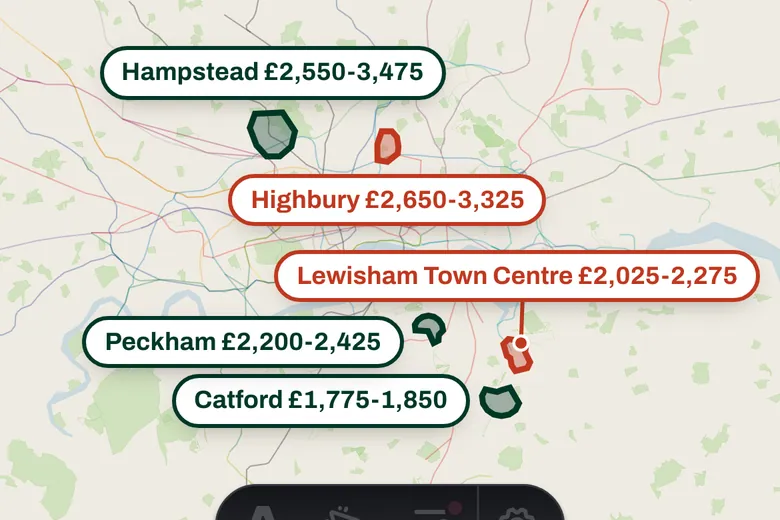
The same test in five areas, 20% under the Mid rent, gives a figure to hold against an advert:
| Area | Basic | Mid | 20% under Mid | Below Basic? |
|---|---|---|---|---|
| Catford | £1,775 | £1,850 | £1,480 | Yes |
| Lewisham Town Centre | £2,025 | £2,275 | £1,820 | Yes |
| Peckham | £2,200 | £2,425 | £1,940 | Yes |
| Highbury | £2,650 | £3,325 | £2,660 | No, by £10 |
| Hampstead | £2,550 | £3,475 | £2,780 | No |
In Highbury and Hampstead the plain flats are already far below the updated ones, so a 20% discount does not trip the test. That is true in 65 of the 337 areas, so check against Basic, not only against Mid.
To run the test on your own advert, enter its area on the Citycomb map or look it up in the rent pages, read the area's Basic, Mid and Premium rents for your number of bedrooms, and compare them with the advert: below Basic is the point to ask why.
In Catford a plain flat is only £75 below an updated one; in Hampstead it is £925.
Five areas where a plain 2-bed costs £75 to £925 less than an updated one
2What should you check inside the flat?
Look for damp and mould, run the hot tap and the heating, and open every window, because GOV.UK makes the landlord responsible for repairing several of these.
GOV.UK's damp and mould guidance (updated 1 April 2026) names three causes: condensation, water getting in "due to defects in the walls, roofs, windows or floors", and moisture rising from the ground. It lists visible mould, a mould smell and water damage as signs, and says a smell without visible mould "may indicate that there is mould behind a surface".
Ten minutes is enough for a first look. Do the first five in this order; GOV.UK makes the landlord responsible for repairing each of these things, or the part of the building they belong to:
| Check | What to do | A bad sign |
|---|---|---|
| Damp and mould | Look at ceiling corners, window frames and behind wardrobes, and smell each room | Visible mould, or a musty smell nobody can explain |
| Windows | Open and close each one, and look at the frames and sills | Water marks, or a window that will not shut |
| Heating and hot water | Run a hot tap, and ask to see the heating come on | A tap that stays cold after a minute: ask the agent about the boiler |
| Sinks, baths and pipes | Run every tap and flush the toilet | A leak, or a tap or drain that will not run |
| Sockets | Try a few, and ask when the wiring was last checked | Nobody can say when: ask for the report |
GOV.UK says the landlord is always responsible for repairing heating and hot water, and windows are part of the structure and exterior it lists. The next five are our own tips, not landlord duties:
| Check | What to do | A bad sign |
|---|---|---|
| Water pressure | Run the shower and a kitchen tap together | The flow collapses |
| Catches and locks | Close each window and the front door | A catch or lock that does not work |
| Pests | Look under the sink and along the skirting boards | Droppings |
| Noise and signal | Stand still for a minute with the windows shut, and check your phone signal in the bedroom | Constant noise, or no signal |
| Boiler and meters | Ask how old the boiler is and where the meters are | Nobody knows |
A fault you find now is cheaper to raise before you sign than after. The damp and mould repairs guide covers what to do if it appears later.
3What paperwork should the landlord show you?
Ask for five documents before you pay anything: the gas safety record, the electrical safety report, the EPC, proof of working alarms and the name of the deposit scheme.
A registered engineer must check each gas appliance and flue every year. The landlord must give a new tenant a copy of the record before they move in, and an existing tenant a copy within 28 days of each check (GOV.UK; regulation 36 of the Gas Safety (Installation and Use) Regulations 1998).
| Ask for | What the rule says | Our view |
|---|---|---|
| Gas safety record | Annual check by a registered engineer; a new tenant gets a copy before moving in | No record is a problem before you have even signed |
| Electrical safety report | At least every 5 years by a qualified person; tenants get proof | Ask the date of the last one |
| EPC | Band E at least, unless exempt; fines up to £5,000 in total | A poor rating means higher bills |
| Alarms | A smoke alarm on each storey with a room used wholly or partly as living accommodation; a carbon monoxide alarm in a room with a fixed combustion appliance other than a gas cooker | Press the test button |
| Deposit scheme | Protected within 30 days in the DPS, MyDeposits or TDS | Ask which scheme and write the name down |
The carbon monoxide rule comes from SI 2022/707, in force since 1 October 2022. GOV.UK's renting page words it more narrowly, as a solid fuel appliance, so we follow the regulation: a boiler is a fixed combustion appliance, so if it is in a room you will live in, ask where the alarm is.
4What can a landlord charge you?
Rent, a refundable deposit and a refundable holding deposit of up to one week's rent: GOV.UK says a landlord cannot charge any payment that is not on its list, which has nothing for referencing, an inventory or check-in.
Take the typical updated 2-bed in Lewisham Town Centre, £2,275 a month, rather than the £1,700 advert. The yearly rent is £27,300, so the deposit is capped at five weeks: a week is £525 and five weeks is £2,625. With the first month's rent the move-in cost is £4,900, and a holding deposit can be at most £525.
Rent and five weeks' deposit come to £4,900, with no fees on top.
A £2,275 2-bed in Lewisham Town Centre costs £4,900 to move in: rent and a five-week deposit
| First month's rent | £2,275 |
|---|---|
| Deposit, five weeks at £525 | £2,625 |
| Fees, referencing, inventorynot allowed | £0 |
| To pay by move-in day | £4,900 |
The calculator opens on the same £2,275 rent and shows the deposit of up to £2,625 and the £525 holding deposit; change the rent to try yours.
What is the most deposit a landlord can ask for?
A worked example for £2,275 a month. Turn on JavaScript to type your own.
The Tenant Fees Act 2019 caps a tenancy deposit at 5 weeks' rent, or 6 weeks when the rent is £50,000 a year or more, and a holding deposit at 1 week's rent. One week is the annual rent divided by 52.
The holding deposit guide and the deposit cap guide have the rules in full, and the penalties for charging more are in the landlord section below.
5What are the signs of a scam?
Which? lists four signs of a rental scam: being asked to pay before you have viewed the flat, photos copied from elsewhere, a price that is too good to be true and a payee name that does not match the landlord or agent.
Which? reports that more than £4.2m was lost to rental fraud in 2023, according to Action Fraud. It adds that rental fraud is one of the five fraud types most reported by people aged between 11 and 29, with average losses of £1,720 per victim (4 September 2024). Which? lists a price that is too good to be true as the third sign, so the price test comes first.
- Never pay before you have been inside. Since 1 May 2026 a landlord also cannot ask for or accept rent before you have signed the tenancy agreement (GOV.UK).
- Search the photos. A reverse image search shows whether the same pictures appear on another advert.
- Match the name. The account holder should be the landlord or the agent you met.
- Ask for the paperwork. A real landlord has the gas safety record to hand.
- Ask which redress scheme the agent belongs to. GOV.UK says a letting agent or property manager in England or Wales must join one, either The Property Ombudsman or the Property Redress Scheme, and can be fined up to £5,000 if not. If an agent cannot name theirs, that is a bad answer.
- Ask whether the home needs a licence. GOV.UK says a large HMO, with at least 5 tenants forming more than one household who share a toilet, bathroom or kitchen, needs a licence from the council, and a smaller shared home may need one depending on the area. You can contact the council to check whether an HMO is licensed.
6What if you are already in a bad flat?
Put the fault in writing with photos and dates, keep paying rent, and contact the council's environmental health team if the landlord does nothing.
GOV.UK says a landlord is always responsible for the structure and exterior, fire safety, sanitary fittings, heating and hot water, gas appliances and the wiring, and to carry on paying rent while you wait. Writing is our own advice, because it gives you the dates.
If your deposit was not protected, you can apply to the county court (Form N208, fee £387): the court may order it repaid or protected within 14 days, and can order up to three times the deposit. The Renters' Rights Act guide lists the other changes since 1 May 2026, and the ending a tenancy guide covers your notice if you decide to leave.
If you are still choosing a flat, the rent negotiation guide shows how to ask for a lower rent with evidence, and the rental referencing guide covers what checks to expect.
7For tenants
This is general information for England, not legal advice; for your case, Shelter, Citizens Advice or a solicitor.
- Compare the advert with the area's typical rent, and ask why if it is far below.
- Check for damp, heating, hot water and windows inside the flat.
- Pay nothing before you have been inside, and check the payee name matches the landlord or agent.
- Ask for the gas safety record, the electrical report, the EPC, the alarms and the deposit scheme name.
- If something is wrong after you move in, put it in writing with photos and dates.
8For landlords
Have the paperwork ready before the viewing, because a tenant can reasonably ask for it first: a gas safety record, an electrical report dated within five years, an EPC at band E or better unless exempt, working alarms and the deposit scheme name.
Protect the deposit in a scheme within 30 days. If you do not, a court can order up to three times the deposit. Charge only the payments on the list: a first breach of the fees rule can bring a penalty of up to £5,000, and a second within five years up to £30,000 or prosecution (GOV.UK, fees guidance for landlords).
9Rules and dates
The rules below were read on 9 November 2026, and the gas regulations' in-force date on 10 November 2026.
| Rule | Date in force | Source |
|---|---|---|
| Annual gas safety check; copy to a new tenant before they move in, to an existing tenant within 28 days | 31 October 1998 (SI 1998/2451, made 3 October 1998) | Regulation 36, legislation.gov.uk |
| Smoke alarm on each storey with a room used wholly or partly as living accommodation; carbon monoxide alarm in a room with a fixed combustion appliance, not a gas cooker | Smoke alarms 1 October 2015; the carbon monoxide rule 1 October 2022 | SI 2015/1693, regulation 4; SI 2022/707, legislation.gov.uk |
| Electrical check at least every 5 years, with proof for tenants | 1 June 2020; new tenancies from 1 July 2020, existing from 1 April 2021 | SI 2020/312, regulation 1, legislation.gov.uk |
| EPC band E at least, unless exempt | New tenancies from 1 April 2018, all tenancies from 1 April 2020 | SI 2015/962, regulation 23, legislation.gov.uk; GOV.UK guidance updated 5 May 2026 |
| Payments limited to a list; deposit up to 5 weeks' rent; holding deposit up to 1 week's rent | 1 June 2019 | Tenant Fees Act 2019 guidance, GOV.UK |
| Deposit protected in a scheme within 30 days | 30 days from 6 April 2012 (SI 2012/628, article 8(c)) | Housing Act 2004, section 213(3), legislation.gov.uk |
| No rent before signing; at most 1 month's rent in advance after | 1 May 2026 | GOV.UK Renters' Rights Act overview |
What else do people ask?
How can you tell if a flat is a bad one?
Start with the price: an advert far below the area's typical rent is a reason to ask why. Inside, look for damp and mould and test the heating, hot water and windows (GOV.UK makes the landlord responsible for heating, hot water and the structure), and ask for the gas safety record, the EPC and the name of the deposit scheme before you pay anything.
What documents should a landlord give you?
GOV.UK says the landlord must give you a gas safety record, an electrical safety report (at least every five years) and an EPC at band E or better unless exempt, and must protect your deposit in a scheme within 30 days. Ask to see them before you pay.
What are the signs of a rental scam?
Which? lists four: being asked to pay before you have viewed the flat, photos copied from elsewhere, a price that is too good to be true, and a payee name that does not match the landlord or agent. Since 1 May 2026 a landlord also cannot ask for or accept rent before you have signed the tenancy agreement (GOV.UK).
How much is too cheap?
There is no fixed line. On a 2-bed, an advert 10% under the typical rent is below a typical plain flat in 108 of 337 areas, and 25% under is below it in 314. Check the area page, then ask why the flat is cheap.
What can a landlord charge you before you move in?
Rent, a refundable deposit and a refundable holding deposit of up to one week's rent. GOV.UK says a landlord cannot charge any payment that is not on its list, which has no fee for referencing, check-in or an inventory.
What if the flat is bad after you move in?
Report the fault in writing with photos and dates. GOV.UK says to carry on paying rent while you wait, and to contact the council's environmental health department if the landlord does nothing. If your deposit was not protected, you can apply to the county court.
How did we work this out?
The figures, their dates and sources
Rents are Citycomb's typical asking rents for a 2-bed from public listings collected in October 2026, at Basic (typical for plain or dated flats), Mid (updated, well kept) and Premium finish. Only the 337 areas with at least 10 listings behind their 2-bed figure are counted, the same rule the app follows, and for 1-beds the 270 areas that meet it. The price test counts the areas where Basic is above the Mid rent less 5%, 10%, 15%, 20%, 25% and 30%: in those areas an advert that far under Mid is below the typical plain flat. It is arithmetic on typical asking rents, not a measure of what any landlord charged, and it cannot tell you whether a particular advert is bad: a landlord can price low for a quick let. Area pages round some figures to the nearest £50, so a figure here can differ from an area page by £25.
The five areas in the table, with their Basic and Mid rents, are from the same data: Catford, Lewisham Town Centre, Peckham, Highbury and Hampstead. The £1,700 advert in Lewisham Town Centre is an example, and the move-in sums use the area's typical Mid rent, £2,275, not the advert. The paperwork duties come from GOV.UK's pages on a landlord's safety responsibilities, electrical safety standards (published 1 November 2025), the minimum energy efficiency standard (updated 5 May 2026) and tenancy deposit protection, with regulation 36 of the Gas Safety (Installation and Use) Regulations 1998 and the Smoke and Carbon Monoxide Alarm (Amendment) Regulations 2022 (SI 2022/707) on legislation.gov.uk. The commencement dates in the last table are from the regulations themselves on legislation.gov.uk (SI 2015/1693 regulation 1, SI 2020/312 and SI 2015/962 regulation 23) and section 213(3) of the Housing Act 2004, whose footnote on legislation.gov.uk dates the change to 30 days to 6 April 2012 under SI 2012/628, article 8(c). The smoke alarm duty on each storey with a room used wholly or partly as living accommodation is regulation 4 of SI 2015/1693. The ten checks inside the flat are in two tables: the first five are GOV.UK landlord duties, the other five are Citycomb's own tips. Windows are part of the structure and exterior in GOV.UK's repairs list. The payments rule is from GOV.UK's Tenant Fees Act 2019 guidance for tenants (updated 7 July 2026) and its "Fees you can charge as part of a tenancy" guidance for landlords, the repairs and deposit court routes are from GOV.UK, the inside-the-flat checks use GOV.UK's repairs page and its damp and mould guidance (updated 1 April 2026), and the scam signs are from Which?, "4 ways to spot a rental scam" (4 September 2024). Which? says more than £4.2m was lost to rental fraud in 2023 (Action Fraud) and that rental fraud is one of the five fraud types most reported by people aged between 11 and 29, with average losses of £1,720 per victim; we quote both sentences as it words them. The redress scheme and HMO points are from GOV.UK's "Registering with a redress scheme as a property agent" and its private renting page on houses in multiple occupation, and the in-force date of the gas regulations (31 October 1998, in the instrument's header on legislation.gov.uk; 3 October 1998 is the date it was made) was checked against the same page: these three were read on 10 November 2026, and all the other sources on 9 November 2026. The move-in figures use the five-week deposit cap, which applies where the annual rent is under £50,000: £2,275 a month is £27,300 a year. The week is £2,275 times 12, divided by 52, which is exactly £525.
Where do these figures come from?
- GOV.UK: Tenant Fees Act 2019, guidance for tenants (updated 7 July 2026), 9 November 2026
- GOV.UK: Fees you can charge as part of a tenancy (guidance for landlords and agents), 9 November 2026
- GOV.UK: Private renting, your landlord's safety responsibilities, 9 November 2026
- legislation.gov.uk: Gas Safety (Installation and Use) Regulations 1998, regulation 36 (duties of landlords), 9 November 2026
- legislation.gov.uk: The Smoke and Carbon Monoxide Alarm (Amendment) Regulations 2022 (SI 2022/707), 9 November 2026
- GOV.UK: Electrical safety standards in the private and social rented sectors, guidance (published 1 November 2025), 9 November 2026
- GOV.UK: Domestic private rented property minimum energy efficiency standard (updated 5 May 2026), 9 November 2026
- GOV.UK: Damp and mould, understanding and addressing the health risks (updated 1 April 2026), 9 November 2026
- legislation.gov.uk: Electrical Safety Standards in the Private Rented Sector (England) Regulations 2020 (SI 2020/312), regulation 1, 9 November 2026
- legislation.gov.uk: Energy Efficiency (Private Rented Property) (England and Wales) Regulations 2015 (SI 2015/962), regulation 23, 9 November 2026
- legislation.gov.uk: The Smoke and Carbon Monoxide Alarm (England) Regulations 2015 (SI 2015/1693), regulations 1 and 4, 9 November 2026
- legislation.gov.uk: Localism Act 2011 (Commencement No. 6 and Transitional, Savings and Transitory Provisions) Order 2012 (SI 2012/628), article 8(c), as noted on Housing Act 2004 section 213, 9 November 2026
- legislation.gov.uk: Housing Act 2004, section 213 (requirements relating to tenancy deposits), 9 November 2026
- GOV.UK: Renters' Rights Act overview for tenants (updated 1 May 2026), 9 November 2026
- GOV.UK: Tenancy deposit protection, 9 November 2026
- GOV.UK: If your landlord does not protect your deposit, 9 November 2026
- GOV.UK: Private renting, repairs, 9 November 2026
- Which?: 4 ways to spot a rental scam (4 September 2024), 9 November 2026
- GOV.UK: Registering with a redress scheme as a property agent, 10 November 2026
- GOV.UK: Private renting, houses in multiple occupation, 10 November 2026
- Citycomb area data, October 2026: typical 2-bed rents by finish, 9 November 2026