Guide
Rental referencing in London
Checked 10 November 2026For England, tenancies from 1 May 2026Rents: October 2026 asking rentsHow we worked it out
Referencing is the set of checks an agent runs before you sign, and it is free for the tenant. Many agents also test that your salary is 30 times the monthly rent, which is trade practice and not law: on £60,000 a typical 2-bed clears it in 81 of 337 London areas.

£48,750the least salary that passes the 30 times test for a typical 2-bed anywhere in London: Kenley asks £1,625
In short
Rental referencing is the set of checks an agent or landlord runs before you sign: right to rent, references, proof of income and often a credit check.
It is free for the tenant, and the usual salary test is 30 times the monthly rent, which is £60,000 a year for a £2,000 flat.
That salary test is trade practice, not law, so each agent sets its own. On Citycomb's October 2026 rents the middle London area's typical 2-bed asks £2,375 a month, so the test asks for £71,250 a year. To see what your own salary divided by 30 reaches, set it as the budget on the Citycomb map: £2,000 a month is £60,000. This guide shows the four checks, how long they take, which areas the test clears, what happens if a check fails or you have no UK credit history, and what a guarantor signs.
1Does referencing cost anything?
No. GOV.UK limits landlords and agents to a list of permitted payments, and a referencing fee is not on it.
The list is short: rent once the agreement is signed, a refundable deposit, a refundable holding deposit, changes you ask for (£50, or more only with evidence that the cost is reasonable), insufficient notice, utilities and council tax, late rent and a replacement key. A first breach can bring a penalty of up to £5,000, and a second within 5 years court action or up to £30,000 (GOV.UK fees guidance for landlords). The tenancy deposit cap guide shows the amounts you do pay.
If you are asked for a referencing fee, say that it is not on the list and ask for the request in writing. A one-line reply is enough: "Referencing is not on the list of permitted payments, so please remove the fee." You can report it to the council.
2What does an agent check?
Four things: your right to rent, references from your employer and past landlords, proof of income, and a credit check with your permission.
| Check | What they ask for | What helps |
|---|---|---|
| Right to rent | British or Irish citizens: a passport or similar. Others: a Home Office share code, or an immigration document | Have the document or code ready on the day |
| References | Your employer, and past landlords | Tell the referee to expect a call |
| Proof of income | Bank statements; for the self-employed, trading accounts and an accountant's reference | Cover your account numbers (Citizens Advice) |
| Credit check | Your permission | You should not pay a fee for it |
An agent's request might read: "Please send your passport or share code, your employer's and last landlord's contact details and your bank statements, and confirm we may run a credit check."
Two changes from 1 May 2026 touch referencing. GOV.UK says a landlord cannot refuse to rent to a tenant who is on benefits or has children, and cannot ask for, encourage or accept rent before you have signed. Section 41 of the Renters' Rights Act 2025 covers the affordability test: "Nothing in this Chapter prohibits taking a person's income into account when considering whether that person would be able to afford to pay rent under a relevant tenancy." So an agent can still test your income, and you can ask what its test counts.
GOV.UK says you must prove your right to rent before you can rent in England. If you are not a British or Irish citizen you can use a share code from the Home Office or an eligible immigration document. The moving to London checklist has the steps for a first rent.
If you cannot give a landlord reference, Citizens Advice says to explain, show proof of past rent paid and offer a character reference.
3How long does referencing take?
Goodlord, a referencing provider, says two to five working days; there is no legal limit that we found.
Goodlord, a referencing provider, says "the average tenant referencing company should be able to complete the referencing process in two to five working days" (17 August 2025). It puts delays down to late documents, slow replies from employers or past landlords, and overseas applications that need extra checks. It is a provider's figure, so treat it as indicative.
Send documents the day they are asked for, and ask the agent how long its checks usually take. The holding deposit's 15-day default deadline is a separate clock, which starts when you pay it; GOV.UK caps it at one week's rent, and the holding deposit guide has the rules in full.
4What salary do you need?
Many agents test for an annual salary of at least 30 times the monthly rent, which is £60,000 for a £2,000 flat and £54,000 for £1,800.
- area passes for a typical 2-bed on £50,000: Kenley
- 1 of 337
- areas pass for a typical 2-bed on £54,000
- 12
- areas pass for a typical 2-bed on £72,000
- 177
The test turns a rent into a salary like this:
| Monthly rent | Salary at 30 times |
|---|---|
| £1,500 | £45,000 |
| £2,000 | £60,000 |
| £2,500 | £75,000 |
Going the other way, divide your salary by 30 for the highest rent you are likely to pass:
This is trade practice, not law. Lovelle says "Generally, your annual salary should be at least 30 times the monthly rent", Rightmove's guide gives the same figure (or 2.5 times the monthly rent in monthly income), and the LettingaProperty help centre gives it for combined income. Each agent sets its own test, so ask the agent for theirs.
The test is stiff for a 2-bed: no salary below £48,750 clears the typical 2-bed in any area, because the cheapest, Kenley, is £1,625 a month. For a typical 1-bed a £60,000 salary clears the test in 134 of 270 areas, against 81 of 337 for a 2-bed.
Take Sydenham, where a typical 2-bed is £1,900: the test asks for £57,000. Tooting Broadway, at £2,575, asks for £77,250, and Putney, at £2,825, asks for £84,750. Enfield Town, at £1,850, asks for £55,500, and Surbiton, at £2,225, asks for £66,750.
The test checks that you earn enough to be safe to let to, not that the rent leaves you enough to live on; the affordability guide covers that.
If you earn less than 30 times the rent, you have three routes:
- Offer a guarantor.
- Offer proof of rent paid and a character reference (see what if a check fails).
- Look at a cheaper area.
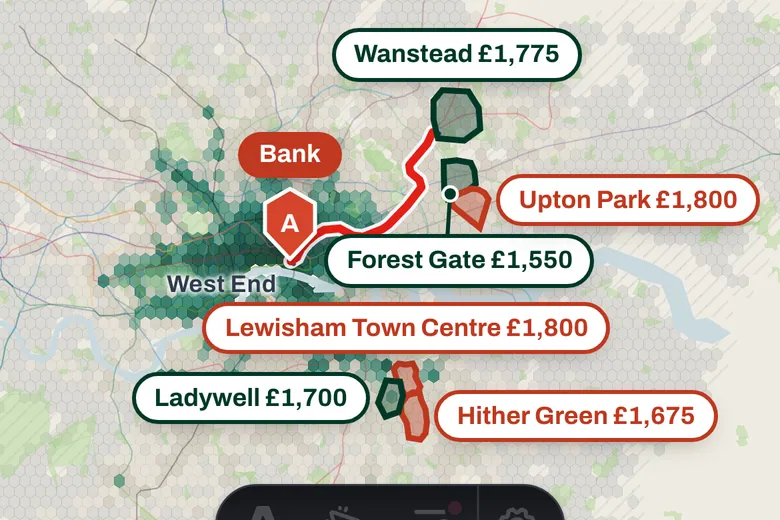
To try the third, divide your salary by 30, set that as the budget on the map, and add the journey time to your workplace. The map below shows the idea on 1-beds: £1,800 (a £54,000 salary divided by 30) and 40 minutes to Bank, which clears in six areas.
At £1,800 and 40 minutes to Bank, six areas fit; set your own salary divided by 30 as the budget to find yours.
Six areas where a 1-bed at £1,800 or less is within 40 minutes of Bank



5What if a check fails?
Ask which check failed and offer something else.
A failed reference or credit check is not on GOV.UK's list of reasons to keep a holding deposit.
GOV.UK lists four reasons a landlord can keep it: you gave false or misleading information, you withdrew or changed your mind, you did not respond, or you failed a right to rent check. If one applies they must give you a written reason within 7 days. If none applies, the holding deposit is returned within 7 days.
Citizens Advice says that if you fail a credit check through a letting agent "you might not get your money back", but its page shows no review date. GOV.UK's guidance was updated on 7 July 2026, so we follow it; if a holding deposit is kept after a failed check, ask in writing which of the four reasons applies.
A landlord choosing another applicant is a different thing, and they can do that. So ask which check failed, then offer one of three things:
- Proof of rent paid to a past landlord.
- A character reference.
- A guarantor.
6What if you have no UK credit history?
Say so early and offer something in its place: a UK guarantor, proof of income and rent paid, or a professional guarantor service.
Wollit, a trade guide, says referencing companies often flag a thin file as unable to verify, and Zoopla (1 May 2026) says landlords will usually want a guarantor who lives in the UK, with commercial guarantor services as the alternative for those without one. Citizens Advice suggests bank statements showing on-time rent and a character reference when you cannot get a reference.
Rent up front is limited. GOV.UK says that after you have signed you can be asked for at most 1 month's rent in advance, and before signing a landlord cannot ask for, encourage or accept rent. Some trade guides still suggest three to six months up front; that conflicts with the 1 May 2026 rule, so do not offer it.
7Do you need a guarantor?
If you earn under 30 times the rent, or have no UK history, expect to be asked for one; Zoopla (1 May 2026) says landlords will usually want a guarantor who lives in the UK.
GOV.UK says a landlord can ask you to provide a suitable rent guarantor as a condition of the tenancy. A guarantor covers your rent if you do not pay, and the guarantee is in writing (Citizens Advice). The landlord can ask them to pay and take them to court. In a shared tenancy a guarantor may be liable for the full rent. Citizens Advice says guarantees can be open-ended, and suggests negotiating a time limit or a rent-only limit and reading the tenancy agreement too. Its page was last reviewed on 7 December 2020, so check the current wording with the agent.
One trade source, the LettingaProperty help centre, gives 36 times the monthly rent for a guarantor's income, and Lovelle says guarantors face credit and employment checks; agents differ, so ask for theirs. At 36 times, a £1,800 flat would need a guarantor on £64,800 a year. Ask the guarantor to read the guarantee first, and ask if they would rather limit it.
8For tenants
This is general information for England, not legal advice; for your case, Shelter, Citizens Advice or a solicitor.
- Pay no referencing fee: it is not on the list of permitted payments.
- Send documents the day they are asked for, and tell your referees to expect a call.
- Divide your salary by 30 to see the rent most agents will pass, then ask the agent for its own test.
- If a check fails, ask which one, then offer proof of rent paid, a character reference or a guarantor.
- If you are asked to be a guarantor, read the guarantee first and ask about a time limit or a rent-only limit.
9For landlords
You cannot charge a tenant for referencing, and a first breach of the payments rule can bring a penalty of up to £5,000, a second within 5 years up to £30,000 or prosecution (GOV.UK fees guidance for landlords).
You can ask a tenant to provide a suitable rent guarantor as a condition of the tenancy, but since 1 May 2026 you cannot refuse a tenant for being on benefits or having children.
If you hold a guarantor agreement made before 1 May 2026, GOV.UK says its terms could be affected by the Renters' Rights Act changes, so review it and get the guarantor's consent to any variation that is needed. A holding deposit is capped at one week's rent and has its own deadline and return rules, set out in the holding deposit guide.
10Rules and dates
The rules below were read on 9 November 2026 (section 41 on 10 November).
The 30 times test is not a rule: it is trade practice.
| Rule | Date | Source |
|---|---|---|
| No referencing fee; payments limited to a list | In force 1 June 2019 | Tenant Fees Act 2019 guidance, GOV.UK; Tenant Fees Act 2019, legislation.gov.uk |
| Holding deposit at most one week's rent; 15 days default deadline; 7 days to give a reason or return it | In force 1 June 2019 | Tenant Fees Act 2019 guidance, GOV.UK; section 5, legislation.gov.uk |
| Penalty up to £5,000, then up to £30,000 within 5 years | In force 1 June 2019; the amounts are as stated in GOV.UK's fees guidance for landlords (first published 1 May 2026, updated 7 July 2026) | Tenant Fees Act 2019, sections 8 and 12, legislation.gov.uk |
| No refusing tenants on benefits or with children | 1 May 2026 | GOV.UK Renters' Rights Act overview; Renters' Rights Act 2025, Part 1, Chapter 3 (sections 33 to 42), brought into force by SI 2026/421, legislation.gov.uk |
| No rent before signing; at most 1 month's rent in advance after | 1 May 2026 | GOV.UK Renters' Rights Act overview; Tenant Fees Act 2019, section 5A, legislation.gov.uk |
| Nothing in the discrimination chapter prohibits taking income into account when judging affordability (section 41) | 1 May 2026 | Renters' Rights Act 2025, section 41, brought into force by SI 2026/421 regulation 3(b), legislation.gov.uk |
| Guarantor agreements made before 1 May 2026 could be affected by the Renters' Rights Act | 1 May 2026 | GOV.UK fees guidance for landlords |
| Right to rent proved by passport (British or Irish) or share code or immigration document (others) | Current on 9 November 2026 | GOV.UK |
| Length of referencing | No legal limit found; two to five working days is one provider's figure | Goodlord (17 August 2025) |
| 30 times salary test | No legal rule | Lovelle (6 October 2023), LettingaProperty, Rightmove |

What else do people ask?
What is rental referencing?
The checks an agent or landlord runs before you sign: right to rent, references from your employer and past landlords, proof of income and often a credit check, which needs your permission.
Is rental referencing free?
Yes. GOV.UK limits landlords and agents to a list of permitted payments and a referencing fee is not on it. A first breach can bring a penalty of up to £5,000, and a second within 5 years up to £30,000.
How long does rental referencing take?
There is no legal time limit that we found. Goodlord, a referencing provider, says an average referencing company should finish in two to five working days. Send documents the day they are asked for and ask the agent how long theirs take.
What salary do you need to pass referencing?
Many agents test for 30 times the monthly rent, which is £60,000 a year for a £2,000 flat and £72,000 for £2,400. Trade sources such as Lovelle and Rightmove give it, but each agent sets its own test, so it is a rule of thumb, not a law.
What if you fail a reference or credit check?
GOV.UK's list of reasons a landlord can keep a holding deposit has four items: false or misleading information, withdrawing, not responding and failing a right to rent check. Failing a reference or credit check is not on it. Ask which check failed, then offer proof of rent paid, a character reference or a guarantor; the chapter above has the detail.
Can you rent with no UK credit history?
Often, with something in its place. Zoopla says landlords will usually want a guarantor who lives in the UK, and commercial guarantor services exist for those without one. GOV.UK says you can be asked for at most 1 month's rent in advance, so do not offer more.
Do you need a guarantor?
Not always. GOV.UK says a landlord can ask for a suitable rent guarantor as a condition of the tenancy, and it is the usual fallback when income or credit history falls short. One trade source, the LettingaProperty help centre, gives 36 times the monthly rent for a guarantor's income; agents differ.
Can you be referenced with a visa?
Visa holders go through the same checks as anyone else. Right to rent is one of them: GOV.UK says that if you are not a British or Irish citizen you prove it with a share code from the Home Office or an eligible immigration document. References and proof of income still apply. See the moving to London checklist.
What does a guarantor sign for?
A guarantor covers your rent if you do not pay, in writing. Citizens Advice says that in a shared tenancy they may be liable for the full rent, and the landlord can ask them to pay and take them to court.
How did we work this out?
The figures, their dates and sources
The checks come from Citizens Advice's page on the information landlords ask for (no review date shown) and its guarantor page (last reviewed 7 December 2020, before the 2026 changes, so on points where they differ this guide leans on GOV.UK). The payments rule, the holding deposit rules and the deposit cap come from GOV.UK's Tenant Fees Act 2019 guidance for tenants (updated 7 July 2026) and its "Fees you can charge as part of a tenancy" guidance for landlords (first published 1 May 2026, updated 7 July 2026), which also says a landlord may ask for a rent guarantor and that guarantor agreements made before 1 May 2026 could be affected by the Renters' Rights Act. The 1 May 2026 points (no refusing tenants on benefits or with children, no rent before signing, at most 1 month's rent in advance after) are GOV.UK's Renters' Rights Act overview for tenants (updated 1 May 2026); the discrimination rule is Renters' Rights Act 2025, Part 1, Chapter 3 (sections 33 to 42) with SI 2026/421 on legislation.gov.uk; the Tenant Fees Act 2019 contents page on legislation.gov.uk lists section 5A, pre-tenancy payments of rent, and sections 8 and 12 on penalties and offences, and the amounts are as GOV.UK states them. Section 41 (No prohibition on taking income into account), in force 1 May 2026 by SI 2026/421 regulation 3(b), is quoted from legislation.gov.uk. How right to rent is proved is from GOV.UK's "Prove your right to rent in England". All were read on 9 November 2026 except section 41, read on 10 November 2026.
GOV.UK sets no time limit for referencing that we could find. The two to five working days is from Goodlord, a referencing provider (17 August 2025), and is a trade figure: Goodlord also says 91% of its own references finish within 72 hours, which is its own claim. The 30 times test is described as common practice by Lovelle (page dated 6 October 2023), the LettingaProperty help centre and Rightmove's guide "Preparing for reference checks" (no date shown, which words it as an annual salary of at least 30 times the monthly rent, or a monthly gross income of at least 2.5 times the rent). These are trade sources that set their own tests; it is a rule of thumb, not a legal one, and each agent decides its own. The advice on no credit history is from Zoopla (1 May 2026) and Wollit (no date shown, a trade guide); where Wollit says there is no cap on rent in advance, we follow GOV.UK's 1 May 2026 limit instead.
Rents are Citycomb's typical asking rents from public listings collected in October 2026: Mid finish, the updated, well-kept flat, unless a line says otherwise. Only areas with at least 10 listings behind their figure count: 337 areas for 2-beds and 270 for 1-beds. The headline counts are for 2-beds; the map is the one 1-bed figure. The £2,375 is the median of the 337 areas' typical 2-bed Mid rents, and £71,250 is that times 30. The rent limit at a salary is the salary divided by 30, and an area passes if its typical rent is at or under it. Area pages round some figures to the nearest £50, so a figure here can differ from an area page by £25. Total journey times to Bank are the walk, wait, ride and walk for a 09:00 weekday arrival, from Citycomb's journey engine built 7 October 2026.
Where do these figures come from?
- Citizens Advice: Information landlords ask for when you start renting, 9 November 2026
- Citizens Advice: If you need a guarantor to start renting (last reviewed 7 December 2020), 9 November 2026
- GOV.UK: Prove your right to rent in England, 9 November 2026
- GOV.UK: Fees you can charge as part of a tenancy (guidance for landlords and agents, first published 1 May 2026, updated 7 July 2026), 9 November 2026
- GOV.UK: Tenant Fees Act 2019, guidance for tenants (updated 7 July 2026), 9 November 2026
- Lovelle: What do letting agents check when referencing? (page dated 6 October 2023), 9 November 2026
- LettingaProperty help centre: how is tenant affordability calculated, 9 November 2026
- GOV.UK: Renters' Rights Act overview for tenants (updated 1 May 2026), 9 November 2026
- legislation.gov.uk: Tenant Fees Act 2019 (2019 c. 4), contents: section 5 (holding deposit), section 5A (pre-tenancy payments of rent), sections 8 and 12 (penalties and offences), 9 November 2026
- legislation.gov.uk: Renters' Rights Act 2025, section 41 (no prohibition on taking income into account), 10 November 2026
- legislation.gov.uk: Renters' Rights Act 2025, Part 1, Chapter 3 (discrimination, sections 33 to 42); SI 2026/421 (commencement), 9 November 2026
- Goodlord: How long does tenant referencing take? (17 August 2025), 9 November 2026
- Rightmove Guides: Preparing for reference checks (no date shown), 9 November 2026
- Zoopla: Reference checks a landlord or letting agent will make (1 May 2026), 9 November 2026
- Wollit: Renting with no credit history in the UK (no date shown), 9 November 2026
- Citycomb area data, October 2026: typical rents by area, 9 November 2026
- Citycomb journey engine, built 7 October 2026: total journey times to Bank, 9 November 2026