Guide
How to raise the rent as a landlord in England (Form 4A)
Checked 9 November 2026England onlyRules read 9 November 2026Rents: October 2026 asking rentsHow we worked it out
A landlord in England raises the rent once a year on Form 4A, with at least two months' notice and no percentage limit. A tenant can ask the First-tier Tribunal to set the open market rent, and it never sets more than the notice asks.
Written for: A landlord of a London assured periodic tenancy deciding how much to ask, or a tenant who has been sent a rent-rise form, in England.
No limiton the size of a rise: the test is the open market rent, and a tenant can ask the tribunal to decide it
In short
- How much: any figure. GOV.UK sets no percentage limit, and the test is the open market rent.
- How often: once a year, 52 weeks apart, and not in the first year of a tenancy.
- How: a completed Form 4A given at least two months before the new rent starts, for a start on the first day of a rent period.
This guide is for England and for assured periodic tenancies, and was checked on 9 November 2026. It is the planner: how much to ask and which start date works. The section 13 rent increase guide is the process guide: the form, the fee and the tribunal's steps.
1How much to ask
Start with the gap between your rent and what new tenants are asked nearby.
- a month between a £2,300 rent and the £2,425 a typical Peckham 2-bed asks, from 16 listings
- £125
- a year for a rise from £2,300 to £2,450 a month, which is +6.5%
- £1,800
- London areas ask £2,100 or less for a typical 2-bed, so £2,100 is at or above their market
- 103 of 327
A Peckham landlord charging £2,300 for a 2-bed is £125 below the typical £2,425 asking rent there, from 16 listings. A rise to £2,450 would put the rent £25 above it. The calculator opens on exactly that: £2,300 rising to £2,450 a month, which is +6.5%, £150 a month and £1,800 a year, with the new rent £25 above the typical Peckham rent. Pick your own area (on a keyboard, type the first letters of its name in the list) and type your rent.
How big is your rent rise?
+6.5%a rise of £150 a month, £1,800 a year
- Rent now
- £2,300
- New rent
- £2,450
- Typical 2-bed in Peckham
- £2,425
The new rent is £25 above the typical asking rent for a 2-bed in Peckham.
See rents in PeckhamA worked example: £2,300 rising to £2,450 a month, for a 2-bed in Peckham. Turn on JavaScript to type your own.
The typical asking rent is our Mid figure from homes advertised in that area, so it is the price of a new let; areas with no figure are not listed. A rent rise can come once a year at most, never in the first year, and only by a notice in the prescribed form (Form 4A for a private landlord). Since 1 May 2026 that notice must give at least two months, and a rent review clause in the tenancy has no effect; you can ask the First-tier Tribunal to set the open market rent (GOV.UK; Housing Act 1988, section 13).
One thing the typical figure hides is finish. Citycomb grades each advertised home's finish from its photos, and across the 327 London areas with more than 10 listings the typical Premium 2-bed asks a median of £825 a month, about 40%, more than the typical Basic one in the same area, so set your rent against homes of your own finish.
The once-a-year and first-year limits are not new on 1 May 2026: they are section 13(2)(b) and (c) of the Housing Act 1988, carried over. What began on 1 May 2026 is Form 4A, the two-month start rule and the end of rises under a review clause.
The open market rent is "the rent that you would expect to receive if you were to relet the property on the open market", GOV.UK says. Any tenant who thinks a rise is higher than that can ask the First-tier Tribunal to decide what the new rent should be, whatever the size of the rise. GOV.UK does not say how the tribunal reaches its figure. Citycomb's typical asking rent is what new tenants are asked, so the gap is a guide only: the typical 2-bed rent is neither a ceiling nor the tribunal's test, and it is not evidence a tribunal has to accept.
For a landlord the tribunal has a ceiling: it sets the open market rent if that is lower than your proposal, and otherwise your proposal (Housing Act 1988, section 14ZB(5)). Asking for too much risks a lower rent than you would have got by asking less.
One way to pick a figure, which is our suggestion and no rule:
- Look up the typical asking rent for your area and bedrooms in the calculator.
- Work out the gap: that rent minus what you charge now.
- Choose a new rent at or below the typical rent, because a figure above it is the one a tenant can ask the tribunal to cut.
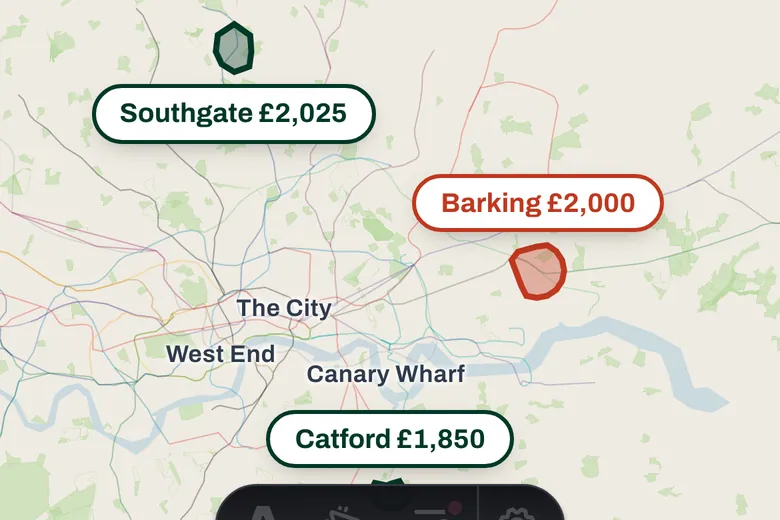
A £2,100 rent is at or above the typical asking rent in Catford, Barking and Southgate, on the map below. Of the 327 London areas with more than 10 listings, 103 ask £2,100 or less for a typical 2-bed in October 2026.
Of the 327 London areas with more than 10 listings, 103 ask £2,100 or less for a 2-bed.
Three London areas where a typical 2-bed asks £2,100 or less, so a £2,100 rent is at or above the market
2Serving the notice
GOV.UK says you should first discuss any rent increase with your tenant.
You then complete Form 4A, "Landlord's notice proposing a new rent", and give it to the tenant at least 2 months before you want the increase to start. You can give it in person, by post, or by email if the tenancy agreement allows it. The process applies every time you raise the rent, even if you have already agreed the rise.
Section 13(2) says the notice proposes a new rent "to take effect at the beginning of a new period of the tenancy", in a period beginning not earlier than two months after the date of service. So the start date has to be the first day of a rent period: with rent due on the 1st it is a 1st, with rent due on the 15th it is a 15th.
GOV.UK says the year between rises runs from the day the last increase took effect, even if that was before 1 May 2026. The Act counts 52 weeks, or 53 in the case set out in section 13(3A) and (3B), so check your own dates.
Say the last rise took effect on Sunday 1 February 2026, with rent due on the 1st. Fifty-two weeks later is Sunday 31 January 2027, so the next rise cannot start before then, and Monday 1 February 2027 clears it. The first-year rule counts the same way: under section 13(2)(b), a rise cannot start earlier than 52 weeks after the first period of the tenancy began, though that paragraph excludes a statutory periodic tenancy. A tenancy that began on Sunday 1 February 2026 first reaches a rise on Monday 1 February 2027.
A Form 4A served on Monday 16 November 2026 gives 77 days. On a plain count, two months before 1 February is Tuesday 1 December 2026, so that is the last day to serve that clearly works. The Act and GOV.UK do not say how days are counted, so serve earlier. Our suggestion, not a rule: serve by Tuesday 17 November 2026 for a 1 February 2027 start, which leaves two weeks of margin.
A Form 4A served on 16 November 2026 can start a new rent on 1 February 2027; the plain-count limit is 1 December, so serve earlier.
A Form 4A served on Monday 16 November 2026 can start a new rent on Monday 1 February 2027
Form 4A, example timeline
| Stop | Minutes from the start | Note |
|---|---|---|
| 16 Nov 2026 | Served, 77 days ahead | |
| 1 Dec 2026 | Last day, plain count | |
| 1 Feb 2027 | New rent starts |
The notice calculator shows the same dates; its other two choices are for tenants and for possession notices, and this page uses the section 13 one. It opens on a form served on Monday 16 November 2026 with rent due on the 1st, and shows Monday 1 February 2027 as the earliest start and Sunday 31 January 2027 as the last day for the tenant to apply to the tribunal. Change the date to 2 December and the earliest start moves to 1 March. It does not check the 52 weeks, so check those yourself.
When does the notice end?
Monday 1 February 2027the earliest day the new rent can start
- Notice given
- Monday 16 November 2026
- Two months on
- Saturday 16 January 2027
- Last day to apply to the tribunal
- Sunday 31 January 2027
The new rent starts at the beginning of a rent period at least two months after the notice is served (Housing Act 1988 s.13(2)(a)). The tenant can apply to the First-tier Tribunal until the day before it starts (s.13(4), s.14(A3)).
A worked example: a landlord giving notice of a rent rise on Monday 16 November 2026, rent due on the 1st. Turn on JavaScript to type your own.
These are the earliest dates the law allows for assured tenancies in England since 1 May 2026, counting from the day the notice is given or served (allow extra days if it goes by post). A tenant's notice must be in writing, and a shorter time than two months counts only if the landlord agreed it in writing. A rent rise goes on Form 4A and a possession notice on Form 3A. Not checked here: the minimum gap since the tenancy began or the last rise (52 weeks, sometimes 53), and, for Ground 1 or 1A, that the tenancy has lasted a year. A possession notice only lets the landlord apply to court, which decides. Rent days from the 29th to the 31st and weekly rents are left out.
3When a tenant disagrees
A tenant who thinks the rent is above the open market rent can ask the First-tier Tribunal to decide what the new rent should be.
The tenant has until the day before the new rent starts: the rent in the notice takes effect as written unless the tenant applies "before the beginning of the new period" (section 13(4)). In the example above, with a start on Monday 1 February 2027, the last day to apply is Sunday 31 January 2027. That is the same date as the 52-week figure only because of the example; they are separate rules.
If the tenant applies, the tribunal's rent runs from the start date in your notice only when the decision comes on or before that date. Otherwise it runs from the first rent period that begins on or after the decision, so a late decision delays the new rent. The tribunal can also direct a later date, within two months of its decision, if the earlier date would cause the tenant undue hardship (section 14ZB(3) and (4)). We did not check the tribunal's own time limits, so this page gives none. The section 13 guide covers the form and the fee.
4The rules by date
All the rules below are in force.
The dated ones come from SI 2026/421 and the Housing Act 1988 as amended; GOV.UK gives no dates, so its rules are marked undated. Form 4A and the two-month start rule are from 1 May 2026; the once-a-year and first-year limits are older (section 13(2)(b) and (c), with the weeks dating from the 2003 Order).
| Rule | Status | Source |
|---|---|---|
| Rent rises only by a section 13 notice, an agreement that follows one, or a tribunal decision; a review clause no longer raises it | In force 1 May 2026 | Housing Act 1988, section 13(4A); SI 2026/421, regulation 2 (regulation 7 covers review-clause rises agreed earlier) |
| New rent starts at the beginning of a rent period, at least two months after service | In force 1 May 2026, for specified purposes | Housing Act 1988, section 13(2); SI 2026/421, regulation 2(a) |
| Form 4A, at least 2 months before the new rent starts | In use for assured tenancies from 1 May 2026 | GOV.UK forms page |
| The section 13 process applies every time, even if the rise is agreed | In force; GOV.UK gives no date | GOV.UK, rent increases |
| One rise a year, 52 weeks apart (53 in some cases), none in the first year | Carried over; the weeks date from 2003 | Housing Act 1988, section 13(2) and (3A) |
| A tenant can ask the tribunal about a rise above the open market rent, before the new period starts | Carried over; regulation 8 saves the old rules for earlier notices | Housing Act 1988, section 13(4); SI 2026/421 |
| The tribunal's rent is capped at the rent you proposed, and runs from the notice date or the next period | In force 1 May 2026, for specified purposes | Housing Act 1988, section 14ZB(3) and (5) |
| A Form 4 notice given before 1 May 2026 still applies | Transitional; GOV.UK gives no date | GOV.UK |
5For tenants
A Form 4A proposes a new rent.
Check the start date is the first day of a rent period at least two months after you were given the form, and that a year has passed since the last rise. If you think the new rent is above the open market rent, you can ask the First-tier Tribunal to decide it before the new rent starts, and it cannot set a rent above the one in the notice.
- Ask what the rise is based on, and compare it with asking rents for homes like yours nearby.
- Keep the form and the envelope or email, so you can show the date you received it.
- If you would rather leave, the guide to giving notice shows which day your tenancy ends.
- The section 13 guide has the form, the fee and the tribunal's limits.
Typical 2-bed asking rents differ widely across London: £2,425 in Peckham, £3,025 in Victoria Park Village, £3,150 in De Beauvoir Town, £3,600 in Pimlico and £3,700 in Primrose Hill, so check your own area.
This is general information, not legal advice. For your own case, ask Shelter, Citizens Advice or a solicitor if you are a tenant, and a solicitor or a landlord association if you are a landlord.
6For landlords
Raise the rent through Form 4A every time, including when the tenant has agreed, and keep the proof of when you served it.
- Talk to the tenant before the form arrives.
- Count from the last rise (52 weeks) and serve at least two months before the new rent starts, for a start on the first day of a rent period.
- Remember the tribunal sets the market rent or your figure, whichever is lower.
- Weigh the rise against an empty month, with the sum below.
- Do not rely on a rent review clause: a rise agreed under one before 1 May 2026 that starts after that date will not apply.
Two figures to weigh before you choose. The ONS puts private rent inflation in London at 3.5% in the 12 months to September 2026, "lowest in London and the South East", which averages every tenancy and sets no limit on yours. And the cost of the tenant leaving: say a 5% rise on £2,000 makes the tenant leave and the home stands empty for a month. That month costs £2,000 and the rise adds £100 a month, so it takes 20 months of the rise to repay it, counting rent only. A new tenant also means advertising, checks and a gap before the rent starts again.
What else do people ask?
How often can a landlord raise the rent in England?
Once a year, and not in the first year of the tenancy, GOV.UK says. The year runs from the day the last increase took effect, even if that was before 1 May 2026. The Act counts 52 weeks between rises, or 53 weeks in the case set out in section 13(3A) and (3B), so use 52 weeks at least when you pick a start date.
How much notice does a rent rise need?
A completed Form 4A has to reach the tenant at least 2 months before the new rent starts. It can be given in person, by post, or by email if the tenancy agreement allows email.
Can a rent rise start on any day?
No. The new rent takes effect at the beginning of a new period of the tenancy, at least two months after the notice is served (Housing Act 1988, section 13(2)). With rent due on the 1st, the new rent has to start on a 1st.
Is there a limit on how much rent can go up?
GOV.UK sets no percentage limit. The test it names is the open market rent, and any tenant who thinks the rise is higher than that can ask the First-tier Tribunal to decide, whatever the size of the rise.
Can the tribunal set a higher rent than my notice?
No. Under section 14ZB(5) of the Housing Act 1988 the tribunal sets the open market rent if that is lower than the rent you proposed, and otherwise your proposed rent.
What happens to the rent if the tenant applies to the tribunal?
If the tenant applies before the new period starts, the rent in the notice does not simply take effect (section 13(4)). The rent the tribunal sets runs from the start date in the notice if the decision comes on or before it, and otherwise from the first rent period that begins on or after the decision, unless the tribunal directs a date to avoid undue hardship to the tenant (section 14ZB(3)).
What is the open market rent?
GOV.UK defines it as the rent you would expect to receive if you were to relet the property on the open market. It does not say how the tribunal reaches a figure.
Does the tenant have to agree to the rise?
The landlord follows the section 13 process every time, even if the increase is agreed. A tenant who does not agree can ask the First-tier Tribunal to decide what the new rent should be.
Can I raise the rent during a fixed term?
This page covers assured periodic tenancies only, which is what the GOV.UK guide it cites covers, and we did not check the rules for a fixed term. For a fixed-term tenancy ask Shelter, Citizens Advice or a solicitor.
Can I use a rent review clause in the tenancy agreement?
No. GOV.UK says a rise agreed under a review clause before 1 May 2026 that takes effect after that date will not apply, and a new rise goes through Form 4A.
How did we work this out?
The figures, their dates and sources
Rules were read on 09/11/2026. What each source says:
- Housing Act 1988 section 13, on legislation.gov.uk: the landlord may serve a notice "proposing a new rent to take effect at the beginning of a new period of the tenancy specified in the notice, being a period beginning not earlier than" two months after the date of service (13(2)(a)); not in the first 52 weeks of the tenancy (13(2)(b)); and not before the "appropriate date" after the last rise, which is 52 weeks after the increased rent took effect, or 53 weeks in the case set out in 13(3A) and (3B) (13(2)(c)). The new rent takes effect as the notice says unless, "before the beginning of the new period", the tenant applies to the tribunal under section 14(A3) or the two agree something else (13(4)). The "two months" and the tribunal route in 13(4) are marked as substituted on 1 May 2026 "for specified purposes" by SI 2026/421 regulation 2(a); the 52-week and 53-week rules date from the Regulatory Reform Order 2003.
- Housing Act 1988 section 14ZB, on legislation.gov.uk, inserted 1 May 2026 "for specified purposes": the rent set after a tribunal determination runs from the start date in the notice if that is on or after the date of the determination, and otherwise from the first new period that begins on or after the determination, or from a date the tribunal directs if applying either would cause undue hardship to the tenant, which must fall within two months of the determination (14ZB(3) and (4)). The tribunal's rent is the open market rent if that is lower than the proposed rent, and otherwise the proposed rent (14ZB(5)).
- GOV.UK, "Rent increases" in the guide for landlords on assured periodic tenancies (no update date on the page): rent can rise once a year and not in the first year; you complete Form 4A and give it at least 2 months before the increase starts; in person, by post, or by email if the tenancy agreement allows; the process applies every time, even if the rise is agreed. The open market rent is "the rent that you would expect to receive if you were to relet the property on the open market". It says nothing on how the tribunal reaches its figure and nothing on a percentage limit.
- The same page: you cannot increase the rent until a year after the last increase took effect, even if that was before 1 May 2026; a Form 4 notice given before 1 May 2026 still applies; a rise agreed under a rent review clause before 1 May 2026 but taking effect after it will not apply.
- GOV.UK's forms page for assured tenancies from 1 May 2026 describes Form 4A as the landlord's notice proposing a new rent. SI 2026/421 regulations 7 and 8 deal with review-clause rises and notices served before that date.
- ONS, "Private rent and house prices, UK: October 2026", published 21/10/2026: private rent annual inflation was "lowest in London and the South East (both 3.5%), in the 12 months to September 2026". The 3.5% averages every tenancy and sets no limit.
The Act and GOV.UK do not say how days are counted or when a posted or emailed form counts as served. The dates assume the form is served on the day it is sent and that two months from 1 December 2026 reaches 1 February 2027, so 1 December is the plain-count limit and the page tells landlords to serve earlier. We did not check the tribunal's time limits for deciding, or how long a decision takes, so the page gives none. The timeline is an example: rent due on the 1st and a last rise that took effect on Sunday 1 February 2026, which is the shape of GOV.UK's own example. In that example 52 weeks after 1 February 2026 is Sunday 31 January 2027, and the 53-week case in 13(3B) does not apply because the 53rd week begins only one day before the anniversary of the first rise, not more than six. The first-year rule is section 13(2)(b)(ii) (read 09/11/2026: the new rent cannot start earlier than "the date that falls 52 weeks after the date on which the first period of the tenancy began", "except in the case of a statutory periodic tenancy"), so a tenancy whose first period began on Sunday 1 February 2026 reaches Monday 1 February 2027 by the same count. The notice calculator counts two months from the day served and finds the first rent day on or after it; it does not check the 52 weeks, as its own note says. Opened on Monday 16 November 2026 with rent due on the 1st, it shows Monday 1 February 2027 as the earliest start and Sunday 31 January 2027 as the last day to apply to the tribunal.
Citycomb rents are typical asking rents for a mid-standard flat (the "Mid" finish) from October 2026 listings, which are rents asked of new tenants and are a guide, not evidence at a tribunal. The counts use the 327 London areas with more than 10 listings for a 2-bed; areas with 10 or fewer listings are left out. Of those 327 areas, 103 ask £2,100 or less for a typical 2-bed. Across them, the typical Premium 2-bed asks a median of £825 a month (about 40%) more than the typical Basic one, in the same area. Peckham asks £2,425 from 16 listings. The rise calculator opens on a Peckham 2-bed going from £2,300 to £2,450, which it shows as +6.5%, £150 a month and £1,800 a year, with the new rent £25 above the typical £2,425 (£2,300 is £125 below it). De Beauvoir Town asks £3,150 from 22 listings, Victoria Park Village £3,025, Pimlico £3,600 and Primrose Hill £3,700. The map card draws Catford £1,850 from 24 listings, Barking £2,000 from more than 60 listings and Southgate £2,025 from 24 (the prose names the areas and leaves the figures to the map). The empty-month sum in the text is the empty month's rent divided by the extra rent a month for an example rent of £2,000 rising 5%, rent only.
Where do these figures come from?
- GOV.UK: Rent increases (assured periodic tenancies: a guide for landlords), 9 November 2026
- GOV.UK: Assured tenancy forms for privately rented properties from 1 May 2026 (Form 4A), 9 November 2026
- legislation.gov.uk: The Renters' Rights Act 2025 (Commencement No. 2 and Transitional and Saving Provisions) Regulations 2026, SI 2026/421, 9 November 2026
- legislation.gov.uk: Housing Act 1988, section 13 (increases of rent under assured periodic tenancies), 9 November 2026
- legislation.gov.uk: Housing Act 1988, section 14ZB (tribunal's rent and undue hardship), 9 November 2026
- ONS: Private rent and house prices, UK: October 2026 (published 21/10/2026; London 3.5% in the 12 months to September 2026), 9 November 2026
- Citycomb area data, October 2026: typical 2-bed rents across London's areas, 9 November 2026