Info sheet
Best time to rent in London: the month matters least
Checked 10 November 2026ONS rents to September 2026 (provisional)140 monthly changesRents from October 2026 listingsHow we worked it out
No month is proven cheapest to rent in London. January has the smallest average rise in the ONS index, but not reliably, and your area and notice date cost far more.
Written for: Someone planning a London move who wants to know whether the month changes the rent, and how to fit the search around a notice date.
4 of 11Januaries since 2016 saw London rents fall in the ONS index, so January is not a safe rule
In short
No month is reliably cheapest to rent in London.
January's average rise in the ONS index is 0.11% against 0.30% in the other months, a gap too small and uneven to plan around. We found no London month-by-month listings or demand data, so whether winter is quieter is not answered here; the area and your notice date, which cost far more, are. The rent hub and the Bank commute page sort areas by price and by journey.
1What moves the cost
An area costs the most, a notice overlap next and the month of the year least, by a wide margin.
January's gap is a difference in the index level, so it lasts into later months unless later rises make it up; the chart counts about £4 a month for the eleven months from February, at most £47 in all. The area figure comes from the 13 areas that are each 40 minutes from Bank by total journey time, where a 2-bed asks from £2,150 to £3,475 a month. ONS marks its September 2026 estimates, including the £2,338 average rent, as provisional, so they may be revised.
The distance from Bank shows the same order of size. Across Citycomb's areas, the 118 areas 41 to 50 minutes from Bank have a median 2-bed ask about £510 a month below the 77 areas 31 to 40 minutes away, more than 100 times January's gap.
2What the months show
The ONS index measures rents on all private tenancies, new and existing, so it is weak evidence about the month you search in, and only January stands out.
The chart averages 140 monthly changes, from February 2015 to September 2026. The other eleven months sit between 0.2% and 0.4%, so waiting for a particular month other than January has no support in this series. January is the lowest, but eleven Januaries are too few to call that a rule:
| What January did | Years | Change in the index |
|---|---|---|
| Fell | 2018, 2019, 2021, 2026 | -0.43%, -0.07%, -0.10%, -0.67% |
| Rose less than 0.3% | 2017, 2020, 2022 | 0.13%, 0.07%, 0.25% |
| Rose 0.3% or more | 2016, 2023, 2024, 2025 | 0.31%, 0.69%, 0.75%, 0.34% |
January 2026's fall of 0.67% is the largest outlier. Without it January averages 0.19%, level with April's 0.20%, so January being the softest month is fragile. The index is also not seasonally adjusted and cannot say whether a flat advertised in January costs less than one advertised in July.
Is winter quieter for lets? One study says so, and it is the only evidence we found. Yilmaz, Talavera and Jia used 300,198 Zoopla listings from August 2015 to August 2017 in 13 UK university cities, among them Birmingham, Leeds and Glasgow, and found homes less likely to let in winter than in summer. London is not among them, and the study measures how quickly homes let, not what they cost. Citycomb's listings start in October 2026, so we hold no month-by-month count of flats on the market.
If winter lets are slower a landlord may be readier to talk, which is our inference, so ask the agent how long the flat has been listed; the negotiation guide covers how to ask for a lower rent. To see what a budget reaches in any month, set it on the map, here £2,000 and 60 minutes to Bank. What the index does show is a year of rises: London rents rose 3.5% in the 12 months to September 2026 (provisional), from £2,260 to £2,338 a month, or £936 a year, which is more than January's gap and far less than the spread between areas.
3Your area moves the rent more than the month
Two London areas that are both 40 minutes from Bank can differ by £1,325 a month, or £15,900 a year.
- a month for a 2-bed in Upton Park, the cheapest of 13 areas 40 minutes from Bank
- £2,150
- a month in Holland Park, the dearest of the 13
- £3,475
- a month between them, £15,900 a year
- £1,325
Thirteen areas reach Bank in exactly 40 minutes by total journey time. A typical 2-bed asks £2,150 in Upton Park and £3,475 in Holland Park, the cheapest and dearest of the 13, so the same journey carries a very different rent. The £15,900 compares two different flats in two different places, not one flat. Six of the 13 are below.
| 2-bed, 40 min to Bank | Rent a month |
|---|---|
| Upton Park | £2,150 |
| East Greenwich | £2,350 |
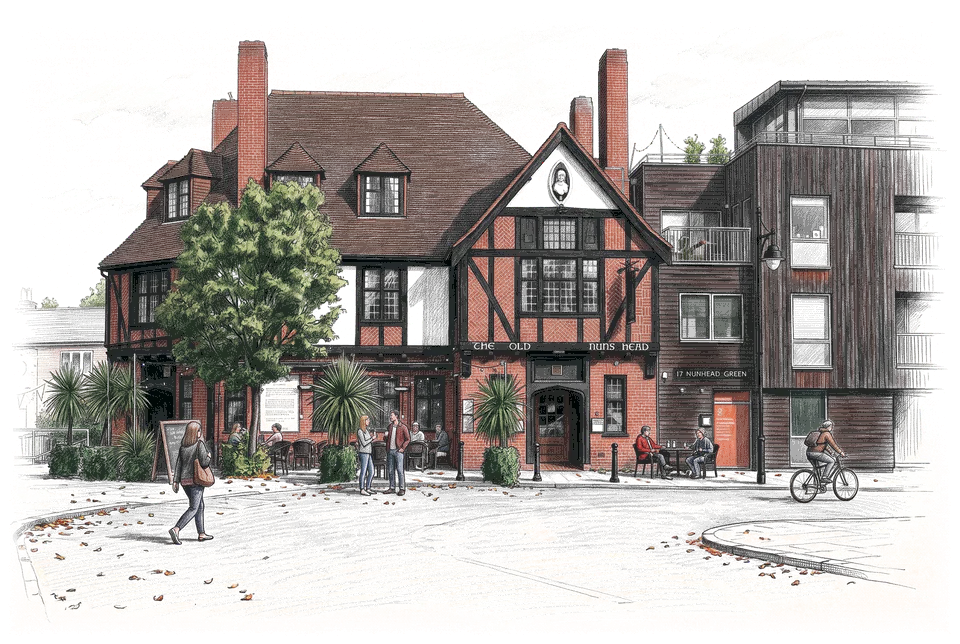
| Nunhead | £2,500 |
| Tooting Broadway | £2,575 |
| Clapton Square & Lower Clapton | £2,750 |
| Holland Park | £3,475 |
The table says nothing about what the extra rent pays for, which is the flat, the street and the area. Upton Park has Queens Market on Green Street and Priory Park; Holland Park has the butchers and greengrocers of Holland Park Avenue and the Kyoto Garden. The area pages set out the rest.
4Your notice date
On a periodic tenancy, check your agreement: it can ask for no more than two months' notice, and if it is silent you give at least two, in writing, ending on a day when the rent is due or the day before.
That is GOV.UK's guidance, and most private tenancies in England have rolled month to month since 1 May 2026 under the Renters' Rights Act; if yours started earlier, the notice depends on its type and agreement. Rent in the notice months is ordinary rent. Double rent happens only when the new home starts before your keys go back, so give notice once you hold a signed agreement for the new home. Say your rent falls due on the 1st and you give notice on 28 December.
Notice given on 28 December means two more rents and keys back on 28 February.
For example, notice given on 28 December means two more rents and keys back on 28 February
| 28 Decembergiven by hand or email that day | Notice in writing |
|---|---|
| 1 Januaryinside the notice period | Rent due |
| 1 Februaryinside the notice period | Rent due |
| 28 Februarytwo months on, and the day before rent is due | Keys back |
The rent-due rule can lengthen the notice. With rent due on the 1st, notice given on 28 January ends on 31 March, three days past two months. Notice given on 15 January also ends on 31 March, 16 days past, because two months from 15 January is 15 March, which is not a rent day. That is our reading of GOV.UK's two rules together, so ask the landlord to confirm the last day in writing.
Put your own notice date and rent day in below. The calculator's other two options are for landlords; those notices are in the ending a tenancy guide.
When does the notice end?
Sunday 28 February 2027the earliest day the tenancy can end
A worked example: a tenant giving notice on Monday 28 December 2026, rent due on the 1st. Turn on JavaScript to type your own.
These are the earliest dates the law allows for assured tenancies in England since 1 May 2026, counting from the day the notice is given or served (allow extra days if it goes by post). A tenant's notice must be in writing, and a shorter time than two months counts only if the landlord agreed it in writing. A rent rise goes on Form 4A and a possession notice on Form 3A. Not checked here: the minimum gap since the tenancy began or the last rise (52 weeks, sometimes 53), and, for Ground 1 or 1A, that the tenancy has lasted a year. A possession notice only lets the landlord apply to court, which decides. Rent days from the 29th to the 31st and weekly rents are left out.
The overlap depends on the day the new home starts. On the £2,338 average rent a week of double rent is about £540, or about £77 a day. Count every day you hold both homes, including 28 February, the last day of the old tenancy:
| New home starts | Days held twice | Double rent at about £77 a day |
|---|---|---|
| 15 February | 14 | about £1,079 |
| 22 February | 7 | about £540 |
| 1 March | none | £0 |
A landlord may charge by the month, not the day, so ask how the last period is billed. To avoid paying twice, ask the new landlord to hold the start date in the agreement, or ask your current landlord in writing to agree a shorter notice period, which GOV.UK says is possible if both sides agree in writing. Read the holding deposit guide before you pay anything, and the ending a tenancy guide for the steps.
5Before you start
Work backwards from the day you want to hand the keys back, because the notice date is what sets your cost.
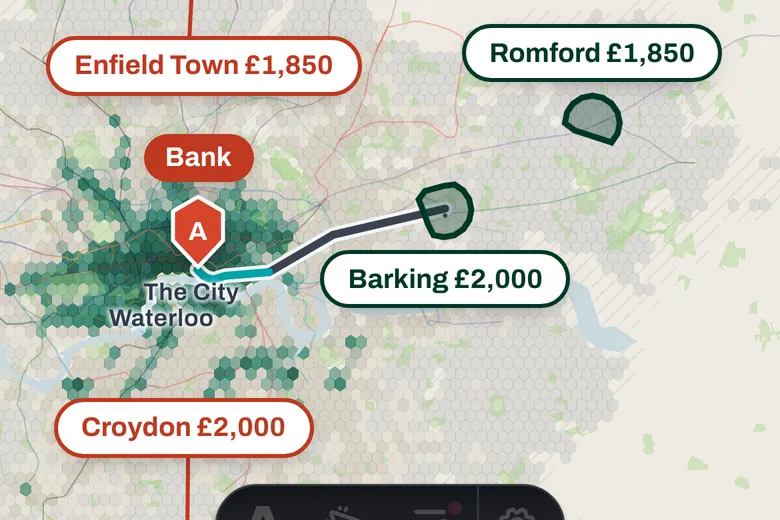
We found no sourced London figure for how many weeks before a move to start looking, so we give none; what we can support is the working-back rule. With rent due on the 1st and keys back on 28 February, notice goes in on 28 December, so aim to sign by then and ask for a start date of 1 March. If you can only get 15 February, you hold both homes for 14 days. Set your maximum rent with the affordability guide, then let the map set your workplace, journey limit and budget together: try £2,000 and 60 minutes to Bank, where in the October 2026 listings 72 areas pass, and Barking, Croydon town centre, Romford and Enfield Town are four of them. Then move the pin to your own workplace.
Four of the 72 areas with a 2-bed at £2,000 or less within 60 minutes of Bank.
Four of the 72 areas with a 2-bed at £2,000 or less within 60 minutes of Bank



What else do people ask?
What is the best month to rent a flat in London?
No source we could check proves one: January has the smallest average rise in the ONS index, but not reliably. For most renters the best month is the one that fits their notice date; see what the months show.
Is it cheaper to rent in winter or summer in London?
The ONS index shows no clear season, and it measures all private tenancies, new and existing, so it cannot show what a flat advertised in a given month costs. See what the months show.
Is January a good time to move in London?
It can be, but January's change has swung from a fall to a strong rise from year to year, so ask how long the flat has been listed. See what the months show.
Do rents change during the year?
Yes: London rents rose 3.5% in the 12 months to September 2026 (provisional), from £2,260 to £2,338 a month across all tenancies.
How much notice do I give to leave a rented flat in London?
Check your agreement: it can ask for no more than two months, and if it is silent you give at least two, in writing. GOV.UK says the tenancy must end on a rent-due day or the day before. Rent is due until it ends, so you pay two rents only if the new home starts before your keys go back. If your tenancy started before 1 May 2026, the notice depends on its type and agreement.
When should I start looking for a flat in London?
We found no sourced London lead time, so we give none. Work back from the day your keys go back: notice goes in once you hold a signed agreement for the new home, and it must be at least two months on a periodic tenancy, so sign by the notice date.
Can a landlord put the rent up after I move in?
GOV.UK says a landlord can raise the rent once a year, not in the first 12 months of a new tenancy, using Form 4A with at least two months' notice. Ask at the viewing when the rent was last changed.
How did we work this out?
The figures, their dates and sources
Rents: the ONS Price Index of Private Rents, released 21/10/2026, gives the London 12-month change (3.5% to September 2026) and the average monthly rent of £2,338 (against £2,260 a year earlier). ONS marks its latest two months as provisional and the next release is 18/11/2026, so both figures may be revised. Both measure rents on all private tenancies, new and existing, and are not seasonally adjusted. Area rents are Citycomb's typical asking rents for a 2-bed (Mid finish) from public listings read in October 2026, unrounded. Journey times are total journey time to Bank for a weekday 09:00 arrival, from the Citycomb journey engine.
Month pattern: Citycomb's average of the ONS London monthly percentage changes in Table 1 of the dataset, from February 2015 to September 2026, 140 months, grouped by calendar month (11 or 12 of each), so one unusual year, such as 2021 or 2026, moves it. The chart shows each average as pence on each £100 of rent, so 0.1147% is 11.5p. The 11 Januaries since 2016 are 0.31, 0.13, -0.43, -0.07, 0.07, -0.10, 0.25, 0.69, 0.75, 0.34 and -0.67% for 2016 to 2026. Without 2026's fall January averages 0.19%, level with April's 0.20%.
January's gap in pounds: the other eleven months average 0.2957%, January 0.1147%, a difference of 0.18 percentage points. That is 0.18% of £2,338, about £4.23, a gap in the level of the index. A level that is lower stays lower in each later month unless later rises make it up, so we show it as about £4 a month from February, and at most about £47 over the eleven months February to December, because later rises may make it up. We cannot say whether they do.
Area gap: 13 areas have a typical 2-bed figure and a total journey time to Bank of exactly 40 minutes. The cheapest is Upton Park at £2,150 and the dearest Holland Park at £3,475, a gap of £1,325 a month, £15,900 a year. Distance finding: of the areas with both a typical 2-bed (Mid finish) and a total journey time to Bank, the 77 areas 31 to 40 minutes from Bank have a median 2-bed ask of £2,850 and the 118 areas 41 to 50 minutes away £2,337.50, a difference of £512.50, about £510 a month, which is 121 times January's £4.23. Same October 2026 listings and journey engine. The map count of 72 is every area whose typical 2-bed is £2,000 or less and whose total journey to Bank is 60 minutes or less, from the same area table the calculators use.
Notice: GOV.UK (Assured periodic tenancies: a guide for landlords, "If your tenant wants to leave", read 09/11/2026) says the tenancy agreement should state the notice, the most a landlord can ask for is 2 months, a tenant whose agreement is silent gives at least 2 months, a shorter period needs a written agreement, and the notice must be in writing so the tenancy ends on a day when the rent is due or the day before. The table's end dates are our reading of the rules together, and match the notice calculator on the page. Most private tenancies in England have been periodic since 1 May 2026 under the Renters' Rights Act. Weekly double rent is the ONS average of £2,338 times 12, divided by 52, and the daily figure divides that by 7. Overlap days are counted including 28 February, the last day of the old tenancy.
Study: Yilmaz, Talavera and Jia (University of Birmingham discussion paper 20-11) used 300,198 Zoopla listings in 13 UK university cities, collected from August 2015 to August 2017: Birmingham, Leeds, Glasgow, Bristol, Liverpool, Manchester, Sheffield, Edinburgh, Cardiff, Coventry, Newcastle, Nottingham and Plymouth. London is not among them, and the study measures how quickly homes let, not their price.
Where do these figures come from?
- ONS: Price Index of Private Rents and house prices bulletin, UK (released 21/10/2026; latest two months provisional), 9 November 2026
- ONS: Price index of private rents, UK: monthly price statistics (dataset, Table 1, 21/10/2026), 8 November 2026
- Yilmaz, Talavera and Jia: Liquidity, Seasonality, and Distance to Universities (University of Birmingham discussion paper 20-11), 9 November 2026
- GOV.UK: Renters' Rights Act overview for tenants, 9 November 2026
- GOV.UK: Assured periodic tenancies: a guide for landlords, If your tenant wants to leave, 9 November 2026
- Citycomb: typical asking rents from public listings, 24/10/2026, 24 October 2026