Where to live in London on £80,000
On £80,000 a year you take home £4,746 a month, so 35% of it, £1,660, is the most to put into rent. A typical 1-bed fits 218 areas, none in zones 1 or 2; the quickest to Bank is Forest Gate, 36 minutes.
Figures checked October 2026. How the figures are worked out
What do people on £80,000 do about rent?
On £80,000 the usual choices are a 1-bed of your own, a 2-bed with a partner or a bigger share of pay. A typical 1-bed fits 218 areas at 35% of take-home pay, £1,660. The nearest list by budget is Flats under £1,800 a month, the first band above the £1,660 line (it runs up to £1,800).
- Keeping to 30% of take-home pay, £1,420, 14 areas have a typical 1-bed. The stretch to 40%, £1,890, is covered below.
- With a partner: two take-home pays come to £9,492 a month, and 486 areas have a typical 1-bed inside 35% of that, £3,320, 124 of them in zones 1 or 2.
- A 2-bed on one salary at 35% fits 5 areas.
Raising the line from 35% to 40% of pay adds areas; the quickest area costs more than the cheapest
- £100a month more for Forest Gate than Woodside, 8 minutes closer to Bank
- +85areas with a typical 1-bed if the line moves from 35% to 40%, £1,890
Where can I live in London on £80,000 a year?
Of the areas that fit, 21 are within 45 minutes of Bank, and the median journey to Bank is 65 minutes, across the 217 areas with a journey time.
One salary: up to £1,660 a month, 35% of pay
The quickest journeys to Bank come first. The table lists the 166 within 75 minutes of Bank; the other 52 stay on the map. The share column is the rent divided by take-home pay of £4,746 a month.
| Area | 1-bed rent | Share of pay | To Bank |
|---|---|---|---|
| Forest GateNewham, zone 3 | £1,550 | 32.7% | 36 min |
| Grove ParkLewisham, zone 4 | £1,575 | 33.2% | 38 min |
| Seven KingsRedbridge, zone 4 | £1,525 | 32.1% | 40 min |
| South WoodfordRedbridge, zone 4 | £1,575 | 33.2% | 41 min |
| Croydon town centreCroydon, zone 5 | £1,525 | 32.1% | 42 min |
| Manor ParkNewham, zone 3 | £1,600 | 33.7% | 42 min |
| Broad GreenCroydon, zone 5 | £1,475 | 31.1% | 43 min |
| South NorwoodCroydon, zone 4 | £1,500 | 31.6% | 43 min |
Show 32 more areas (40 quickest of 166)
| Area | 1-bed rent | Share of pay | To Bank |
|---|---|---|---|
| Southend, CatfordLewisham, zone 4 | £1,525 | 32.1% | 43 min |
| WoodsideCroydon, zone 4 | £1,450 | 30.6% | 44 min |
| CharltonGreenwich, zone 3 | £1,525 | 32.1% | 44 min |
| NorburyCroydon, zone 3 | £1,550 | 32.7% | 44 min |
| SydenhamLewisham, zone 3 | £1,600 | 33.7% | 44 min |
| CatfordLewisham, zone 3 | £1,475 | 31.1% | 45 min |
| Newbury ParkRedbridge, zone 4 | £1,500 | 31.6% | 45 min |
| Orpington townBromley, zone 6 | £1,500 | 31.6% | 45 min |
| Chadwell HeathRedbridge, zone 5 | £1,550 | 32.7% | 45 min |
| SelhurstCroydon, zone 4 | £1,575 | 33.2% | 45 min |
| TubbendenBromley, zone 6 | £1,575 | 33.2% | 45 min |
| BarkingBarking and Dagenham, zone 4 | £1,625 | 34.2% | 45 min |
| MottinghamGreenwich, zone 4 | £1,625 | 34.2% | 45 min |
| ElthamGreenwich, zone 4 | £1,550 | 32.7% | 46 min |
| Highams ParkWaltham Forest, zone 4 | £1,600 | 33.7% | 46 min |
| Gants HillRedbridge, zone 4 | £1,475 | 31.1% | 47 min |
| Lower BelvedereBexley, zone 5 | £1,550 | 32.7% | 48 min |
| PengeBromley, zone 4 | £1,575 | 33.2% | 48 min |
| ShortlandsBromley, zone 4 | £1,600 | 33.7% | 48 min |
| BarkingsideRedbridge, zone 4 | £1,625 | 34.2% | 48 min |
| RedbridgeRedbridge, zone 4 | £1,550 | 32.7% | 49 min |
| AddiscombeCroydon, zone 5 | £1,450 | 30.6% | 50 min |
| Palmers GreenEnfield, zone 4 | £1,525 | 32.1% | 50 min |
| Halfway Street & LamorbeyBexley, zone 5 | £1,550 | 32.7% | 51 min |
| East HamNewham, zone 3 | £1,600 | 33.7% | 51 min |
| Bromley town centreBromley, zone 5 | £1,450 | 30.6% | 52 min |
| Avery HillGreenwich, zone 4 | £1,500 | 31.6% | 52 min |
| BeckenhamBromley, zone 4 | £1,550 | 32.7% | 52 min |
| Thornton HeathCroydon, zone 4 | £1,550 | 32.7% | 52 min |
| WealdstoneHarrow, zone 5 | £1,575 | 33.2% | 52 min |
| SouthburyEnfield, zone 5 | £1,600 | 33.7% | 52 min |
| SurbitonKingston upon Thames, zone 6 | £1,600 | 33.7% | 52 min |
Quickest to Bank on £80,000: Forest Gate, Grove Park, Seven Kings and South Woodford, 36 to 41 minutes
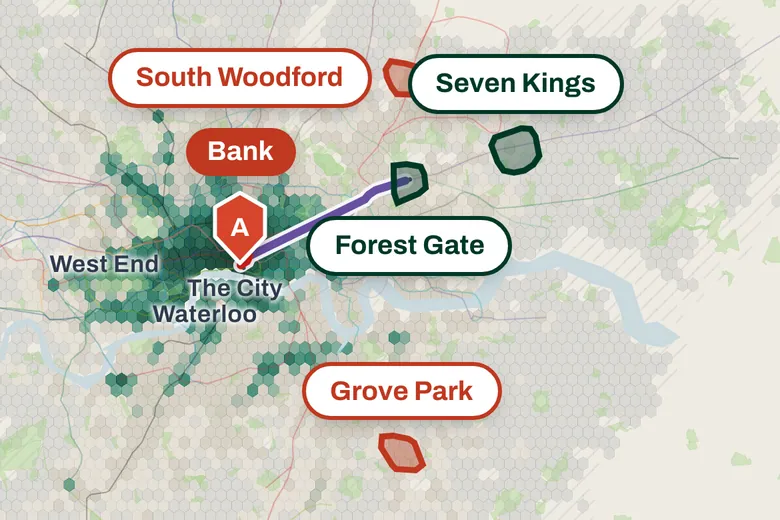
Bromley (29), then Croydon (20), then Bexley, Havering and Hillingdon (19 each) have the most of these areas, 106 of the 218. By fare zone, zone 5 has 72, zone 6 has 61, zone 4 has 56 and zone 3 has 11; 18 have no zone in our data.
Stretch to 40% of pay: up to £1,890 a month
Raising the line from 35% to 40% adds 85 areas. The quickest to Bank is Hither Green, 27 minutes, at £1,675 a month.
| Area | 1-bed rent | Share of pay | To Bank |
|---|---|---|---|
| Hither GreenLewisham, zone 3 | £1,675 | 35.3% | 27 min |
| Blackheath VillageLewisham, zone 3 | £1,850 | 39.0% | 32 min |
| Lee Manor & LeeLewisham, zone 3 | £1,675 | 35.3% | 33 min |
| PeckhamSouthwark, zone 2 | £1,875 | 39.5% | 33 min |
| Lewisham town centreLewisham, zone 2 | £1,800 | 37.9% | 34 min |
| MarylandNewham, zone 3 | £1,825 | 38.5% | 34 min |
| Blackheath Standard & Westcombe ParkGreenwich, zone 3 | £1,850 | 39.0% | 34 min |
| BrockleyLewisham, zone 2 | £1,875 | 39.5% | 34 min |
Typical asking rent for a flat in updated condition. The last column is the whole journey to Bank for a weekday 09:00 arrival. Journeys over 75 minutes are left out of the tables (53 rows in all), but those areas stay on the map. 14 of the 40 rows in the first table rest on fewer than 10 listings, so read them as a guide; the area page shows each range. The area counts come from our rent model, which covers every London area Citycomb maps: see how we build the rents and the list of areas.
Does a cheaper area mean a longer journey to Bank?
Of the 40 quickest to Bank, Woodside is the cheapest at £1,450 and Forest Gate, at £1,550, the quickest to Bank. The shorter journey costs about £13 a month for each minute saved and gives back 6 hours over a working month of about 21 days.
Of the 40 quickest to Bank, the cheapest, Woodside, saves £100 a month and adds 8 minutes to the journey to Bank
Total journey time, in minutes. Each bar is one route, split into its legs.
| Route | Leg | Minutes |
|---|---|---|
| Woodside to Bank | Walk | 14 |
| Woodside to Bank | Train | 25 |
| Woodside to Bank | Walk | 5 |
| Woodside to Bank | Total | 44 |
| Forest Gate to Bank | Walk | 7 |
| Forest Gate to Bank | Elizabeth line (includes a change) | 24 |
| Forest Gate to Bank | Walk | 5 |
| Forest Gate to Bank | Total | 36 |
Woodside's journey starts from Norwood Junction station and Forest Gate's from Forest Gate station. Each time is a total journey time: the walk to the station, the ride and the walk at the Bank end.
Forest Gate rides the Elizabeth line, which does not stop at Bank, so that ride includes a change of line on the way.
Bank is only one workplace. Add where you work on the map and each area shows its own journey to your desk, which these Bank times cannot.
What if I spend more than 35%, or two of us pay?
At 40% of take-home pay (£1,890) 303 areas have a typical 1-bed and 402 have a typical studio. At 50% (£2,370), 415 have a 1-bed and 463 have a studio.
Raising the rent line from 35% to 50% of £4,746 take-home pay takes the 1-bed count from 218 to 415 areas
Areas that fit at each share of take-home pay. Every panel uses the same scale.
| Place | Item | Areas that fit at each share of take-home pay |
|---|---|---|
| Studio | 30% | 234 |
| Studio | 35% | 343 |
| Studio | 40% | 402 |
| Studio | 45% | 440 |
| Studio | 50% | 463 |
| 1-bed | 30% | 14 |
| 1-bed | 35% | 218 |
| 1-bed | 40% | 303 |
| 1-bed | 45% | 370 |
| 1-bed | 50% | 415 |
Agents often ask for a salary of 30 times the monthly rent. At £80,000 that allows £2,666 a month, 56% of take-home pay, and it reaches 449 areas for a 1-bed. That is above the 30% to 35% budget on this page, £1,420 to £1,660. Past 40% leaves less room for bills, travel and saving.
Typical 1-bed rents bunch between £1,420 and £1,660. Moving the line up by £240, from 30% to 35% of pay, adds 204 areas, which is why the count jumps there.
A stretch to 45% of take-home pay, £2,130, leaves £2,616 a month for council tax, energy, travel and food: £470 a month less than at 35%.
On one salary (£1,660 a month) a typical studio fits 343 areas, a 1-bed 218, a 2-bed 5 and a 3-bed none. Two salaries of £80,000 (£3,320 a month at 35%) fit a studio in 494 areas, a 1-bed in 486, a 2-bed in 439 and a 3-bed in 351.
How much money do I need to move in?
Plan for the first month's rent plus the deposit, which is capped at five weeks' rent, or six weeks when the annual rent is £50,000 or more, plus your own moving costs.
First month's rent £1,660 + deposit up to £1,915 (5 weeks) + your own costs £0 = £3,575 to have ready on moving day.
This is a worked example. Turn on JavaScript to type your own figures.
The example uses £1,660 a month, the top of this page's 35% rent line. The deposit is capped at five weeks' rent, or six weeks when the annual rent is £50,000 or more; at £1,660 a month the annual rent is £19,920. The deposit shown is the most a landlord can ask, so yours may be less. A holding deposit, up to one week's rent, is normally put towards the first month or the deposit, so it is not added on top. Source: GOV.UK. The extra costs are your own figures; we add none.
What does £80,000 come to after tax and National Insurance?
£80,000 a year leaves £56,957 after £19,432 of tax and £3,611 of National Insurance, which is £4,746 a month.
£80,000 leaves £4,746 a month; 35% of that is £1,660
| Salary | £6,667 |
|---|---|
| TaxBasic and higher rates | -£1,619 |
| National Insurance | -£301 |
| Take-home payRent lines: £1,420 at 30%, £1,660 at 35% | £4,746 |
Our arithmetic from the GOV.UK 2026/27 rates for England, Wales and Northern Ireland: no pension, student loan or other deduction, and employee National Insurance (category A). Scotland sets its own tax bands.
About £29,730 of the pay is taxed at 40%. National Insurance is 2% on the same slice, so each extra pound keeps 58p. 71% of the £80,000 reaches your account.
What does a pay rise change at £80,000?
You keep £48 a month of each extra £1,000 of salary, 58p in the pound.
At £100,000 take-home pay is £5,713 a month, £967 more than here. At 35% of that, £1,990, 334 areas have a typical 1-bed, against 218 at £1,660 on £80,000. A second salary of £80,000 would add £4,746 a month, against £967 for the step up to £100,000.
Our take-home figure leaves out a student loan. On Plan 2 (threshold £29,385, GOV.UK, read 31/10/2026), 9% of the £50,615 above it is £4,555 a year, or £380 a month, which would lower every budget line above.
What should I do next?
The map opens with the rent line at £1,660 a month and the home size already chosen. Add your workplace and each area shows its journey from your door to the desk.
- Full lists by budget, the nearest rent band at or above each line on this page: Flats under £1,800 a month (1-beds, your 35% line, £1,660).
- Other salaries: £70,000 and £100,000, or every step on the salary hub.
- Check the journey from your own workplace: the commute times to Bank show how long each area takes.
- Before you sign: how much rent you can afford and the deposit cap.
What else do people ask?
Can you live in London on £80,000?
Yes, on these figures, and alone: 218 areas have a typical 1-bed rent inside 35% of take-home pay (£1,660 a month), none in zones 1 or 2. It depends on the area, the size of home and your other costs, so check the journey as well as the rent.
Can I split the rent to live in London on £80,000?
Yes, with a partner. Two salaries of £80,000 come to £9,492 a month, so the 35% line is £3,320: 486 areas have a typical 1-bed inside it and 439 areas have a typical 2-bed. We have no room rents, so sharing with housemates is outside our figures; the couple's line is the nearest guide to splitting a home.
Are Hockenden and Selsdon, the cheapest areas, realistic choices on £80,000?
Hockenden and Selsdon tie for the lowest typical 1-bed in London in our data, £1,325 a month, both from 2 listings. A figure from so few listings is a guide, not a price, so the sums on this page start from Yeading, £1,375, the cheapest with 10 or more. Each area page shows the range and the journey: Hockenden and Selsdon.
What salary would a 1-bed in zone 1 or 2 need, compared with £80,000?
The cheapest typical 1-bed in zones 1 and 2 is £1,800 in Lewisham town centre, which stays at or under 35% of take-home pay from a salary of about £88,200, £8,200 more than £80,000.
How much is £80,000 a year after tax in the UK?
On the 2026/27 rates for England, Wales and Northern Ireland, £80,000 leaves £56,957 a year, or £4,746 a month, after £19,432 of tax and £3,611 of National Insurance, with no pension or student loan.
Can I afford a 2-bed on £80,000?
5 areas have a typical 2-bed rent at or under £1,660; for a couple on £80,000 each, the 35% line is £3,320 and 439 areas fit.
What is a good rent budget on £80,000?
A common rule is 30% to 35% of take-home pay: £1,420 to £1,660 a month on £4,746. An agent using the 30-times test would allow £2,666, 56% of take-home pay.
How did we work this out?
The figures, their dates and sources
Take-home pay at £80,000 is our own arithmetic on the 2026/27 rates for England, Wales and Northern Ireland (GOV.UK, read 31/10/2026), with employee National Insurance (category A) and no pension or student loan: £4,746 a month. Scotland sets its own tax bands. The rent lines are 30% to 35% of that, rounded down to £10, and the agent line is the salary divided by 30, rounded down to the pound. An area fits when its typical rent for the size is at or under the line. Typical rent is the area's asking rent a month for a flat in updated condition, the same figure the map and the area guide show, or the borough's ONS average where the area has none, marked *. A journey time means the whole journey: the walk to the station, the wait, the ride and any changes, and the walk at the other end, for a weekday 09:00 arrival by train, Tube, Overground, DLR or tram. A couple's budget is £9,492, twice one take-home pay. Zones are those of each area's nearest station; some areas have none in our data.
Where do these figures come from?
- Citycomb area asking rents for a flat in updated condition, 7 October 2026
- ONS Price Index of Private Rents, August 2026, Open Government Licence, 31 October 2026
- TfL timetables via the Citycomb journey network, 31 October 2026
- GOV.UK: tax rates and bands for 2026 to 2027 (England, Wales and Northern Ireland), 31 October 2026
- GOV.UK: rates and thresholds for employers 2026 to 2027, employee National Insurance, 31 October 2026
- Letme: referencing criteria, an example of the 30-times salary test, 31 October 2026
- Haart: guide to tenant referencing (salary of 30 times the monthly rent), 31 October 2026
- GOV.UK: repaying your student loan, what you pay, 31 October 2026