Guide
Cycling to work in London: ride times and where to live
Checked 9 November 2026Ride times: Citycomb estimateRents from October 2026 listingsTfL fares 2026How we worked it out
Count 5.2 minutes of riding for each kilometre in a straight line to your desk, our own estimate: 3 km is about 16 minutes and 5 km about 26. Cycle to Work saves 28% to 47% on the bike, and for a desk at Bank 12 areas within 5 km cost £2,200 a month or less for a 1-bed, from Old Kent Road at £1,825.
Written for: Someone choosing where to live in London so they can ride to work, with a desk at Bank and up to £2,200 a month for a 1-bed as the worked example.
5.2 minof riding for each straight-line kilometre to your desk, on Citycomb's 15 km/h estimate
In short
A 5 km ride to work takes about 22 to 33 minutes at 18 to 12 km/h, Citycomb's own estimate, because we used no published London pace.
Cycle to Work can save 28% to 47% on the bike, and from the 12 areas below a ride beats the public transport journey to Bank.
- Time: at our middle pace of 15 km/h, 3 km is about 16 minutes and 5 km about 26.
- Cost: Cycle to Work comes out of pre-tax pay, so in Cycling UK's example a £1,500 package over 12 months costs £1,080 in all.
- Storage: a bike needs somewhere to live, so ask at the viewing.
- Try it: the map shows public transport times, not bike times, so set Bank as your desk, drag the pin to your own desk, and any card over 40 minutes is where a bike pays back most.
- The catch: Citycomb does not rate the road, so a short ride can still be an unpleasant one. Look at TfL's Cycleways map before you sign.
1How long a ride takes
A 5 km ride takes about 22 minutes at 18 km/h, 26 at 15 and 33 at 12, so pick the pace that sounds like yours.
The 15 km/h is an assumption, not a measured pace: we found no published London commuter average to cite, and the route is taken as 30% longer than the straight line. This page suits a desk within about 5 km in a straight line, where our middle pace gives about 26 minutes. Further out, test the ride before you count on it. How many areas sit within 5 km, and how many cost £2,200 or less for a 1-bed, depends on the desk:
| Desk | Within 5 km | At £2,200 or less |
|---|---|---|
| Bank | 55 | 12 |
| King's Cross | 58 | 4 |
| Oxford Circus | 59 | 2 |
| Canary Wharf | 42 | 26 |
For the two West End desks the cheapest area is Holloway at £2,050. It is 2.9 km from King's Cross, about 15 minutes by bike against 22 by public transport, and 4.9 km from Oxford Circus, about 26 minutes against 32. Canary Wharf is the easiest desk on this budget, and Limehouse is 0.9 km from it at a typical 1-bed of £2,150. The rest of this page uses Bank.
2Cycle to Work, and where the bike lives
Cycle to Work is a salary-sacrifice scheme run through your employer, and Cycling UK (read 09/11/2026) puts the saving at between 28% and 47%, depending on your tax band.
The cost comes out of your pay before tax, so you pay no income tax or National Insurance on it. Cycling UK's example is a £1,500 package repaid over 12 months: £90 a month, £1,080 in all, so £420 saved. It is a hire scheme, so at the end you return the bike, buy it at what HMRC calls a fair market price, or extend the hire. The steps:
- Ask your employer whether it runs the scheme, and with which provider.
- Ask what limit it sets, because the old £1,000 cap went in June 2019 and the limit is now your employer's own.
- Choose the bike and repay it through payroll, usually over 12 to 18 months.
- Before you sign a tenancy, find where the bike will live.
It is open only to employees paid through PAYE. If you have nowhere safe to keep a bike, Cycling UK says it has covered bike-share subscriptions since 2024, which suits a shared house.
On routes, TfL says its Cycleway network is now 450km, five times larger than a decade ago (11 August 2026). For the south-east side of the river, the Cycleways page lists Cycleway 4 from London Bridge to Greenwich. It names no route along Old Kent Road or into Bank, so check its map for those stretches. A flat above a shop with no hallway space is a harder fit than one with a shared store, and the viewing checklist is a good place to add it.
3The 12 areas near Bank
Twelve areas within 5 km of Bank cost £2,200 or less for a 1-bed, and by our estimate a bike beats public transport from every one.
Riding beats public transport to Bank from all 12 areas, by 4 to 34 minutes: Bow is closest at 21 against 25, Old Kent Road widest at 15 against 49.
Minutes to Bank from 12 areas, by bike and by public transport
| Workplace | By bike | Public transport |
|---|---|---|
| Clapton | 26 min | 40 min |
| Peckham | 24 min | 34 min |
| Camberwell | 23 min | 44 min |
| Shacklewell | 22 min | 35 min |
| Limehouse | 21 min | 29 min |
| Bow | 21 min | 25 min |
| Surrey Quays | 20 min | 31 min |
| South Bermondsey | 19 min | 35 min |
| Stepney | 15 min | 29 min |
| Old Kent Road | 15 min | 49 min |
| Rotherhithe Village | 15 min | 33 min |
| St George in the East | 9 min | 27 min |
The chart sets our ride estimate against the total journey time by public transport for a 09:00 weekday arrival, which counts no buses, with the gap shown for each area. The table adds the distance and the rent.
| Area | Km to Bank | Typical 1-bed |
|---|---|---|
| St George in the East | 1.7 | £2,175 |
| Rotherhithe Village | 2.9 | £2,050 |
| Old Kent Road | 2.9 | £1,825 |
| Stepney | 3.0 | £2,125 |
| South Bermondsey | 3.6 | £1,925 |
| Surrey Quays & Greenland Dock | 3.8 | £2,000 |
| Bow & Roman Road | 4.0 | £2,100 |
| Limehouse | 4.0 | £2,150 |
| Shacklewell | 4.2 | £2,125 |
| Camberwell | 4.3 | £1,950 |
| Peckham | 4.6 | £1,875 |
| Clapton Square & Lower Clapton | 4.9 | £2,175 |
We'd look at St George in the East first. It costs £50 a month more than Stepney and is 1.2 km nearer Bank, and its area page lists Watney Market and Shadwell Basin, where people sail and kayak.
At the other end, Rotherhithe Village has riverside pubs and King's Stairs Gardens about 300 m away, and Camberwell is 7 minutes' walk from Burgess Park.
Across all areas, distance and rent move together: the median 1-bed is £2,675 within 3 km of the nearest desk and about £2,390 at 3 to 5 km, about £290 a month less for a ride of 16 to 26 minutes. For another desk, the Bank commute page and the rent hub list the areas by journey time and rent.
Just outside the line, Hackney Wick is 5.3 km from Bank, about 27 minutes of riding, with a typical 1-bed at £2,375 and 44 minutes by public transport.
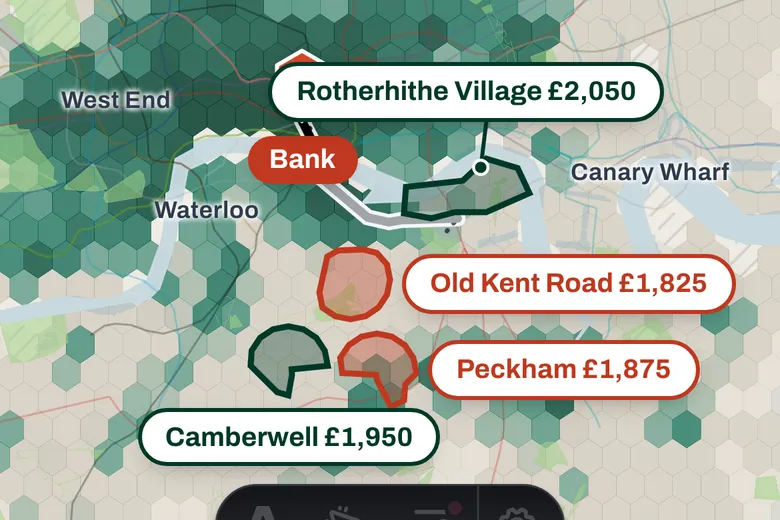
On the map below, any area whose card shows more than 40 minutes, such as Old Kent Road at 49 or Camberwell at 44, is where a bike pays back most.
Four of the 12 areas, with their 1-bed rents and the public transport journey to Bank.
Four of the 12 areas, 33 to 49 minutes from Bank by public transport, each with a 1-bed up to £2,200
4Is a nearer flat worth the rent?
Peckham is £1,875, which is £300 a month less than St George in the East at £2,175, for 2.9 km more riding: about 24 minutes against 9, so 15 more minutes each way.
- St George in the East, 1.7 km from Bank
- £2,175
- Peckham, 4.6 km from Bank
- £1,875
- more riding each way to Peckham (estimate)
- 15 min
Over 20 riding days a month that is 10 hours more on the bike for £300 saved, or £30 an hour. If an hour of your time is worth more than that, St George in the East is the better buy. Change the rents, the minutes and the days to your own.
What is an hour of your commute worth?
£30saved for each extra hour of travel
A worked example: £2,175 against £1,875 a month, 15 more minutes each way, 20 commuting days a month. Turn on JavaScript to type your own.
Clock minutes door to door, both ways, on the days you travel; the rents and fares are your own figures. Only you can say what an hour on a train costs you: some read or work on the way.
On days you ride you skip the fare too: on TfL's adult rate prices 2026 (read 09/11/2026), the zones 1-2 weekly cap and 7-day Travelcard are both £44.70 and the annual Travelcard is £1,788. The zones guide lists the caps for the other zones. Add any fare saved in the last box.
5Old Kent Road and the walk a bike replaces
Old Kent Road is the cheapest of the 12 at £1,825 and the slowest to Bank by public transport at 49 minutes, because its first leg is a long walk.
- Old Kent Road to Bank by public transport
- 49 min
- the same trip by bike (estimate)
- 15 min
- saved each way by riding
- 34 min
It has no station of its own, and the nearest, Bermondsey on the Jubilee line, is about 1.4 km away in a straight line. The journey engine walks that at 1.4 times the straight line and 75 metres a minute, which is about 26 minutes as the area page lists, and adds 3 minutes into the station: 29 in all. The engine counts no buses, so a bus along the road would change this figure. A bike replaces the walk, and Burgess Park is 2 minutes from the area.
Old Kent Road's 49 minutes include a 29-minute walk to the station.
Old Kent Road to Bank takes 49 minutes by public transport, and 29 of them are the walk to the station
| Walk to the station26 on foot plus 3 into the station | 29 min |
|---|---|
| Rest of the journey | 16 min |
| Walk at the Bank end | 4 min |
| Total journey time | 49 min |
By public transport the total journey time is 49 minutes. By bike it is about 15, so you save about 34 minutes each way, which is 5 h 40 min over ten trips a week, though the ride is only our estimate.
6Before you sign
Ride the route once in your own rush hour before you sign, because an estimate cannot see the junctions.
- Pick your desk and count the straight-line kilometres, then use the ride rule from the first chapter.
- Trace the road from the flat to your desk on TfL's Cycleways page and its map.
- Ask your employer about Cycle to Work and whether the building has bike storage, and ask the landlord or agent where the bike would live.
- Ride it once at the time you would travel.
The London regions pages group the areas by part of London, and the guide to how much rent you can afford shows how to set the budget.
What else do people ask?
How long does it take to cycle to work in London?
Citycomb counts 5.2 minutes of riding for each straight-line kilometre. That is our estimate, and it assumes 15 km/h over a route 30% longer than the straight line. At that rule 3 km is about 16 minutes and 5 km about 26. A slower rider at 12 km/h needs about 33 minutes for 5 km and a faster one at 18 km/h about 22. Try the route in your own rush hour before you sign.
Where should I live in London to cycle to work?
Close to your own desk, and best where the train or bus is slow. For a desk at Bank and a 1-bed at or under £2,200, St George in the East (1.7 km, about 9 minutes of riding) is the closest and Old Kent Road (2.9 km, £1,825) is the cheapest. Citycomb does not rate route quality, so check TfL's Cycleways map for the road you would ride.
How far can you live from work and still cycle in London?
Citycomb measures straight lines, so the ridden route will differ. 55 areas are within 5 km of Bank, 12 of them at £2,200 or less for a 1-bed. By our rule the farthest of those, at 4.9 km, is about 26 minutes of riding. A different point for Bank would move a few areas at the 5 km edge in or out.
How much does Cycle to Work save?
Cycling UK says the scheme saves between 28% and 47% depending on your tax band, because the cost comes out of pre-tax pay. Its example is a £1,500 package repaid over 12 months: £90 a month, £1,080 in all, so £420 saved. The hire period is usually 12 to 18 months, and your employer must be registered with a provider.
Is there a limit on Cycle to Work?
Cycling UK says the old £1,000 cap was removed in June 2019, and that your employer sets its own limit. Ask what it is before you choose a bike.
How much does cycling to work save on travel in London?
Up to £44.70 a week in zones 1-2, which is the most pay as you go charges, or £1,788 a year against an annual Travelcard, if you would otherwise travel every day. TfL's adult rate prices for 2026 list a zones 1-2 Travelcard at £44.70 for 7 days, £171.70 for a month and £1,788 for a year, and say Travelcards and caps are frozen until March 2027. If you ride on some days only, the weekly cap is the price to compare, because pay as you go never costs more than it.
How many kilometres of Cycleways does London have?
TfL's press release of 11 August 2026 puts the network at 450km, five times larger than a decade ago. A separate TfL release of 3 October 2024 said 27% of Londoners lived within 400m of a high-quality cycle route, which is a measure of reach, not of distance.
Can I use Cycle to Work if I have nowhere to keep a bike?
Cycling UK says that since 2024 the scheme also covers monthly or annual subscriptions to bike-share schemes such as Lime, Santander and Beryl, through two providers, CycleSaver and Dash. It is open only to employees paid through PAYE, and not when the deduction would take your pay below the National Minimum Wage.
How did we work this out?
The figures, their dates and sources
Distances are straight lines from the centre point of each area to the desk's station point in Citycomb's data (Bank 51.51345 N, 0.08899 W), so a ridden route is longer, and the 5 km edge moves with that point: Bromley-by-Bow and Camberwell Grove (5.0 km), Holloway and Peckham Rye (5.1 km) and Stockwell Park (5.1 km) are also cheap and sit just outside. Ride times are Citycomb's own estimate, not a measured journey: 15 km/h over a route 30% longer than the straight line, which is 5.2 minutes for each kilometre. The same sum at 12 km/h is 6.5 minutes for each kilometre and at 18 km/h 4.3, so 5 km is about 33 and 22 minutes.
Journey times are total journey time by public transport for a weekday 09:00 arrival, from the same engine as the map. Its walk is the straight line times 1.4 at 75 metres a minute, plus 3 minutes into the station and 4 at a central end: Old Kent Road to Bermondsey is 1.4 km in a straight line, about 26 minutes on foot as its area page lists, and 29 with the 3 minutes; the 16 minutes left of the 49 is what remains after both walks, with no Jubilee-only timing behind it. The engine counts no buses, so every public transport time on this page is a walk, rail and Tube figure. "Nearest desk" means the nearest of Bank, King's Cross, Oxford Circus and Canary Wharf, and the medians cover areas.
Rents are Citycomb's typical asking rents for a 1-bed (Mid finish: updated, well kept) from public listings read in October 2026, unrounded. The area cards on the map round rent to the nearest £50, so a figure here can differ from its card by up to £25. Travelcard and cap prices are from TfL's adult rate prices 2026 table, the Cycleways facts from TfL's pages, and the Cycle to Work figures from Cycling UK's page, all read on 09/11/2026.
Where do these figures come from?
- TfL: Cycleways, 9 November 2026
- TfL press release: London's Cycleway network now five times larger than a decade ago (11 August 2026), 9 November 2026
- TfL press release: London's Cycleway network expands to cover more than 400km (3 October 2024), 9 November 2026
- TfL: Adult rate prices 2026 (caps and Travelcards), 9 November 2026
- TfL: Tube and rail fares change from 1 March 2026 (press release, Travelcards frozen until March 2027), 9 November 2026
- Cycling UK: Cycle to Work scheme (28% to 47% saving, £1,500 example, loan period, June 2019 cap removal, bike share, PAYE), 9 November 2026
- Citycomb: station data, typical asking rents and journey times, October 2026, 24 October 2026