Info sheet
Commute time in London explained
Total journey time is the whole trip from your front door to your desk for a weekday 09:00 arrival: the walk, the wait, the ride, any change and the walk at the far end. Stratford to Bank is 37 minutes this way, made of 15 to the platform, 18 waiting for and riding the Central line and 4 at the far end.
Written for: Anyone renting in London who is comparing flats by journey time to a job, and wants to know what a figure such as 37 minutes to Bank includes.
Updated 8 November 2026
Figures checked 8 November 2026. How we worked this out
In short
Someone leaving a flat in Stratford for a desk at Bank walks to the station, gets through the barrier and down to the platform, waits for a Central line train, rides it, then climbs to street level and walks to the desk.
Total journey time counts all of it, so Citycomb does not stop at the time on the train. Maryland, on the Elizabeth line, is about 10 minutes' walk from the middle of Stratford, yet the quickest route to Bank in the app's model boards the Central line at Stratford station, because a longer walk can still make a shorter trip.
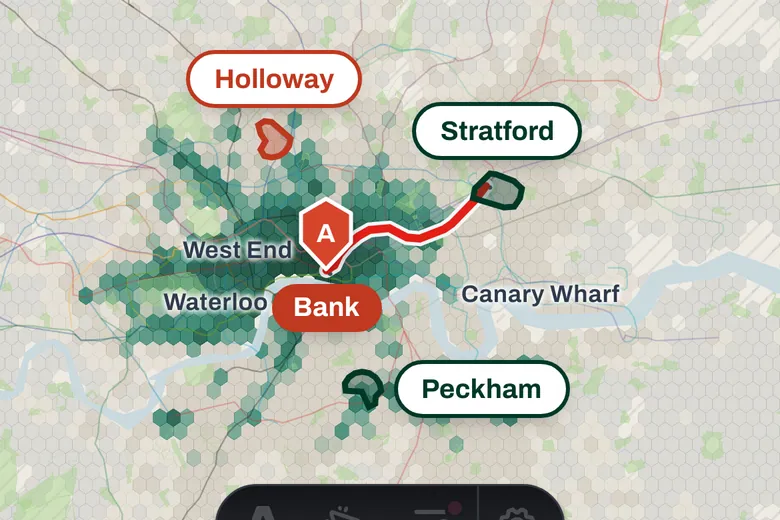
Pin your workplace on the map and set a limit in minutes to see which areas fall inside it, or see the same count for Bank on the Bank commute page. The map below places three areas with a Bank pin.
Stratford, Holloway and Peckham reach Bank from the east, north and south
1One journey, leg by leg
The first and last legs are on foot and in stations, and the middle is whatever carries you.
From Stratford to Bank the first 15 minutes are getting to the platform, mostly on foot, then 18 waiting for and riding the Central line and 4 climbing to street level and walking to the desk.
Getting to the platform is 15 of Stratford's 37 minutes to Bank
Total journey time, in minutes. Each bar is one route, split into its legs.
| Route | Leg | Minutes |
|---|---|---|
| Stratford to Bank | Walk | 15 |
| Stratford to Bank | Tube (Central line) | 18 |
| Stratford to Bank | Walk | 4 |
| Stratford to Bank | Total | 37 |
| Holloway to Bank | Walk | 7 |
| Holloway to Bank | Tube (Piccadilly line) | 25 |
| Holloway to Bank | Walk | 4 |
| Holloway to Bank | Total | 36 |
| Peckham to Bank | Walk | 11 |
| Peckham to Bank | Train | 19 |
| Peckham to Bank | Walk | 4 |
| Peckham to Bank | Total | 34 |
| Greenwich Peninsula to Canary Wharf | Walk | 6 |
| Greenwich Peninsula to Canary Wharf | Tube (Jubilee line) | 7 |
| Greenwich Peninsula to Canary Wharf | Walk | 4 |
| Greenwich Peninsula to Canary Wharf | Total | 17 |
Type your workplace into the map and every area shows its own split of walk, wait and ride.
Holloway takes 7 minutes to reach the platform at Holloway Road, then the Piccadilly line, with a change on the way to Bank. Peckham has no Tube station, yet it is 34 minutes from Bank: 19 of them are waiting for and riding the train from its National Rail station. Greenwich Peninsula to Canary Wharf is 17 minutes, 7 of them waiting for and riding the Jubilee line, which is one stop. Monument to Bank is walked all the way, 9 minutes.
The workplace changes the order of areas as much as the distance from the centre does. The Holloway and Greenwich Peninsula area pages give Holloway as 36 minutes from Bank and Greenwich Peninsula 32, but to King's Cross it reverses: Holloway 22 minutes and Greenwich Peninsula 40.
2How the walk is counted
| Step | What is counted |
|---|---|
| The walk | A straight line to the station, multiplied by 1.4 for the bends in real streets, at 75 metres a minute (about 4.5 km/h) |
| First station | About 3 minutes to get through the barrier and down to the platform |
| Far end | About 1 minute to street level (a little more at a deep central station), then the walk to the desk |
A station 800 metres away is 1,120 metres of street, 15 minutes on foot, so about 18 minutes before the train. If walking all the way is quicker the model uses that. Area pages list station walks from the middle of the area, and the journey legs start from the middle of the nearest map cell, so the two can differ by a few minutes.
3How long is a normal commute?
The Department for Transport's National Travel Survey puts the average commute in England at 29 minutes in 2023.
That is a national figure, not a London one, and it counts commuters, not areas.
What Citycomb can show is how far a commute reaches from one workplace. The middle of the areas with a Bank time has a total journey time of 53 minutes, 34% are 45 minutes or under and 67% an hour or under, the same counts as the Bank commute page. These count areas, not commuters.
The middle area is 53 minutes from Bank, and 6% of areas are 30 minutes or under
Dashed line: the typical area, the one in the middle.
| Total journey minutes to Bank | Number of areas |
|---|---|
| 0 to 9 min | 1 area |
| 10 to 19 min | 2 areas |
| 20 to 29 min | 20 areas |
| 30 to 39 min | 70 areas |
| 40 to 49 min | 121 areas |
| 50 to 59 min | 111 areas |
| 60 to 69 min | 82 areas |
| 70 to 79 min | 43 areas |
| 80 to 89 min | 20 areas |
| 90 to 99 min | 13 areas |
| 100 to 109 min | 7 areas |
| 110 or more min | 7 areas |
What will the trip to work cost?
£125a month, the cheapest way: pay as you go
A worked example for zone 4, three office days a week. Turn on JavaScript to pick your own.
TfL 2026 adult fares on Tube and rail: two peak fares each office day, pay as you go capped daily and Monday to Sunday; a month is 52 weeks ÷ 12. Trips on other days are left out.
4How accurate it is
The time is a model of one weekday morning, arriving at 09:00, not a live timetable.
It is built to compare areas at the same workplace, and your own street, the train you catch and the day will move a journey by a few minutes either way.
5What it leaves out
- Buses on area and commute pages. Those pages count rail and walking only. On the map buses are included unless you switch them off, as estimates from stop distance, typical speeds and an average 4.5-minute wait.
- Cycling, driving and delays. Cycling and driving are not counted, and the figure is a model of one weekday morning, not a live timetable.
- Your exact street. Each area is about 500 metres across and the time is from its middle.
6Using the number to compare flats
Compare areas at the same workplace and the same arrival time, using the commute hub or the Bank page.
We'd read a gap under 3 minutes as level and take a gap of 9 minutes or more as real. Nine minutes each way is 90 minutes over a five-day week.
Then work out the walk from the flat to its nearest station. Look at the first leg in particular, because a flat on the far side of an area can add a few minutes of walking that the area figure does not include. The first job guide and the viewing checklist show where that check fits in a search, and the zones guide relates fare zones to journey time.
Whitechapel is 23 minutes from Bank by Tube and New Cross 30 by a short train. Pin your own workplace on the map to see the same split for every area, or read how it works for the rest of the method.
What is an hour of your commute worth?
£30saved for each extra hour of travel
A worked example: £1,900 against £1,600 a month, 15 more minutes each way, 20 commuting days a month. Turn on JavaScript to type your own.
Clock minutes door to door, both ways, on the days you travel; the rents and fares are your own figures. Only you can say what an hour on a train costs you: some read or work on the way.
What else do people ask?
What is a door to door commute?
The whole journey from your front door to your desk, which Citycomb calls total journey time: the walk to the station, getting to the platform, the wait, the ride, any change, and the walk and climb to street level at the far end. Citycomb measures it for a weekday 09:00 arrival.
How long is the average commute in London?
The Department for Transport's National Travel Survey puts the average commute in England at 29 minutes in 2023, a national figure, not a London one. In Citycomb's data the middle area has a total journey time of 53 minutes to Bank, but that counts areas, not commuters.
How long is the commute to Bank from a typical area?
Of the areas with a Bank time, about 6% are 30 minutes or under in total journey time, 34% are 45 or under and 67% are an hour or under, for a weekday 09:00 arrival. The middle area is 53 minutes.
How long should a commute be?
There is no set figure. The Department for Transport's National Travel Survey gives an average of 29 minutes for commuting in England in 2023, a national figure. From Bank, Citycomb counts 34% of London areas at 45 minutes total journey time or under and 67% at an hour or under, so a 45-minute limit is far tighter than an hour. See the Bank commute page for the list.
Is total journey time the same as door to door?
Yes. Both count the trip from your front door to your desk, including the walk at each end and the time at the barrier and platform. Older pages on Citycomb called it door to desk.
How accurate are the times?
They are modelled estimates for a weekday 09:00 arrival, not read from a live timetable, so use them to compare areas at the same workplace. Your street, the train you catch and the day will move a journey by a few minutes.
Do the times include buses?
Area and commute pages count rail and walking only. On the map, buses are included unless you switch them off, as estimates from distance, typical bus speeds and an average 4.5-minute wait.
Why does my own journey differ from the number?
The figure is for the middle of an area about 500 metres across, and your street may be a few minutes either side. Look at the first leg in particular for a flat you are serious about.
How did we work this out?
The figures, their dates and sources
Citycomb walks at 75 metres a minute with a 1.4 street factor and adds about 3 minutes at the first station for the barrier and platform. At the far end it adds about 1 minute to get up to street level, and a little more at a deep central Zone 1 station, then the walk on to the desk (the last leg is 4 minutes in total in the Bank journeys shown here). It tries up to six stations near home and five near the desk and keeps the quickest pairing. The ride between stations is modelled from the rail network for a weekday 09:00 arrival, not read from a live timetable, with an average wait added at the first station, so the ride figure includes the wait and any change. Area pages list the walk to each station from the middle of the area, while the journey legs start from the middle of the nearest map cell and include the barrier and platform, so the two can differ by a few minutes in either direction. The Bank counts use the app data built on 07/10/2026 and, like the Bank commute page, count areas at or under a limit (about 6% at 30 minutes or under, 34% at 45 or under, 67% at 60 or under; the bars of the chart are ten minutes wide, so 23 areas are under 30 minutes and 6 are exactly 30). The England commute figure is from the Department for Transport, National Travel Survey 2023, as published in Transport Statistics Great Britain 2023 (table TSGB0111).
Where do these figures come from?
- Citycomb: How it works, commutes, rents and accuracy, 8 November 2026
- DfT: Transport Statistics Great Britain 2023 summary (average commuting time, England, 2023: 29 minutes; table TSGB0111, from the National Travel Survey), 8 November 2026
- Citycomb: total journey times from the app's commute data, built 07/10/2026, 8 November 2026